In a finding that could reshape how we grow functional foods indoors, researchers have shown that near-infrared radiation — light so deep in the red spectrum that it is invisible to the human eye — can dramatically alter the nutritional and biochemical profile of radish sprouts, even though the plants cannot photosynthesize with it. The study, published in BMC Plant Biology, reveals that two specific near-infrared wavelengths, 850 nanometers and 940 nanometers, act as powerful metabolic switches, each steering the young plants toward distinctly different chemical outcomes. One wavelength pushed the sprouts to build more protein; the other coaxed them into producing a richer arsenal of antioxidant compounds. Neither, however, could rescue the plants from etiolation, the pale, spindly growth that occurs when green plants are deprived of visible light.
The research, led by Grzegorz Fiutak of the University of Agriculture in Krakow together with Barbara Stefanska of the University of British Columbia and an international team spanning Poland and Canada, set out to answer a question that has long lingered at the margins of plant photobiology. Scientists know a great deal about how red, blue, and far-red light shape plant growth, because these wavelengths are absorbed by the pigments that drive photosynthesis and regulate development. But the near-infrared region beyond the far-red — roughly the band where 850 and 940 nanometer LEDs operate — has remained poorly understood. These wavelengths are widely used in consumer wellness devices and industrial heating applications, yet their direct effects on plant biochemistry, independent of photosynthesis, had not been systematically explored in an edible crop.
To probe the question, the team grew radish sprouts in complete darkness and compared them with sprouts cultivated under monochromatic near-infrared LEDs at 850 nanometers and 940 nanometers, with no visible light supplied at all. This design was critical: by excluding photosynthetically active radiation, the researchers could isolate any metabolic effects of near-infrared light from the familiar machinery of photosynthesis. They then subjected the harvested sprouts to an extensive battery of analyses, measuring dry matter, fiber, protein content, amino acid profiles, ascorbic acid, chlorophylls, carotenoids, anthocyanins, and phenolic compounds using high-performance liquid chromatography and other analytical techniques. Finally, they tested whether extracts from the sprouts had measurable biological activity in cell-based assays.
The results were striking in their wavelength specificity. Sprouts grown under 940 nanometer radiation accumulated the highest protein content of any treatment, while maintaining a stable amino acid profile and high protein quality — meaning the extra protein was not simply diluted in quality but retained a balanced composition of essential amino acids. This is a notable outcome for a crop grown entirely without visible light, and it suggests that deep near-infrared exposure may influence nitrogen metabolism or protein synthesis pathways through mechanisms that do not depend on photosynthetic energy capture. For controlled-environment agriculture, where protein enrichment of crops is an ongoing goal, the finding points to a potentially simple lever: changing the wavelength of supplementary lighting rather than altering inputs like fertilizer.
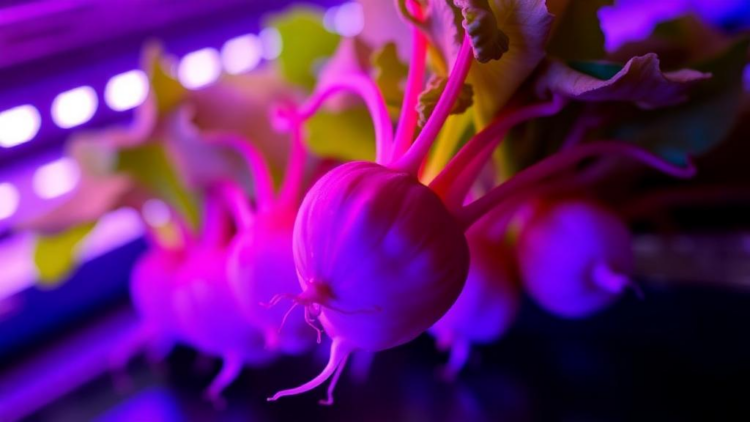
The 850 nanometer treatment told a very different story. Rather than boosting protein, this wavelength promoted the accumulation of ascorbic acid — vitamin C — along with anthocyanins, the pigments responsible for red and purple coloration in plants, and several carotenoids. The effect was visible to the naked eye: sprouts under 850 nanometer light developed more intense red pigmentation than their dark-grown counterparts. Anthocyanins are of intense interest to food scientists because of their antioxidant and anti-inflammatory properties, and carotenoids such as lutein are valued for their roles in eye health and as dietary antioxidants. The fact that a single, precisely chosen invisible wavelength could elevate these compounds without any photosynthetic input is the kind of result that lends itself to immediate application in vertical farming and sprout production facilities.
Importantly, the two treatments shared some common ground. Both 850 and 940 nanometer radiation increased the concentrations of lutein, violaxanthin, and selected derivatives of sinapic acid relative to sprouts grown in darkness. Sinapic acid derivatives belong to the broad family of phenolic compounds that plants deploy as chemical defenses and antioxidants. Their elevation under both wavelengths indicates that near-infrared exposure, even beyond the far-red region, acts as an elicitor of secondary metabolism — the branch of plant biochemistry responsible for producing many of the compounds humans prize in fruits, vegetables, and herbs. At the same time, some fundamentals proved stubbornly resistant to manipulation: dry matter, fiber content, and the overall amino acid composition of the sprouts remained unaffected by either treatment, and neither wavelength restored chlorophyll synthesis or prevented the etiolated growth pattern typical of plants raised in the dark.
Perhaps the most intriguing results came from the biological activity assays. The team extracted carotenoids from the sprouts using acetone-based methods and tested these extracts on Raw 264.7 macrophages, a widely used mouse cell line in immunology research. The cells were stimulated with lipopolysaccharide, a bacterial molecule that triggers a strong inflammatory response, and the researchers measured the production of interleukin-6, a pro-inflammatory signaling molecule implicated in chronic inflammatory diseases. The extracts from sprouts grown under 940 nanometer radiation were the most effective at reducing lipopolysaccharide-induced interleukin-6 production, outperforming extracts from the dark-grown and 850 nanometer treatments. While cell-culture findings are an early step and cannot be directly translated into health claims for consumers, they provide a proof of concept that light-grown sprouts can carry not just different nutrient profiles but measurably different bioactivity.
The broader significance of the study lies in what it says about light as a tool rather than merely as fuel. Photosynthesis is the process by which plants convert visible light into chemical energy, and most agricultural lighting strategies are built around maximizing it. But plants are also exquisitely sensitive photoreceivers in other ways, and this work demonstrates that near-infrared radiation beyond the far-red range modifies plant metabolism independently of photosynthesis altogether. In practical terms, this means growers could potentially use narrow-band near-infrared LEDs as elicitors — a kind of biochemical seasoning applied through the lighting system — to tailor crops for specific nutritional or functional goals. A producer targeting protein enrichment might favor 940 nanometer supplementation, while one aiming to maximize antioxidant content and visual appeal might choose 850 nanometers.
The implications extend to sustainability as well. Sprouts are among the most resource-efficient foods humans produce, requiring minimal water, space, and time from seed to harvest, and they are increasingly grown in controlled-environment facilities where every aspect of light, temperature, and humidity can be tuned. If a simple change in LED wavelength can elevate vitamin C, anthocyanins, carotenoids, or protein in such a crop without additional agricultural inputs, the energy cost of that intervention may be modest compared with the nutritional gain. The authors suggest that wavelength-specific near-infrared radiation could become a practical instrument in controlled-environment agriculture and sustainable functional food production, complementing the red and blue lighting that dominates indoor farms today.
There remain open questions, as with any early-stage finding. The study was conducted on a single crop species, radish, and the mechanisms by which 850 and 940 nanometer light exert their distinct effects on protein accumulation and secondary metabolism have not yet been fully mapped. Whether the same wavelength-specific responses hold for other sprouts, leafy greens, or fruiting crops is unknown, and the anti-inflammatory signal observed in macrophage cultures will need to be followed through further biological testing before any dietary relevance can be established. Still, the central message is clear and, for a field accustomed to thinking about light in terms of photosynthetically active radiation, genuinely surprising: there is useful information in the invisible part of the spectrum, and plants are listening. As indoor farming scales up around the world, the humble radish sprout — grown in the dark, bathed in light no one can see — may turn out to be an early glimpse of a new kind of precision agriculture, one where the recipe for a more nutritious vegetable is written in nanometers.
Subject of Research: Effects of near-infrared LED radiation on the biochemistry and biological activity of radish sprouts
Article Title: Biochemical composition and biological activity of radish sprouts grown in near-infrared radiation
Article References: Fiutak, G., Filipczak-Fiutak, M., Sady, M., Jarzębski, M., Mohammadi, X., Klein, G.-R., Relova-Clegg, E., Pratap-Singh, A., Świąder, K., Kapusta, I., Kołton, A., Tabaka, P., Grabacka, M., & Stefanska, B. (2026). Biochemical composition and biological activity of radish sprouts grown in near-infrared radiation. BMC Plant Biology. https://doi.org/10.1186/s12870-026-10053-3
Image Credits: AI Generated
DOI: 10.1186/s12870-026-10053-3
Keywords: near-infrared radiation, radish sprouts, carotenoids, anthocyanins, ascorbic acid, protein content, plant biochemistry, LED lighting, controlled-environment agriculture, functional foods, interleukin-6, photobiology
Cite Scienmag News
APA MLA Chicago
Daisy Hatcher. (October 1, 2026). Invisible Light, Visible Change: Near-Infrared LEDs Reshape Radish Sprout Nutrition. Scienmag. https://scienmag.com/invisible-light-visible-change-near-infrared-leds-reshape-radish-sprout-nutrition/
Daisy Hatcher. “Invisible Light, Visible Change: Near-Infrared LEDs Reshape Radish Sprout Nutrition.” Scienmag, 1 October 2026, https://scienmag.com/invisible-light-visible-change-near-infrared-leds-reshape-radish-sprout-nutrition/. Accessed 1 October 2026.
Daisy Hatcher. “Invisible Light, Visible Change: Near-Infrared LEDs Reshape Radish Sprout Nutrition.” Scienmag. October 1, 2026. https://scienmag.com/invisible-light-visible-change-near-infrared-leds-reshape-radish-sprout-nutrition/
Copy citation Download RIS
Tags: anthocyaninsascorbic acidbiochemical changes induced by invisible lightcarotenoidscontrolled environment agricultureeffects of invisible light on plant biochemistryenhancement of protein and antioxidant production in sproutsfunctional foodsimpact of 850nm and 940nm wavelengths on radish sprout nutritionindoor cultivation of functional foodsinfluence of non-photosynthetic wavelengths on plant developmentinnovative techniques in sprout nutritional optimizationinterleukin-6LED lightingnear-infrared light as metabolic switchesnear-infrared radiationNear-infrared radiation in plant growthphotobiologyphotobiology of near-infrared lightplant biochemistrypotential for controlled environment agricultureprotein contentradish sprouts