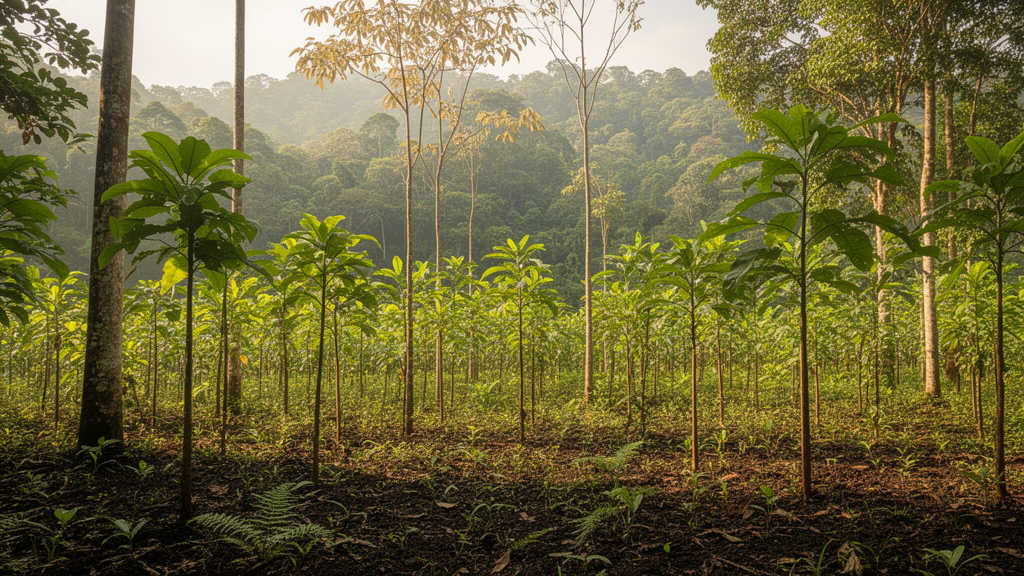
The thick stands of fast-growing foreign trees that colonize abandoned pastures across the tropics are not the permanent problem many restoration ecologists have feared. An international analysis of more than 1,500 regenerating forest plots across the Americas has found that the early dominance of non-native trees in secondary forests gives way, over time, to native species as the canopy closes and light becomes scarce. The study, published in the journal Nature Plants, brought together researchers from approximately 60 institutions and drew on data from 1,561 representative plots of secondary forest in ten Neotropical countries: Bolivia, Brazil, Colombia, Costa Rica, French Guiana, Mexico, Panama, Peru, Puerto Rico and Venezuela. Its central conclusion is that the initial burst of exotic trees, which multiply easily in the abundant sunlight of recently deforested land, is a temporary phase in the natural trajectory of forest recovery rather than a lasting takeover.
The researchers found that non-native trees typically flourish during the first 10 to 20 years of regeneration, exploiting the open, sunlit conditions of areas recently cleared for agriculture or pasture. As native trees grow taller and shade the forest floor, however, the exotics decline. The reason, the authors explain, is that the non-native species in these regrowing forests tend to behave like native pioneer species: they grow rapidly and require abundant light to thrive, exactly the conditions found in recently abandoned pastures. At first, native and non-native pioneers compete for space, but eventually both give way to slow-growing native trees that germinate in the shade and gradually come to dominate the landscape. As the canopy closes and the environment becomes less suitable for species that depend on full sunlight, non-native trees persist only at low densities.
Angelica Faria de Resende, the first author of the article, conducted the study during her postdoctoral research at the Luiz de Queiroz College of Agriculture at the University of São Paulo (ESALQ-USP) in southeastern Brazil, with a fellowship from the São Paulo Research Foundation (FAPESP) and an internship at the University of Stirling in Scotland. She emphasizes that the initial concern about non-native trees in young forests is well founded. “By replacing the role of one or more native species and altering natural processes, invasive species can modify food webs and functional, structural, and biological diversity in the forest,” she says. The new results, however, indicate that this interference tends to be partial or temporary rather than permanent.
The strength of that interference differs markedly between forest types. In humid forests, exotic trees accounted for 28 percent of the tree trunks and 22 percent of the total species recorded during the first two decades of regeneration. In dry forests, the corresponding figures were 9 percent for both indicators. “It caught our attention that both species diversity and the number of individuals decreased significantly shortly after that initial peak,” Resende notes, pointing out that although some non-native trees remain in the mature stage of the forest, their presence decreases as the forest matures. The pattern suggests that the window in which exotic trees dominate is limited, and that maturation itself acts as a filter against them.
The study also offers a nuanced picture of what “non-native” actually means in regrowing tropical forests. Of the 3,735 species sampled across the plots, 131 were classified as non-native but non-invasive, 14 were classified as non-native and potentially invasive, meaning they had been reported as invasive in another country, and 11 were classified as non-native and invasive. Non-native species were present in 18 percent of the dry forest plots studied and 41 percent of the humid forest plots. These figures show that foreign trees are a common feature of young Neotropical forests, but that only a small fraction of the foreign species sampled behave as true invaders.
Two Brazilian examples illustrate the distinction. Pine (Pinus elliottii) is native to the Northern Hemisphere and is cultivated in Brazil for its wood and resin. Because it disperses its seeds through the air and sprouts without human intervention, it dominates landscapes and is considered invasive. Eucalyptus (Eucalyptus spp.), by contrast, is native to Oceania but does not spread on its own in Brazil, occurring only where it is planted, typically for timber, paper and pulp production, which makes it a non-native but non-invasive species. Resende cautions that formal designations do not always follow scientific criteria alone. “In some countries, scientific criteria aren’t always sufficient, and the decision to classify a species as invasive ends up being political since government agencies are responsible for issuing official lists of invasive species,” she explains. “Some species are widely used in agriculture, are perceived as beneficial to the economy, and are therefore not considered invasive.”
One of the study’s more striking findings concerns the species that are foreign but not invasive. Many species listed as non-native and non-invasive accounted for more than 25 percent of the tree trunks sampled in some areas. These included Croton glabellus and Leucaena leucocephala in Colombia, Piper colonense in Costa Rica, Hovenia dulcis in Brazil and Lagerstroemia speciosa in Panama. In other words, a substantial share of the trees in some regenerating Neotropical forests are exotics that coexist with native vegetation without taking it over. This complicates the common assumption that any non-native tree in a recovering forest is an obstacle to restoration, and suggests that management decisions should distinguish between species that spread aggressively and those that stay where they were planted or introduced.
Because forests take decades to grow, the researchers could not simply watch single sites mature in real time. Instead, they used a strategy known as a chronosequence: rather than monitoring the same area over time, they analyzed plots of different ages within the same region, ranging from recently abandoned land to mature forest. In each sample plot, all trees above a certain diameter were identified and measured. This allowed the team to reconstruct how vegetation evolves over time by comparing young, intermediate and old plots within comparable landscapes. Some of the areas monitored in the study form part of the project “Understanding Restored Forests for the Benefit of People and Nature – NewFor,” which is supported by FAPESP through its Research Program on Biodiversity Characterization, Conservation, Restoration and Sustainable Use (BIOTA-FAPESP) and by the Dutch Research Council (NWO). The study also received FAPESP funding through a postdoctoral fellowship for Fabio Matos at ESALQ-USP, who is currently completing an internship at the University of Cambridge in England.
Beyond the temporal pattern, the analysis revealed how the surrounding landscape shapes the presence of foreign trees. The species richness of non-native species increased as the Human Development Index (HDI) of the region rose, a correlation the authors report alongside their other landscape-level findings. Conversely, both the density and the abundance of non-native trees decreased as surrounding forest cover, proximity to agricultural areas and precipitation increased, according to the study. These relationships indicate that the fortunes of exotic trees in regenerating forests are tied to the human and environmental context of each site, not merely to the age of the forest itself.
Taken together, the results carry a practical message for restoration policy across the Neotropics. “Our findings suggest that natural forest regeneration and relatively intact landscapes provide a nature-based solution for controlling non-native species while protecting biodiversity, ecosystem integrity, and local ways of life,” Resende concludes. Rather than treating every young forest dominated by fast-growing exotics as a failure, the study suggests that allowing secondary forests to mature can itself suppress invasive trees over time. For land managers, the implication is that patience, combined with the protection of intact forest cover in the surrounding landscape, may accomplish much of what active intervention against non-native species has been expected to do, while simultaneously restoring the biodiversity and ecological functions that mature tropical forests provide.
Subject of Research: The temporary dominance and decline of non-native and invasive tree species during natural regeneration of Neotropical secondary forests
Article Title: Natural forest regeneration helps curb spread of invasive species
Article References: Natural forest regeneration helps curb spread of invasive species. Original publication (Bibliographic details unavailable.)
Image Credits: AI Generated
DOI: Not provided
Keywords: secondary forests, forest regeneration, invasive species, non-native trees, Neotropics, tropical forest restoration, pioneer species, biodiversity, chronosequence, Nature Plants, FAPESP, canopy closure
News Source: Margaret Porter. (October 24, 2026). Invasive trees fade as young tropical forests mature, large study finds. Scienmag.