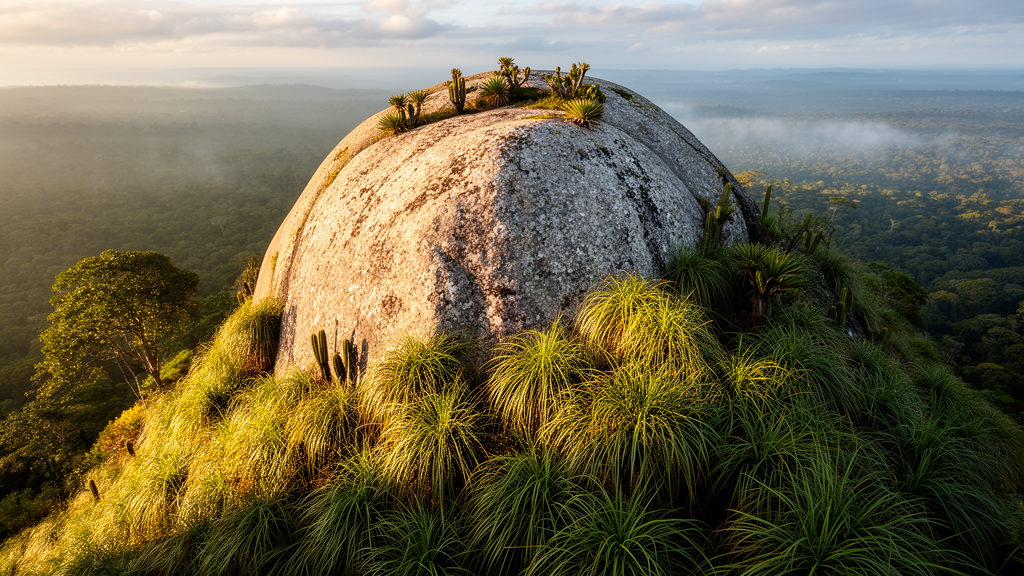
Rising abruptly from Brazil’s coastal plains and arid interior, inselbergs — the word fuses the German terms for island and mountain — are granitic and gneissic monoliths that function as terrestrial islands embedded in continental landscapes. These rock outcrops host highly specialised plant communities shaped by extreme abiotic stressors: intense solar radiation, shallow impermeable soils and pronounced water scarcity. Now, a comprehensive new study published in Neotropical Biology and Conservation reveals that these ancient botanical sanctuaries are being quietly colonised by non-native species at a scale never before documented, with nearly one-third of the exotic flora identified as invasive and urgent intervention needed to prevent irreversible ecological damage.
The research team compiled the first comprehensive checklist of non-native plant species on inselbergs across two Brazilian phytogeographic domains: the Atlantic Forest, a global biodiversity hotspot along the eastern coast, and the Caatinga, the largest fragment of Seasonally Dry Tropical Forests in the Neotropics. Drawing on georeferenced occurrence records from herbaria collections within the Global Biodiversity Information Facility and SpeciesLink databases, filtered using domain shapefiles and targeted keywords such as inselberg, granito and lajedo, the researchers cross-referenced their species list with the Flora e Funga do Brasil platform to determine native or non-native status. A systematic literature review and a review of invasive species notifications from databases including Horus, GRIIS and the ICMBio list of invasive species in protected areas completed the compilation.
The results are sobering. Across 118 inselbergs — 58 in the Atlantic Forest and 60 in the Caatinga — the team documented 99 non-native species, comprising 95 angiosperms, two ferns, one lycophyte and one bryophyte. Of these, 33 species, or 33.3 percent, were classified as invasive, and 27 had already been recorded as invasive in Brazilian protected areas. The Atlantic Forest inselbergs hosted 71 non-native species dominated by the grass family Poaceae with 11 species, followed by Asteraceae and Fabaceae with seven each. The Caatinga inselbergs supported 54 species across 20 angiosperm families, with Poaceae again leading at 18 species. Forty-five species were found only in the Atlantic Forest, 28 were exclusive to the Caatinga and 26 occurred in both domains.
Statistical analyses revealed domain-specific ecological preferences amongst the invaders. Using Fisher’s exact tests on 2 × 2 contingency tables with odds ratios, the researchers found that Melinis minutiflora, an African grass, was significantly associated with Atlantic Forest inselberms, while its congener Melinis repens showed a significant affinity for Caatinga inselbergs. Urochloa mollis and Boerhavia diffusa were recorded exclusively in the Caatinga, while Desmodium incanum was exclusive to the Atlantic Forest. The Indicator Value Index analysis, which combines species frequency and specificity, confirmed these patterns, identifying M. minutiflora as a significant indicator of the Atlantic Forest and M. repens, U. mollis and Dactyloctenium aegyptium as Caatinga indicators. A PERMANOVA analysis revealed a statistically significant difference in non-native species composition between the domains, though the low explanatory power suggests that local factors such as anthropogenic disturbance, microhabitat conditions and propagule pressure play a more prominent role in shaping invasion patterns.
Life-form analysis using Raunkiaer’s classification system uncovered a striking pattern: therophytes, annual plants that complete their life cycle during favourable seasons, were significantly associated with Caatinga inselbergs, while chamaephytes, plants with vegetative buds close to the soil surface, were significantly associated with Atlantic Forest inselbergs. These affinities likely reflect adaptations to contrasting environmental conditions. In the arid Caatinga, extreme seasonality, shallow soils and high irradiance favour annuals, whereas the Atlantic Forest’s more humid and stable conditions promote perennial woody forms. Remarkably, the life-form spectra of non-native species closely mirror those of native rock outcrop floras in both domains, suggesting that environmental filtering favours traits adapted to local conditions regardless of geographic origin.
The biogeographic origins of the invaders tell a story of ecological compatibility and colonial history. Seasonally Dry Tropical Forests emerged as the primary source biome, accounting for 50 percent of non-native species in the Atlantic Forest and 66.7 percent in the Caatinga, likely because these habitats share high solar radiation, shallow soils and strong seasonality with inselberg environments. A significant proportion of species originated from Africa and Asia, reflecting historical plant introductions through Portuguese colonial networks for agricultural, forage, medicinal and ornamental purposes. Asian species were more prevalent in the Atlantic Forest, exemplified by Alpinia zerumbet and Artocarpus heterophyllus, while African species dominated in the Caatinga, including Cenchrus ciliaris and Dactyloctenium aegyptium, introduced for forage and erosion control.
Several invaders stand out for their ecological strategies. Melinis repens, one of the most frequently recorded species across both domains, colonises ephemeral vegetation and shallow depressions with comparatively higher resource availability while avoiding extreme microhabitats such as epilithic vegetation, demonstrating that invasibility is strongly mediated by fine-scale habitat heterogeneity. Melinis minutiflora is notorious in Cerrado ecosystems for altering fire regimes and increasing fine fuel loads, raising concerns that similar dynamics may develop on drought-prone inselbergs. Lantana camara, the second most frequently recorded non-native species, forms dense allelopathic thickets that suppress native vegetation. Furcraea foetida, an ornamental agave relative, spreads via bulbils and has already invaded inselbergs in South Africa and tropical Africa, with documented occurrences near tourist hubs in Rio de Janeiro where ornamental escapes from peri-urban landscaping establish on rocky outcrops.
Perhaps most remarkably, the moss Campylopus introflexus, though diminutive and easily overlooked, is recognised as highly invasive in Europe, where it rapidly forms dense mats that outcompete native bryophytes in disturbed environments. Its recent records on inselbergs in the Brazilian states of Paraná and Rio de Janeiro represent new regional occurrences that expand its known distribution within Brazil. The study’s authors emphasise that even inconspicuous taxa can pose substantial ecological risks to fragile inselberg systems, and that non-native plants are systematically under-collected by botanists during fieldwork, creating gaps in herbarium records that limit our ability to reconstruct invasion histories or evaluate ecological impacts.
The conservation implications extend beyond botany. Inselbergs act as refugia for biota with both recent and ancient phylogenetic histories, harbour unusual and often endemic lineages, and provide vital ecosystem services, including functioning as key water catchments and freshwater sources for nearby human settlements. Inselberg plant populations often show high local genetic diversity and strong differentiation amongst outcrops, reflected in high beta diversity, making them particularly vulnerable to biotic homogenisation driven by generalist invaders. The surrounding matrix degradation can impair essential ecological interactions involving pollinators and seed dispersers like bats and hummingbirds, while commercial quarrying, uncontrolled fires, unplanned urbanisation and unsustainable tourism compound the threats.
The research team proposes a roadmap for future studies: linking functional traits to invasion patterns, integrating biogeographic and phylogenetic information, assessing how landscape connectivity and corridors such as trails and roads facilitate propagule movement, and developing invasion risk assessment frameworks specific to rocky outcrop ecosystems. The checklist itself provides a foundation for detecting invasion hotspots, selecting priority species for monitoring and control, and implementing early detection strategies, especially in protected areas and near urban centres. As the authors conclude, restoration of vulnerable microhabitats and maintenance of healthy surrounding matrix vegetation will be crucial to increasing ecosystem resilience and achieving long-term conservation effectiveness for these unique natural laboratories before their evolutionary legacies are lost forever.
Subject of Research: Biodiversity and Conservation
Article Title: Non-native plant species on inselbergs of Brazilian tropical forests: checklist and insights for biodiversity management and conservation
Article References: Moreira, F. G. L., Carvalho, F. A., & de Paula, L. F. A. (2025). Non-native plant species on inselbergs of Brazilian tropical forests: checklist and insights for biodiversity management and conservation. Neotropical Biology and Conservation, 20(3), 255-280. https://doi.org/10.3897/neotropical.20.e156777
Image Credits: AI Generated
DOI: 10.3897/neotropical.20.e156777
Keywords: invasive species, inselbergs, Atlantic Forest, Caatinga, biodiversity conservation, plant invasion, Brazil, ecology, Non-native, plant, species, Brazilian
News Source: Gavin Prescott. (October 17, 2026). Invasive Plants Are Quietly Conquering Brazil’s Ancient Granite Islands. Scienmag.