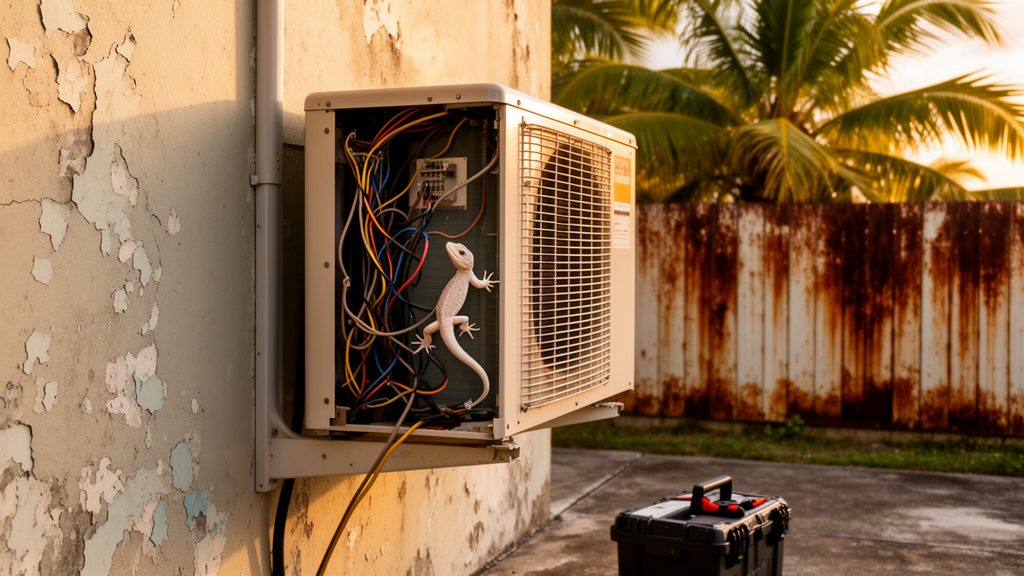
On the island of Saipan in the Commonwealth of the Northern Mariana Islands, an invasive lizard has found an unlikely and lethal refuge: the warm electronics inside air conditioning compressors. A new case study published in the journal Discover Life documents two incidents in which the introduced Common House Gecko, Hemidactylus frenatus, caused the failure of multiple mini-split air conditioning units in a single private beachfront residence, short-circuiting their motherboards and killing the animals involved. The study pairs these firsthand observations with an online literature review suggesting that gecko-induced electrical damage is a broader, underreported problem across much of the species’ range.
The first incident unfolded on 28 March 2020, when the compressor of a 24-kW Whirlpool mini-split unit at the residence stopped producing cool air. The system, which had sat idle for several weeks, consisted of an interior wall-mounted evaporator and an outdoor compressor. Although air was still being pumped through the evaporator, no cooling occurred. When the apparently faulty external compressor was dismantled, a single adult H. frenatus of undetermined sex was found fused to the unit’s motherboard. Replacing the motherboard restored the unit to full function. Notably, the service technician stated that he had never seen such a failure before and considered it an anomalous, isolated event.
That assessment proved premature. On 22 June 2020, less than three months later and again after a period of idleness, three of the four mini-split systems in the same residence, including the one just repaired, failed to produce cool air when switched on. Inspection of the three compressor motherboards confirmed that in each case multiple geckos had been electrocuted on the boards: three animals in one unit, two in another, and two in the third, for a total of seven. Two of the specimens were identified as egg-bearing females, while the sex of the other five could not be determined because of their mummified condition. Once again, replacing the short-circuited motherboards returned all three units to proper operation.
The explanation for this fatal attraction lies in the basic physics of idle electronics. The authors note that a computer motherboard operating idle or on standby produces a surface temperature slightly above ambient, which can provide a suitable spot for geckos of both sexes to raise their body temperature for thermoregulation. A hidden retreat with few predators, while simultaneously supporting food digestion or pre-oviposition egg maturation, would be favored by natural selection over more open environments. The danger comes not from predators but from cross-connecting electrical poles on the surface of the hideaway, a risk that is fatal for the gecko and costly for the human host, who must pay to replace the motherboard.
To gauge whether such incidents were isolated curiosities, the researchers conducted online searches in early December 2025 using Google and Google image searches, Google Scholar, ResearchGate, SciELO, PubMed, and the archives of herpetology-focused journals, applying a Boolean search string combining gecko genera with damage, failure, short circuit, and electrical equipment terms. They excluded citizen science posts from iNaturalist and social media but surveyed websites discussing geckos and electrical equipment failures. The searches consistently retrieved the same set of scientific publications, while attempts on ResearchGate, SciELO, and PubMed to find additional published information were unproductive.
The reviewed literature shows the problem is geographically widespread. In Cuba, Borroto-Páez and Reyes Pérez documented 68 instances of gecko-induced electrical damage, primarily to televisions, air conditioners, and computers, with most incidents resulting from short circuits caused by live animals crawling over circuit plates; technicians rarely linked the damage to geckos, pointing to substantial underreporting. A follow-up Cuban study added mummified Hemidactylus mabouia found inside a television and identified high-density gecko occupancy in electrical meter rooms, up to 5.63 individuals per cubic meter, as a potential fire hazard. In Taiwan, Chang and colleagues reported repeated short circuits in air conditioning units caused by H. bowringii and H. frenatus, with repair costs averaging 170 US dollars per incident, and recommended unplugging idle units and installing screens over vents.
The scope of damage extends well beyond air conditioners. House geckos have been found dead and identified as the cause of failures in televisions, desktop computers, audio equipment, microwaves, a washing machine, refrigerators, and table lamps. The Cuban meter-room density of 5.63 individuals per cubic meter is exceptionally high for a lizard whose population density in anthropogenic environments has otherwise been measured at up to 13.5 individuals in an entire house. Lizards sheltering inside lamps, electrical wall outlets, or meter boxes can pose risks of circuit interruptions and potential fires, especially in wooden houses. The study also recounts a life-threatening case in which two geckos falling from the inner access door of a 415-volt switchboard caused a short circuit that expelled hot gas and copper toward two tradesmen, though no serious injuries were reported.
Mitigation strategies, many developed in Australia where public and industry awareness of the problem is keen, range from chemical deterrents such as mothballs, vapour rub, and lanolin sprayed on circuit boards, to eggshell halves, garlic cloves, and chili sprays at access points, to more structural fixes. These include professionally applied insulating coatings on circuit boards, sealing air conditioner drain holes with manufacturer-supplied drain kits, placing stainless steel mesh over outdoor drain pipes, filling gaps around refrigerant pipe access holes with silicone or expanding foam, and installing gecko mesh screens. The authors judge covers on ventilation openings and other apertures, or fine gauge screening attached with zip ties, to be the most effective and ethically responsible approach. Chang and colleagues additionally proposed unplugging idle units to remove the heat that attracts geckos and placing glue-trap boards around internal components.
Financial and legal complications add to the burden. Replacing a circuit board is costly, motherboards can be out of stock for weeks, and manufacturers’ warranties often contain vermin exemptions that may exclude coverage. The authors note, however, that no dictionary definition of vermin clearly includes house geckos, and at least one such case was adjudicated in favor of the plaintiff by the Queensland Civil and Administrative Tribunal in Australia. Misinformation can hamper control efforts as well: the Queensland Government has stated that house geckos chew electrical wiring, but while air conditioner damage is factual, it stems from cross-connecting electrical poles rather than chewed wiring. In Australia, house geckos are reported to cost Queensland households thousands of dollars in appliance damage, and damage to the power network in Iran is considered extensive.
The Saipan observations also raise an evolutionary puzzle. Both specimens whose sex could be determined were gravid females, and none of the published reports from Cuba or Taiwan recorded the sex of their specimens at all. The authors speculate that electrical circuitry may be particularly attractive to females in the period preceding egg deposition, and they suggest rehydrating mummified specimens for dissection to test for a sex-specific bias in motherboard occupancy. They argue that the real question is not why geckos occupy electronics, which makes sense from an evolutionary standpoint, but why the problem is reported so infrequently. Drawing a parallel to the blackouts caused by the Brown Treesnake on nearby Guam, they urge greater awareness and proactive mitigation in affected regions worldwide, noting that even isolated observations can broaden knowledge of the economic impact and mortality of lizards in contact with electronic devices.
Subject of Research: Damage to air conditioning units caused by invasive Common House Geckos on Saipan
Article Title: Air conditioning units as death traps for introduced Common House Geckos, Hemidactylus frenatus Duméril & Bibron, 1836, on Saipan, Commonwealth of the Northern Mariana Islands, with a discussion of impacts
Article References: Kaiser, H., & Zdunek, P. (2026). Air conditioning units as death traps for introduced Common House Geckos, Hemidactylus frenatus Duméril & Bibron, 1836, on Saipan, Commonwealth of the Northern Mariana Islands, with a discussion of impacts. Discover Life, 56(1), Article 38. https://doi.org/10.1007/s11084-026-09758-0
Image Credits: AI Generated
DOI: 10.1007/s11084-026-09758-0
Keywords: Hemidactylus frenatus, Common House Gecko, invasive species, air conditioners, Saipan, Northern Mariana Islands, short circuits, motherboards, human-wildlife conflict, thermoregulation, economic damage, herpetology
News Source: Drew Townsend. (October 29, 2026). Invasive House Geckos Keep Short-Circuiting Air Conditioners on Saipan. Scienmag.