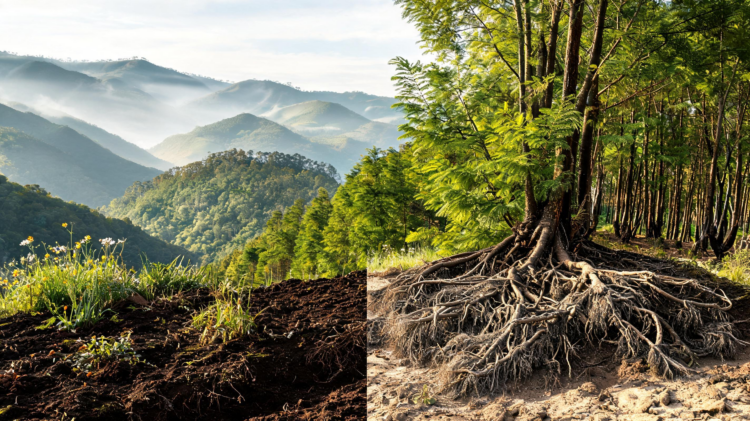
High in the Vumba uplands of eastern Zimbabwe, where Afromontane forests cling to granite-derived slopes between 1,320 and 1,720 meters above sea level, an Australian import is quietly rewriting the chemistry of the ground beneath its roots. Black wattle, Acacia mearnsii, was brought to the region in the early-to-mid twentieth century for commercial forestry, prized for its rapid growth and its bark rich in tannins. A century later, the species has escaped its plantations and spread through protected areas of the Eastern Highlands, outcompeting native shrubs, grasses and trees. Now, a field study published in the journal Discover Soil reports that where black wattle establishes, it does far more than displace vegetation: it measurably alters soil pH, nitrogen, carbon, electrical conductivity, dissolved solids and moisture, reshaping the very conditions that determine which plants can survive.
The study, conducted by Innocent Mahakata of the Zimbabwe Parks and Wildlife Management Authority’s Scientific Services Unit, set out to fill a persistent knowledge gap. Although black wattle’s invasion of the Eastern Highlands has been documented for decades, with Nyanga National Park recording nearly 40 percent encroachment as early as 1988, localized data on how the species modifies soil in the Vumba specifically had been lacking. That absence of data has made it difficult for conservation managers to choose between control strategies, or even to understand what they are up against below ground. The Zimbabwe Environmental Management Act, under the Ministry of Environment, Climate and Wildlife, has explicitly recommended quantifying the species’ ecological impacts, making studies of this kind a matter of national policy rather than academic curiosity.
To isolate the invader’s fingerprint from the background noise of landscape variability, the study employed a paired stratified sampling design along a 12.5-kilometer transect along Bvumba road, stretching from the Cloudland area to the Vumba Botanical Gardens. Twenty 25-meter-by-25-meter plots were established in black wattle stands, and for each of these a matching control plot was placed just 60 meters away in adjacent native vegetation, in a random direction. Placing pairs so close together, and matching them for slope, aspect, soil texture, parent material and land-use history, meant that any systematic difference in soil chemistry could be attributed to the invasion itself rather than to geology or management history. Successive plot pairs were spaced 200 meters apart to ensure statistical independence.
Sampling took place over a concentrated four-day window in early May 2025, deliberately timed for the transitional, post-wet-season phase when hydrologic conditions are relatively stable. Using a V-shaped auger driven to a depth of 30 centimeters, the researcher collected composite samples from the center and four corners of each 1-meter-by-1-meter sub-plot, pooled them, and submitted 500 grams of soil from every plot for laboratory analysis. The laboratory protocol followed standard USDA NRCS Soil Survey methods: texture was determined by the pipette method, moisture by gravimetric oven-drying at 105 degrees Celsius for 24 hours, and organic carbon by wet oxidation with potassium dichromate and sulfuric acid, following the classic Walkley-Black approach. Nitrogen was quantified with the indophenol blue method, phosphorus spectrophotometrically as the phosphomolybdate blue complex at 655 nanometers, and pH, electrical conductivity and total dissolved solids in a 1:2.5 soil-to-water suspension.
The results were unambiguous. Soil pH averaged 5.56 in uninvaded native habitats but fell to 4.25 beneath black wattle, a drop of roughly 1.31 units. That degree of acidification matters enormously in ecological terms. Below about pH 5.5, soluble aluminum and iron ions react with inorganic phosphate to form highly insoluble complexes, effectively locking phosphorus away from plant roots and microorganisms. Similar acidification of roughly one pH unit has been documented under alien trees in South Africa’s Kouga Mountains, lending regional weight to the Vumba findings, although other studies elsewhere have recorded pH increases under invasive species, underscoring that the direction of change depends on species traits and starting conditions.
Nitrogen told a more surprising story. Despite being a legume with symbiotic nitrogen-fixing bacteria, black wattle stands showed total soil nitrogen of 0.176 percent, about 25 percent lower than the 0.234 percent measured in native plots. This counterintuitive result is consistent with the nutrient depletion hypothesis: fast-growing invaders create intense nutrient demand, absorbing mineral nitrogen faster than it can accumulate, while acidification accelerates nitrification and leaching. The finding mirrors earlier work in Nyanga National Park, where nitrogen concentrations in invasion hotspots fell by as much as 0.06 percent relative to adjacent areas. Organic carbon moved in the opposite direction, rising 32 percent, from 2.37 percent to 3.13 percent, beneath the wattle, driven by high biomass inputs and slower decomposition in the more acidic soils. Meanwhile electrical conductivity more than doubled, from 31.6 to 71.4 microsiemens per centimeter, and total dissolved solids rose from 21.7 to 47.6 milligrams per kilogram, a signature of nutrient uplift in which deep-rooted wattle mines calcium, magnesium and potassium ions from the subsoil and deposits them at the surface through litterfall.
All of these differences were statistically robust in paired t-tests using Minitab 17 software: pH, nitrogen, electrical conductivity, dissolved solids and moisture each showed p-values below 0.001, carbon at p below 0.006, and pH at p below 0.01, with 20 paired plots and 19 degrees of freedom. The lone exception was phosphorus, which showed a slight increase from 0.0297 to 0.0354 percent in invaded plots but fell short of statistical significance at p equals 0.165. That inconsistency echoes a broader pattern in the invasion literature, where phosphorus responses to invasion are famously variable, likely shaped in Vumba by the interplay of soil mineralogy, microbial activity and local disturbances such as veld fires.
Perhaps the most consequential finding concerns water. Soil moisture content was significantly lower under black wattle than under native vegetation, and the mechanism is structural as much as chemical. The invader’s aggressive root system behaves as a dense, efficient pump, extracting water from deep soil profiles that shallow-rooted native plants cannot reach, while its dense evergreen canopy increases rainfall interception and evapotranspiration. Comparable studies in South African subtropical grasslands have shown that wattle-dominated soils receive less percolating water, leading to severe desiccation. In the Vumba, where montane grasslands and the endemic species they support depend on consistent soil moisture, this hydrological competition poses a direct threat to water retention, streamflow and the survival of moisture-sensitive native flora during dry periods.
Taken together, these changes do not simply describe degraded soil; they describe a feedback loop that entrenches the invader. Acidification, moisture depletion, altered conductivity and nutrient imbalance create conditions that are hostile to the evolutionarily adapted, nutrient-sensitive native Afromontane flora but favorable to the wattle and to secondary non-native invaders. The species compounds this chemically, since its leaves and branches contain allelochemicals that suppress native seed germination, and structurally, through accumulating litter layers that shade and cool the soil surface. In effect, the invader engineers an ecosystem tailored to itself, pushing forest understories and grasslands into a wattle-specific ecological state from which native communities struggle to recover even after the trees are removed.
For conservation managers, the implications are sobering. Simple mechanical clearing, which is already underway in Vumba conservation areas, will not neutralize the soil legacy effects that persist after felling, and the wattle’s prolific coppicing and seed production make long-term control notoriously difficult. The study argues that restoration must pair invasive removal with active soil remediation and strategic replanting of native Afromontane species, an integrated framework that addresses both the above-ground biomass and the below-ground chemistry the invader leaves behind. The findings represent a snapshot of a single post-wet-season sampling period in a small area, and the author acknowledges that multi-seasonal monitoring and larger sample sizes would strengthen the picture. Even so, the message from the Vumba uplands is clear: black wattle is not merely a botanical problem but an active driver of soil degradation, and reversing its chemical legacy may be the decisive factor in whether Zimbabwe’s Eastern Highlands keep their biodiversity.
Beyond the specific measurements, the Vumba results contribute to a wider scientific debate about how invasive legumes reshape soils. Because Acacia mearnsii hosts nitrogen-fixing bacteria in root nodules, many studies have assumed enrichment of soil nitrogen beneath its stands, yet the observed depletion here shows that fixation and demand do not always balance. Fast-growing trees can immobilize or absorb fixed nitrogen as quickly as it is produced, meaning the net effect on any given soil depends on growth rates, litter quality and leaching losses.
The paired design also illustrates why context matters when interpreting invasion impacts. The Vumba’s high rainfall, around 1,500 millimeters annually, and its cool montane temperatures slow decomposition and favor the accumulation of organic litter, which helps explain the substantial carbon gains under wattle. In drier or more degraded lowland settings, the same species might produce different chemical signatures. This site-specificity is a recurring theme in invasion ecology and cautions against transferring management prescriptions wholesale between regions.
Finally, the open-access publication of the dataset offers a baseline against which future monitoring can be judged. If clearing programs in the Eastern Highlands succeed, repeat sampling along the same Bvumba road transect could reveal how quickly soil pH, nitrogen and moisture recover, providing rare empirical grounding for restoration timelines in Afromontane ecosystems.
Subject of Research: The effects of Acacia mearnsii invasion on soil chemical properties in the Afromontane ecosystem of the Vumba uplands, Zimbabwe.
Article Title: Investigating effects of Black wattle (Acacia mearnsii) invasion on selected soil chemical properties in the Afromontane ecosystem of the Vumba uplands in Zimbabwe
Article References: Mahakata, I. (2026). Investigating effects of Black wattle (Acacia mearnsii) invasion on selected soil chemical properties in the Afromontane ecosystem of the Vumba uplands in Zimbabwe. Discover Soil, 3(1), Article 150. https://doi.org/10.1007/s44378-026-00310-0
Image Credits: AI Generated
DOI: 10.1007/s44378-026-00310-0
Keywords: Acacia mearnsii, black wattle, invasive species, soil chemistry, Afromontane ecosystem, Vumba uplands, Zimbabwe, soil pH, soil moisture, nitrogen cycling, ecological restoration, Discover Soil
Cite Scienmag News
APA MLA Chicago
Bethany Barker. (September 3, 2026). Invasive Black Wattle Quietly Rewrites the Chemistry of Zimbabwe’s Mountain Soils. Scienmag. https://scienmag.com/invasive-black-wattle-quietly-rewrites-the-chemistry-of-zimbabwes-mountain-soils/
Bethany Barker. “Invasive Black Wattle Quietly Rewrites the Chemistry of Zimbabwe’s Mountain Soils.” Scienmag, 3 September 2026, https://scienmag.com/invasive-black-wattle-quietly-rewrites-the-chemistry-of-zimbabwes-mountain-soils/. Accessed 3 September 2026.
Bethany Barker. “Invasive Black Wattle Quietly Rewrites the Chemistry of Zimbabwe’s Mountain Soils.” Scienmag. September 3, 2026. https://scienmag.com/invasive-black-wattle-quietly-rewrites-the-chemistry-of-zimbabwes-mountain-soils/
Copy citation Download RIS
Tags: Acacia mearnsiiAfromontane ecosystemblack wattleblack wattle’s influence on soil pH and nutrient levelschanges inDiscover Soilecological consequences of invasive Acacia species in Eastern Zimbabweecological restorationeffects of Acacia mearnsii invasion on mountain soilsenvironmental effects of black wattle encroachment in Zimbabwean protected areasimpact of invasive plants on native vegetation and soil healthInvasive black wattle impact on soil chemistry in ZimbabweInvasive Speciesnitrogen cyclingsoil chemistrysoil modification by non-native tree species in Afromontane forestssoil moisturesoil pHsoil property changes due to black wattle spreadVumba uplandsZimbabwe