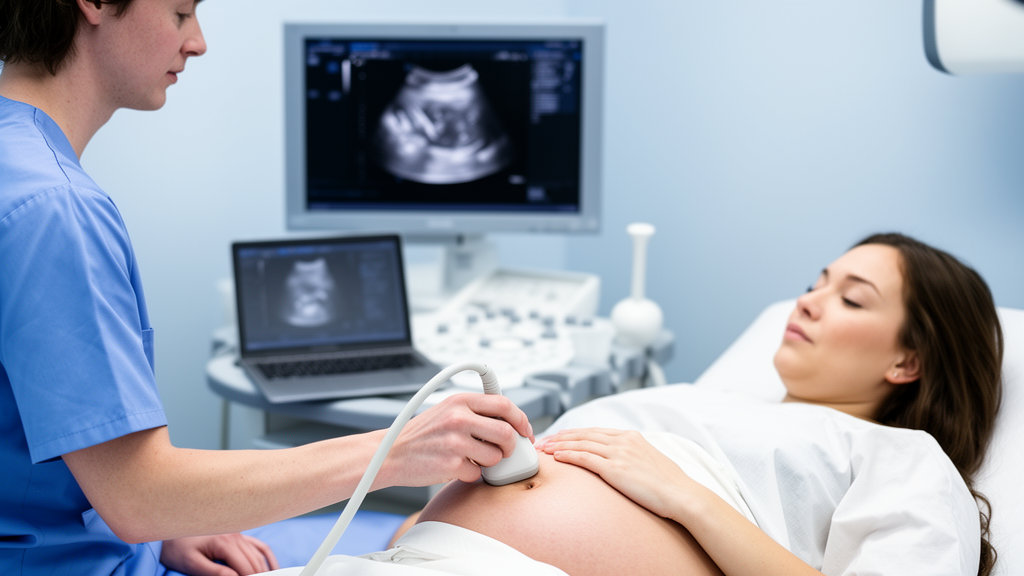
For first-time mothers, one of the most uncertain moments of pregnancy is not knowing how labour will unfold. Will the baby descend smoothly and deliver vaginally, or will the process stall and end in an emergency caesarean? A new scoping review published in BMC Nursing suggests that ultrasound scans performed during labour itself, known as intrapartum ultrasound, could help answer that question, but the evidence is not yet strong enough to change clinical practice. The review, led by Yanwen Li and colleagues at the International Peace Maternity and Child Health Hospital and the School of Nursing at Shanghai Jiao Tong University, systematically mapped how measurements taken by ultrasound during labour have been incorporated into prediction models for mode of birth in nulliparous women, meaning women giving birth for the first time.
The technical premise behind intrapartum ultrasound is straightforward but powerful. Unlike traditional digital vaginal examinations, which rely on the clinician’s subjective sense of how far the foetal head has descended, ultrasound provides objective, quantifiable measurements of foetal head position and descent. Two parameters dominated the field: the angle of progression, which describes the angle formed between a line running along the pubic bone and a line extending from the pubic symphysis to the leading edge of the foetal skull, and the head-perineum distance, which measures the shortest gap between the foetal head and the perineal skin. Both can be captured quickly with a simple transperineal probe and require no bladder filling or invasive preparation.
To understand how these measurements have been used, the research team followed the Joanna Briggs Institute scoping review methodology and reported their work according to PRISMA-ScR, the systematic review reporting standard. They searched ten English- and Chinese-language databases through February 2026, looking for studies that developed or validated a prediction model containing at least one intrapartum ultrasound parameter for a mode-of-birth outcome in nulliparous women. Two reviewers independently screened records, extracted data, and assessed risk of bias using PROBAST, the Prediction model Risk of Bias Assessment Tool. The findings were synthesised narratively and stratified by clinical timing, meaning the stage of labour at which measurements were taken.
The search yielded nineteen cohort studies, fourteen prospective and five retrospective, published between 2011 and 2026, with sample sizes ranging from 64 to 1,020 women. Sixteen of these studies relied on logistic regression, the classical statistical approach for binary outcomes such as vaginal birth versus caesarean section. Two studies used machine-learning methods, and one used only time-to-event modelling. The angle of progression and head-perineum distance appeared most frequently as sonographic predictors, confirming their status as the workhorses of intrapartum ultrasound assessment.
Performance varied widely across the included studies. Authors reported area under the receiver operating characteristic curve values ranging from 0.75 to 0.99, a metric that describes how well a model distinguishes between women who will deliver vaginally and those who will need a caesarean. Values near 0.5 indicate performance no better than chance, while values near 1.0 indicate near-perfect discrimination. The reported range suggests that some models performed only moderately while others approached exceptional accuracy, though the upper end of the range should be interpreted cautiously given the risk of overfitting in small samples.
Within-study comparisons sometimes showed higher discrimination after ultrasound parameters were added to a model, which is exactly what proponents of intrapartum ultrasound hope to demonstrate. However, the review found that comparator definitions and modelling methods varied considerably between studies, making it difficult to draw firm conclusions about how much ultrasound actually improves prediction beyond what clinical assessment alone can achieve. The review explicitly excluded comparison with clinical-only models from its scope, meaning the authors could not establish incremental value over models that rely solely on clinical parameters such as maternal body mass index, foetal head circumference, or cardiotocography findings.
The risk-of-bias assessment revealed a sobering picture. All nineteen studies had a high risk of bias according to PROBAST, none reported external validation, and none evaluated implementation outcomes. External validation, in which a model is tested on data from a different population than the one used to develop it, is considered the gold standard for demonstrating that a prediction model generalises beyond its original setting. Without it, even models with impressive internal performance statistics may fail when applied to new patients in different hospitals or healthcare systems.
The implications for obstetric nursing and midwifery are particularly relevant given the review’s publication in a nursing journal. Midwives and obstetric nurses are often the clinicians performing intrapartum assessments and would be the ones integrating ultrasound findings into care decisions. The review concludes that evidence for routine intrapartum ultrasound use in obstetric nursing and midwifery is insufficient, despite the potentially useful discrimination reported by individual studies. The authors emphasise that future research should prioritise multicentre external validation, standardised measurement timing, direct comparison with clinical-only models, and co-designed implementation studies examining workflow, acceptability, and woman-centred outcomes.
Standardised measurement timing emerged as a key concern in the review. The angle of progression and head-perineum distance change dynamically as labour progresses, so the same measurement taken at different cervical dilatations or foetal head stations could yield very different values. Studies that measured parameters at different stages of labour without accounting for this variation may have introduced noise into their models, potentially inflating or deflating apparent predictive accuracy. The review stratified its findings according to clinical timing to address this issue, but the underlying heterogeneity across studies remains a barrier to drawing unified conclusions.
The broader context of this work sits within a growing movement to bring objective measurement into labour care. The World Health Organization and the International Society of Ultrasound in Obstetrics and Gynecology have both shown interest in standardising intrapartum assessment, and machine-learning approaches such as convolutional neural networks and bidirectional long short-term memory networks have been explored in some of the included studies. Yet the review’s bottom line is clear: while intrapartum ultrasound parameters show promise within prediction models for mode of birth in nulliparous women, the field needs rigorous multicentre validation, direct comparisons with clinical-only models, and implementation research co-designed with midwives, nurses, and the women themselves before routine clinical use can be recommended. For now, the promise of ultrasound during labour remains exactly that, a promise awaiting proof.
Subject of Research: Intrapartum ultrasound parameters within prediction models for mode of birth in nulliparous women: a scoping review
Article Title: Intrapartum ultrasound parameters within prediction models for mode of birth in nulliparous women: a scoping review
Article References: Li, Y., Rao, L., Pan, L., Xie, P., Zhou, W., & Li, H. (2026). Intrapartum ultrasound parameters within prediction models for mode of birth in nulliparous women: a scoping review. BMC Nursing. https://doi.org/10.1186/s12912-026-05510-1
Image Credits: AI Generated
DOI: 10.1186/s12912-026-05510-1
Keywords: Intrapartum, ultrasound, parameters, within, prediction, models, mode, birth, nulliparous, women, scoping, review
News Source: Ophelia Keating. (October 17, 2026). Intrapartum ultrasound parameters within prediction models for mode of birth in nulliparous women: a scoping review. Scienmag.