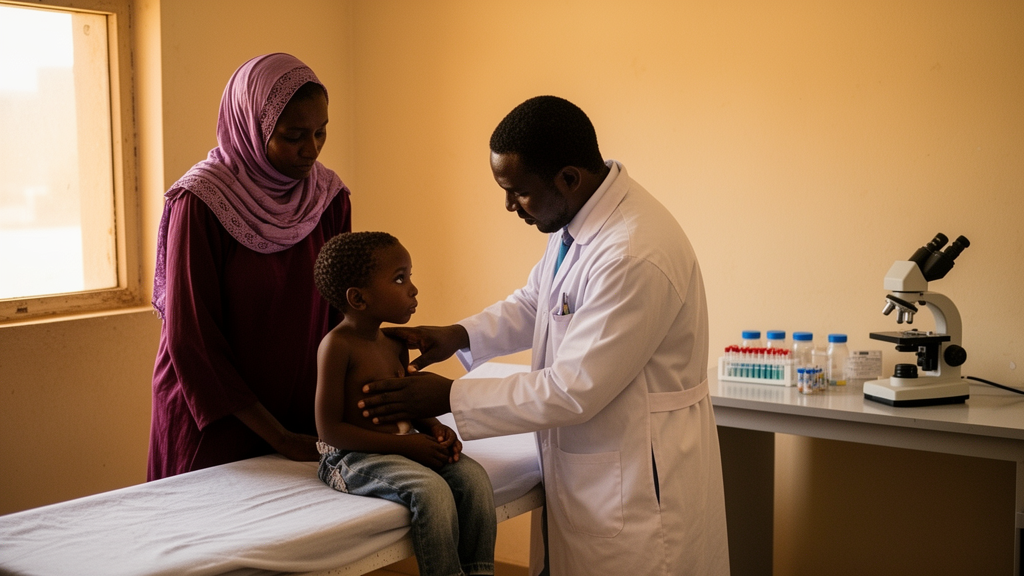
Children with sickle cell anemia in Sudan are being hit by intestinal parasitic infections at extraordinary rates, according to a new study from Kosti Teaching Hospital that found 86 percent of young sickle cell patients carrying gut parasites. The research, published in BMC Pediatrics, examined 200 stool samples from children admitted to the pediatric emergency department between September 2022 and March 2023, splitting them evenly between 100 children with sickle cell anemia and 100 without the condition. What the investigators found was not a story about genetic vulnerability but about environment: infection rates were nearly identical in both groups, with 86 percent prevalence among sickle cell patients and 82 percent among non-sickle cell children, and no statistically significant link between sickle cell status and parasitic infection.
The finding carries real technical weight because it reframes a long-standing clinical question. Sickle cell anemia results from a single point mutation in the beta-globin gene that causes hemoglobin S polymerization under low oxygen conditions, leading to the characteristic sickling of red blood cells, vaso-occlusive crises, chronic hemolysis, and progressive organ damage. For decades, clinicians have debated whether children with sickle cell anemia face heightened susceptibility to intestinal parasites, either because of altered gut immunity, repeated transfusions, nutritional deficits, or the general frailty that accompanies chronic hemolytic disease. The Kosti data suggest the answer is no, at least not in a way that shows up as a measurable difference in infection prevalence. Instead, the parasites appear to be an extrinsic problem, driven by contaminated water, poor sanitation, and living conditions that expose all children in the region regardless of their hemoglobin genotype.
The parasite landscape itself tells a detailed story. Among children with sickle cell anemia, Giardia intestinalis dominated at 62 percent, followed by Entamoeba histolytica or Entamoeba dispar at 54 percent, Entamoeba coli at 31 percent, and Hymenolepis nana at 1 percent. Among non-sickle cell children, the picture shifted: Entamoeba coli was the most common parasite at 69 percent, with the other species present at lower rates. Giardia intestinalis, a flagellated protozoan that colonizes the small intestine and disrupts nutrient absorption through its adherence to the intestinal wall, emerged as the dominant pathogen in the sickle cell group. This is significant because Giardia infection can compound the nutritional challenges that children with sickle cell anemia already face, given their elevated metabolic demands and the growth delays that often accompany chronic hemolysis.
The distinction between Entamoeba histolytica and Entamoeba dispar deserves particular attention. These two species are morphologically identical under light microscopy, which is why the study reports them together as a single category. Entamoeba histolytica is the pathogenic species responsible for amoebic dysentery and invasive disease, capable of destroying host tissue through its cytotoxic activity, while Entamoeba dispar is generally regarded as non-pathogenic. Without molecular differentiation techniques such as polymerase chain reaction, the true proportion of pathogenic infections within that 54 percent category remains uncertain. This is a recognized limitation of microscopy-based parasitology in resource-limited settings, where the formal ether concentration technique and direct wet mount remain the standard diagnostic tools.
The diagnostic methodology itself is worth unpacking. Each of the 200 stool samples was examined using two complementary techniques: direct wet preparation, which allows rapid visualization of motile trophozoites in fresh samples, and the formal ether concentration technique, which concentrates cysts, ova, and larvae from larger stool volumes to increase sensitivity. The concentration step is critical because many intestinal parasites shed intermittently, and direct examination alone can miss low-burden infections. By combining both approaches, the investigators maximized their detection capacity, though even this dual method cannot distinguish morphologically identical species or detect parasites present below the threshold of microscopic visibility.
Age emerged as a meaningful risk factor in the analysis. Infection prevalence was higher among children older than five years, a pattern consistent with the epidemiology of intestinal parasites in endemic regions. Older children spend more time playing outdoors, have wider contact with contaminated soil and water, and are less likely to be exclusively breastfed or protected within household environments that shield infants from environmental exposure. This age gradient also aligns with the natural history of Giardia and Entamoeba transmission, which depends on ingestion of contaminated food or water and fecal-oral spread within households and communities.
The clinical implications for sickle cell care are substantial. Children with sickle cell anemia already contend with a cascade of complications: recurrent vaso-occlusive pain crises, acute chest syndrome, stroke risk, splenic dysfunction that impairs immune defense against encapsulated bacteria, and chronic anemia that requires careful transfusion management. Adding a heavy parasitic burden to this picture creates a dangerous synergy. Giardia infection impairs fat and carbohydrate absorption and can cause malabsorption syndromes that worsen growth failure. Entamoeba histolytica, when genuinely pathogenic, causes bloody diarrhea and can invade the intestinal wall, potentially triggering systemic inflammation in children whose bodies are already stressed by chronic hemolysis. Even non-pathogenic parasites like Entamoeba coli serve as markers of fecal contamination, signaling that a child is being repeatedly exposed to enteric pathogens, some of which may be bacterial or viral and harder to detect.
What makes the study particularly valuable is its case-control design within a single emergency department setting. By recruiting both sickle cell and non-sickle cell children from the same pediatric emergency population, the investigators controlled for many confounders that typically plague parasitology studies in endemic areas. Both groups came from the same geographic catchment, faced similar water and sanitation conditions, and were examined with identical diagnostic protocols. The near-identical prevalence rates, 86 percent versus 82 percent, therefore represent a clean comparison rather than an artifact of different sampling frames. The absence of a statistically significant association between sickle cell status and parasitic infection is a finding that should redirect clinical attention from genetic predisposition toward environmental intervention.
The public health message that follows is direct. If intestinal parasitic infections are driven by extrinsic factors rather than by sickle cell biology, then the solution lies in water treatment, sanitation infrastructure, hygiene education, and routine deworming and antiparasitic programs that target all children in the community, not just those with hemoglobin disorders. Sudan, like many tropical countries, faces persistent challenges with intestinal parasites, and the extraordinarily high prevalence documented in Kosti, exceeding 80 percent in both groups, reflects a level of environmental contamination that demands systemic response. For the sickle cell community specifically, the study suggests that pediatric sickle cell clinics in endemic regions should incorporate routine stool screening and antiparasitic treatment into standard care, not because sickle cell patients are uniquely vulnerable, but because they are being exposed at the same rate as everyone else while carrying a chronic condition that makes any additional insult more dangerous.
The research team, led by Abdelhakam G. Tamomh of the University of El Imam El Mahdi in Kosti, working with colleagues in Sudan and Ghana, conducted the study with institutional ethics approval and informed consent from all participants or their parents, adhering to the Declaration of Helsinki. The work received no external funding, and the authors declare no competing interests. Published as an open access article under a Creative Commons license, the study adds to a growing body of evidence that the health burdens of children with sickle cell anemia in resource-limited settings cannot be addressed through hematology alone. The parasites in their guts are a community problem, and solving it requires looking beyond the blood smear to the water supply, the toilet, and the playground.
Subject of Research: Parasitology and Pediatric Hematology
Article Title: Intestinal parasitic infections and associated risk factors in Sudanese pediatric sickle cell patients
Article References: Tamomh, A. G., Walana, W., Ibrahim, R. M., Elamin, E., Ali, M. O., Ali, H. O., & Aldaw, T. H. (2026). Intestinal parasitic infections and associated risk factors in Sudanese pediatric sickle cell patients. BMC Pediatrics. https://doi.org/10.1186/s12887-026-07647-z
Image Credits: AI Generated
DOI: 10.1186/s12887-026-07647-z
Keywords: intestinal parasitic infections, sickle cell anemia, Sudan, pediatric health, Giardia intestinalis, Entamoeba histolytica, public health, BMC Pediatrics, Intestinal, parasitic, infections, associated
News Source: Kristina Jarvis. (October 18, 2026). Intestinal parasites strike 86% of Sudanese children with sickle cell anemia. Scienmag.