• HOME
  • NEWS
  • EXPLORE
    • CAREER
      • Companies
      • Jobs
    • EVENTS
    • iGEM
      • News
      • Team
    • PHOTOS
    • VIDEO
    • WIKI
  • BLOG
  • COMMUNITY
    • FACEBOOK
    • INSTAGRAM
    • TWITTER
Monday, July 20, 2026
BIOENGINEER.ORG
No Result
View All Result
  • Login
  • HOME
  • NEWS
  • EXPLORE
    • CAREER
      • Companies
      • Jobs
        • Lecturer
        • PhD Studentship
        • Postdoc
        • Research Assistant
    • EVENTS
    • iGEM
      • News
      • Team
    • PHOTOS
    • VIDEO
    • WIKI
  • BLOG
  • COMMUNITY
    • FACEBOOK
    • INSTAGRAM
    • TWITTER
  • HOME
  • NEWS
  • EXPLORE
    • CAREER
      • Companies
      • Jobs
        • Lecturer
        • PhD Studentship
        • Postdoc
        • Research Assistant
    • EVENTS
    • iGEM
      • News
      • Team
    • PHOTOS
    • VIDEO
    • WIKI
  • BLOG
  • COMMUNITY
    • FACEBOOK
    • INSTAGRAM
    • TWITTER
No Result
View All Result
Bioengineer.org
No Result
View All Result
Home NEWS Science News Chemistry

Interstellar iron isn’t missing, it’s just hiding in plain sight

Bioengineer by Bioengineer
July 9, 2019
in Chemistry
Reading Time: 3 mins read
0
IMAGE
Share on FacebookShare on TwitterShare on LinkedinShare on RedditShare on Telegram

IMAGE

Credit: NASA/JPL-Caltech

Astrophysicists know that iron (chemical symbol: Fe) is one of the most abundant elements in the universe, after lightweight elements such as hydrogen, carbon, and oxygen. Iron is most commonly found in gaseous form in stars such as the Sun, and in more condensed form in planets such as Earth.

Iron in interstellar environments should also be common, but astrophysicists detect only low levels of the gaseous kind. This implies that the missing iron exists in some kind of solid form or molecular state, yet identifying its hiding place has remained elusive for decades.

A team of cosmochemists at Arizona State University, with support from the W.M. Keck Foundation, now claims that the mystery is simpler than it seems. The iron isn’t really missing, they say. Instead it’s hiding in plain sight. The iron has combined with carbon molecules to form molecular chains called iron pseudocarbynes. The spectra of these chains are identical with the much more common chains of carbon molecules, long known to be abundant in interstellar space.

The team’s work was published late in June in the Astrophysical Journal.

“We are proposing a new class of molecules that are likely to be widespread in the interstellar medium,” said Pilarasetty Tarakeshwar, research associate professor in ASU’s School of Molecular Sciences. His coauthors, Peter Buseck and Frank Timmes, are both in ASU’s School of Earth and Space Exploration; Buseck, an ASU Regents Professor, is also in the School of Molecular Sciences with Tarakeshwar.

The team examined how clusters containing only a few atoms of metallic iron might join with chains of carbon molecules to produce molecules combining both elements.

Recent evidence obtained from stardust and meteorites indicate the widespread occurrence of clusters of iron atoms in the cosmos. In the extremely cold temperatures of interstellar space, these iron clusters act as deep-freeze particles, enabling carbon chains of various lengths to stick to them, thus producing different molecules from those that can occur with the gaseous phase of iron.

Said Tarakeshwar, “We calculated what the spectra of these molecules would look like, and we found that they have spectroscopic signatures nearly identical to carbon-chain molecules without any iron.” He added that because of this, “Previous astrophysical observations could have overlooked these carbon-plus-iron molecules.”

That means, the researchers say, the missing iron in the interstellar medium is actually out in plain view but masquerading as common carbon-chain molecules.

The new work may also solve another longstanding puzzle. Carbon chains with more than nine atoms are unstable, the team explains. Yet observations have detected more complex carbon molecules in interstellar space. How nature builds these complex carbon molecules from simpler carbon molecules has been a mystery for many years.

Buseck explained, “Longer carbon chains are stablized by the addition of iron clusters.” This opens a new pathway for building more complex molecules in space, such as polyaromatic hydrocarbons, of which naphthalene is a familiar example, being the main ingredient in mothballs.

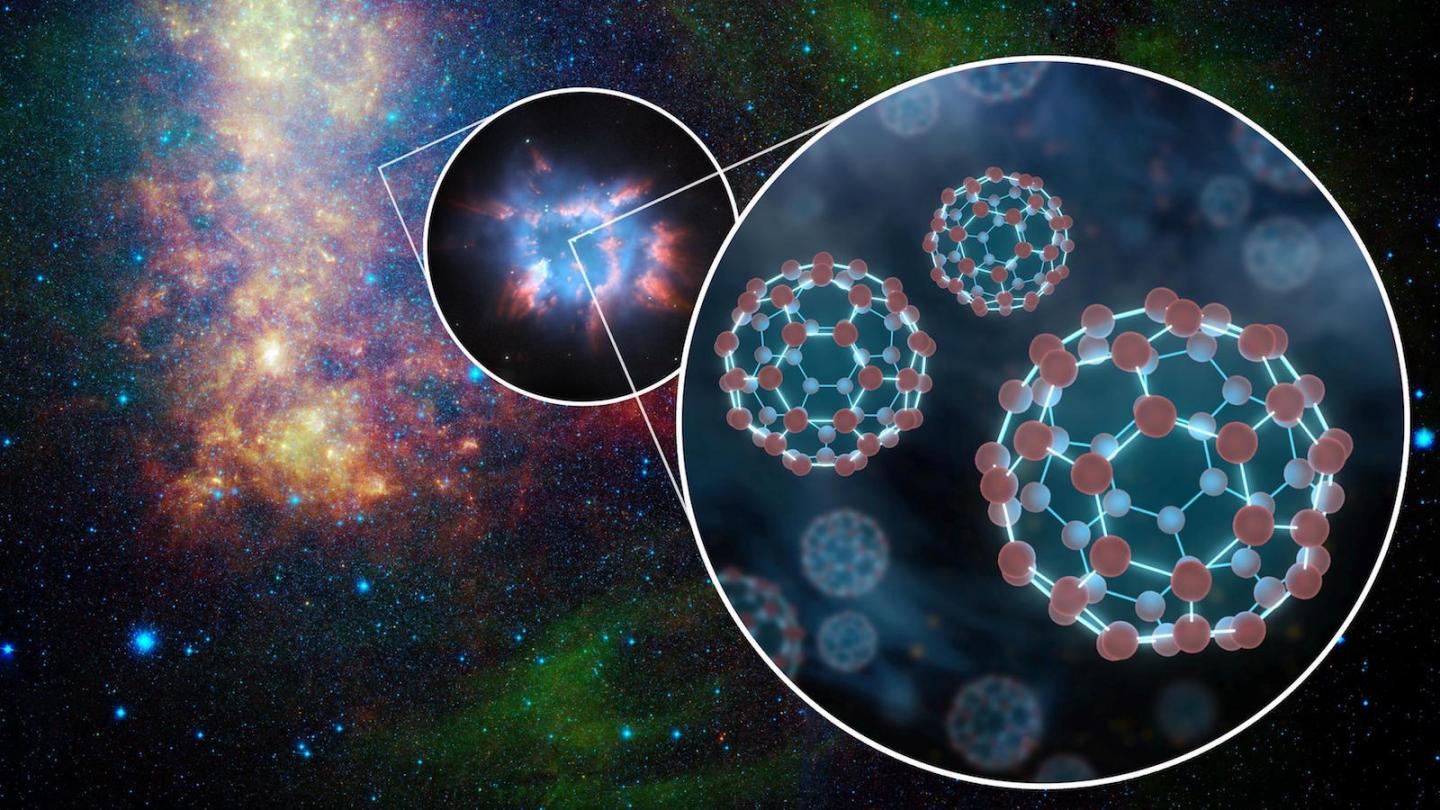
Said Timmes, “Our work provides new insights into bridging the yawning gap between molecules containing nine or fewer carbon atoms and complex molecules such as C60 buckminsterfullerene, better known as ‘buckyballs.'”

###

Media Contact
Robert Burnham
[email protected]

Original Source

https://asunow.asu.edu/20190709-interstellar-iron-isnt-missing-its-just-hiding-plain-sight

Related Journal Article

http://dx.doi.org/10.3847/1538-4357/ab22b7

Tags: AstronomyAstrophysicsSpace/Planetary Science
Share12Tweet8Share2ShareShareShare2

Related Posts

Researchers Enhance Hydrogen Production with Single-Element Dual-Site Substitution

Researchers Enhance Hydrogen Production with Single-Element Dual-Site Substitution

July 17, 2026
Satellite Observations Improve Global Mapping of Soil Moisture

Satellite Observations Improve Global Mapping of Soil Moisture

July 17, 2026

Noble Metal-Modified Zinc Oxide Nanoflakes Show Enhanced Gas Sensing Properties

July 17, 2026

Y-Added FeCoNiSiB Amorphous Multi-Principal Alloys Demonstrate Enhanced Performance

July 17, 2026
Please login to join discussion

POPULAR NEWS

  • Groundbreaking Discovery: New Shark Species Identified for the First Time — Technology and Engineering

    Groundbreaking Discovery: New Shark Species Identified for the First Time

    34 shares
    Share 14 Tweet 9
  • Controlled Study Defines Pediatric Long COVID Features

    32 shares
    Share 13 Tweet 8
  • Behavioral Nudge Boosts Medication Prescriptions for Alcohol Reduction

    35 shares
    Share 14 Tweet 9
  • Clean Cooking and Remittances Slash Somalia’s Ecological Footprints

    31 shares
    Share 12 Tweet 8

About

We bring you the latest biotechnology news from best research centers and universities around the world. Check our website.

Follow us

Recent News

Sleep Quality Links Synergistically with Frailty to Increase Cardiometabolic Multimorbidity in Elderly Chinese

Cognitive reserve helps older adults resist frailty and recover better

Physical Activity and Health Inequality in China’s Older Adults

Subscribe to Blog via Email

Success! An email was just sent to confirm your subscription. Please find the email now and click 'Confirm' to start subscribing.

Join 85 other subscribers
  • Contact Us

Bioengineer.org © Copyright 2023 All Rights Reserved.

Welcome Back!

Login to your account below

Forgotten Password?

Retrieve your password

Please enter your username or email address to reset your password.

Log In
No Result
View All Result
  • Homepages
    • Home Page 1
    • Home Page 2
  • News
  • National
  • Business
  • Health
  • Lifestyle
  • Science

Bioengineer.org © Copyright 2023 All Rights Reserved.