


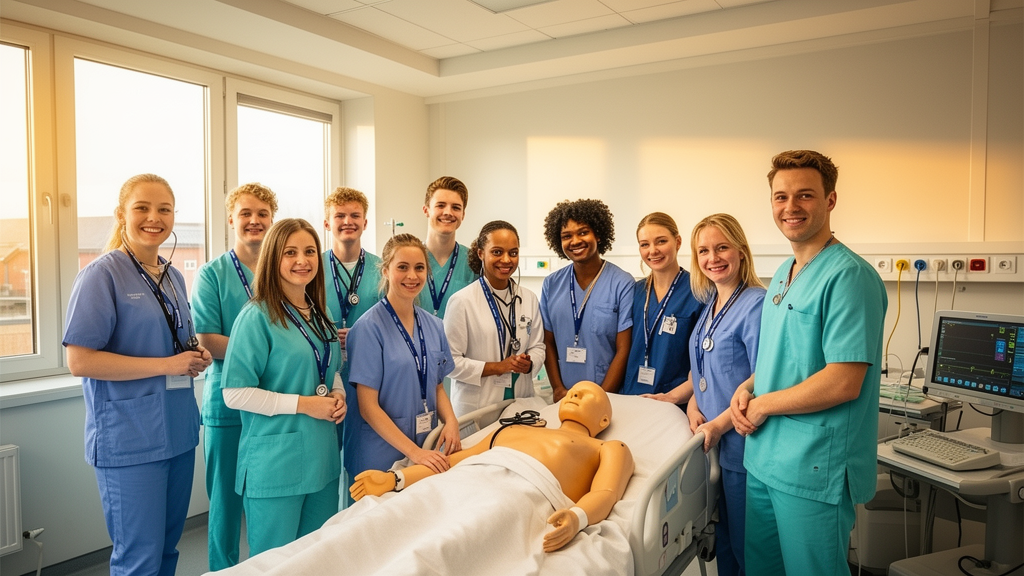
Students training for four different health professions at Oslo Metropolitan University have given consistently high ratings to a shared simulation programme designed to teach them how to work together before they enter the workforce. The programme, known as studentBEST, was evaluated by 363 students from biomedical laboratory science, radiography, nursing and paramedicine, and the results have now been published in BMC Medical Education.
The study responds to a requirement in the National Curriculum Regulations for Norwegian Health and Welfare Education, known as RETHOS, which states that curricular objectives shall focus on interprofessional communication and collaboration. The research team set out to further develop the existing Norwegian interprofessional team training model called BEST, which stands for Better and Systematic Team Training, for these four student groups.
Each student group represented its respective future profession during the simulations and performed the tasks associated with that role. This design meant that a nursing student, a radiography student, a paramedicine student and a biomedical laboratory science student could each contribute from their own professional perspective within the same scenario.
The researchers collected anonymous student evaluations from interprofessional simulations carried out between 2023 and 2025. The evaluations were grouped by educational programme and analysed retrospectively using descriptive statistics. Because the analysis was descriptive and based on self-reported evaluations, the findings reflect how students rated their own experiences rather than measured effects on later clinical performance.
The ratings were strongly positive. Students rated all the scenarios with a minimum median score of 5 out of 6, on a scale where 1 represents very dissatisfied and 6 represents very satisfied. Two items received the highest possible median: “interprofessional simulation as a learning method” and “how relevant studentBEST was in relation to your studies and your future job situation” both received a median score of 6, with an interquartile range of 1.
The authors interpret this positive feedback as indicating that the students found the scenarios relevant and valuable. In their view, the high ratings for relevance to studies and future job situations suggest the approach is well aligned with the students’ educational and career goals and could help prepare them for real-world challenges in their respective fields.
However, the study also identified an important caveat. Experiences varied across the professional groups, and the authors highlight that these differences underline the importance of ensuring meaningful and equitable learning experiences for all participating professions. In other words, a programme that works well overall may still leave some professional groups with a less satisfying experience than others.
To help other institutions adopt the model, the researchers have included the full instructor manual as supplementary material to the published article, with the explicit aim of allowing replication of studentBEST in other educational settings.
The article was published on 30 October 2026 as an open access research paper in BMC Medical Education. As with any evaluation study based on anonymous student feedback, the results describe satisfaction with the training format rather than demonstrating improved patient outcomes or long-term professional performance, and the retrospective design limits the conclusions that can be drawn about cause and effect.
Subject of Research: Evaluation of an interprofessional team training programme for biomedical laboratory science, radiography, nursing and paramedicine students in Norway
Article Title: Great alone, BEST together: interprofessional better and systematic team training for biomedical laboratory science, radiography, nursing, and paramedicine students (studentBEST)
Article References: Harring, A. K. V., Solvi, T. Ø., Aandahl, I. J., Alvestad, V., Bakke, J., Christiansen, C. R., Grimholt, R. M., Knutsen, I. R., & Hjortdahl, M. (2026). Great alone, BEST together: interprofessional better and systematic team training for biomedical laboratory science, radiography, nursing, and paramedicine students (studentBEST). BMC Medical Education. https://doi.org/10.1186/s12909-026-10624-w
Image Credits: AI Generated
DOI: 10.1186/s12909-026-10624-w
Keywords: interprofessional education, simulation training, studentBEST, health professions education, Norway, Oslo Metropolitan University, nursing students, radiography, paramedicine, biomedical laboratory science, student evaluations, BMC Medical Education
News Source: Courtney Benton. (October 30, 2026). Interprofessional team training earns top marks from Norwegian health students. Scienmag.



