


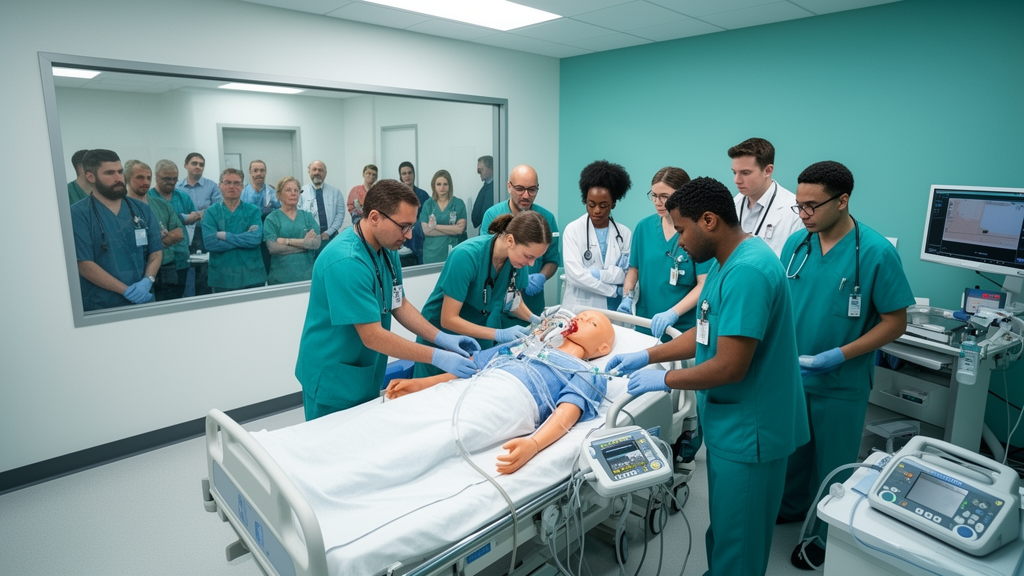
Simulation-based procedural training is a major focus of healthcare education, but training on complications arising from procedures remains variable and context-specific. A new study published in Advances in Simulation argues that this gap may compromise procedural competence and patient safety, and sets out to identify the factors that shape how healthcare teams handle procedural complications when they occur.
The research, led by Victoria Sobolewska with Sarah Galbraith and Siobhan A. Connolly, used interprofessional, in-situ simulation focused on potential complications of bronchoscopy. The intervention was delivered across two hospital sites on four occasions between January 2025 and February 2025, placing the training directly in the clinical environment where teams normally work.
Sixteen participants took part: eight respiratory registrars and eight endoscopy nurses. The study’s data collection relied on audio recordings of the simulation debriefings, which were transcribed and then analysed using reflexive thematic analysis, an approach sensitised by Bandura’s Social Cognitive Theory.
From that analysis, the researchers generated three themes that influence quality and safety within procedural teams. The first, Clinical Experience Shapes Anticipation and Sensemaking, points to the role of accumulated experience in how team members anticipate problems and interpret unfolding events during a complication.
The second theme, Teams Distribute Practical and Cognitive Work, describes how effective teams divide both hands-on tasks and thinking tasks among members during an adverse event, rather than relying on a single individual to manage everything. The third theme, The Environment Extends or Constrains Cognition, highlights how the physical and organisational setting can either support or limit the team’s collective ability to respond.
The authors conclude that these themes reveal the multifaceted nature of team performance during procedural complications. Their central finding is that technical competence alone is insufficient for managing iatrogenic complications; patient safety instead depends on the integration of individual experience, team adaptation and supportive systems working together.
As a qualitative study based on debriefing transcripts from a small cohort at two sites and a single procedure type, the findings are exploratory rather than generalisable proof of what improves outcomes. The study was designed to understand contributing factors, not to measure the effectiveness of the simulation intervention itself, and the published version is an early peer-reviewed, accepted manuscript subject to further edits before the final Version of Record.
Nevertheless, the researchers argue the work has practical value: the three themes, framed through Social Cognitive Theory, are offered as a guide for designing and delivering future educational interventions aimed at enhancing the quality and safety of procedural teams managing complications.
Subject of Research: Factors influencing how interprofessional procedural teams manage iatrogenic complications, studied through in-situ bronchoscopy simulation
Article Title: Unlocking safety and quality: exploring factors which contribute to procedural teams’ management of iatrogenic complications through interprofessional simulation
Article References: Sobolewska, V., Galbraith, S., & Connolly, S. A. (2026). Unlocking safety and quality: exploring factors which contribute to procedural teams’ management of iatrogenic complications through interprofessional simulation. Advances in Simulation. https://doi.org/10.1186/s41077-026-00491-2
Image Credits: AI Generated
DOI: 10.1186/s41077-026-00491-2
Keywords: simulation-based training, interprofessional education, iatrogenic complications, bronchoscopy, patient safety, reflexive thematic analysis, Social Cognitive Theory, respiratory registrars, endoscopy nurses, in-situ simulation, team performance, healthcare education
News Source: Courtney Benton. (October 29, 2026). Interprofessional Simulation Reveals How Procedural Teams Manage Iatrogenic Complications. Scienmag.



