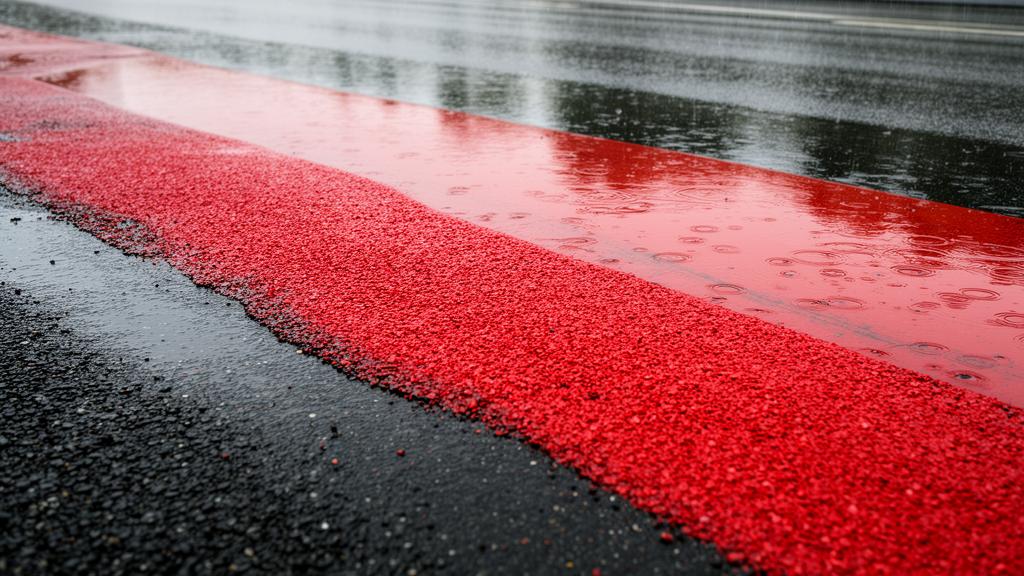
A controlled field evaluation of asphalt pavement treatments has demonstrated that applying red anti-skid cold-plastic surfacing in an intermittent pattern yields superior tire friction under wet conditions compared to continuous, full-length coating. Conducted across a closed 1,000-meter straight asphalt test section in Thailand, the study systematically compared untreated baseline roadway surfaces against full-length coverage and an intermittent layout consisting of an 80-centimeter coated segment followed by a 20-centimeter uncoated gap. While continuous coverage maximized frictional resistance under completely dry conditions, the intermittent 80/20 configuration delivered a higher coefficient of friction when tested beneath a standardized one-millimeter water film. The measured wet-surface performance, paired with a twenty percent reduction in polymer material usage, provides empirical support for an application geometry that had previously raised traction concerns among motorists.
Pavement skid resistance is recognized globally as a fundamental determinant of vehicular driving safety, governing the contact friction between vehicle tires and road surfacing to minimize stopping distances during sudden braking events. In monsoon regions such as Thailand, where frequent and prolonged rainfall creates persistent wet-weather hazards, roadway slipperiness contributes to an elevated risk of severe vehicular crashes. Past transportation literature notes that wet driving conditions regularly increase traffic accident rates by fifteen to thirty-five percent. To counter these risks at designated hazardous roadway segments—such as tight curves, highway intersections, railway crossings, and pedestrian school zones—transportation authorities frequently apply specialized red cold-plastic coatings complying with industrial standard TIS 2611–2556. These high-friction surface treatments dramatically enhance surface grip while simultaneously improving daytime visual conspicuity and nighttime retroreflectivity.
Despite the recognized safety benefits of high-friction coatings, highway maintenance agencies have intermittently deployed segmented red paint markings on expressways to conserve materials and lower project expenditures. This non-uniform installation raised substantive safety questions among highway users and transportation planners, who voiced concerns that periodic uncoated gaps might induce uneven traction, exacerbate hydroplaning risks, and compromise vehicle directional control in heavy rain. Because earlier investigations into red cold-plastic surfacing concentrated predominantly on laboratory simulations, durability wear tests, or full-coverage installations, empirical field data verifying the frictional trade-offs between uniform and intermittent application patterns under live environmental moisture conditions remained absent from the transportation engineering literature.
To rigorously resolve this friction controversy, researchers established an empirical testing protocol along a dedicated, closed asphalt test facility measuring one meter wide and one thousand meters long. The selected tangent road section featured a level profile with zero vertical gradient, ensuring consistent geometric conditions across all testing cycles between August and November 2022. The experimental design structured comparisons across three operational pavement scenarios: an untreated asphalt control surface representing baseline conditions, a continuous full-length cold-plastic coating delivering complete surface coverage, and the intermittent 80/20 pattern alternating eighty centimeters of treated pavement with twenty centimeters of exposed asphalt. Surface preparation required clearing road debris, repairing pre-existing fissures, applying a specialized primer layer, spreading an evenly distributed four-millimeter layer of polymethyl methacrylate resin blended with benzoyl peroxide hardener, and removing guide masking after complete curing.
Friction data acquisition followed ASTM E2340/E2340M-11 standards utilizing a Continuous Surface Friction Tester, specifically a trailer-mounted Airport Surface Friction Tester model ASFT T-10 towed behind an instrumented survey vehicle. Operating at a standardized test velocity of fifty-six kilometers per hour and an engineered fixed slip ratio of thirteen percent, the specialized device measured the drag force and vertical wheel load exerted upon a standardized ASTM E1551 smooth test tire. An onboard automated water-delivery system and storage reservoir applied a continuous water film measuring no less than one millimeter in depth across the pavement path to replicate controlled wet-weather conditions. Data logging captured continuous measurements averaged over discrete ten-meter intervals, yielding one hundred independent friction readings per single test run across the one-kilometer section.
The experimental layout mandated four complete testing replications across each permutation of the three surface scenarios and two atmospheric moisture states, accumulating four hundred discrete ten-meter friction observations per experimental cohort. Preliminary screening revealed that untreated baseline asphalt yielded average ten-meter friction coefficients of 0.2146 under dry conditions and 0.2069 under wet conditions. Both figures fall significantly below the 0.2900 critical intervention threshold defined by the Thailand Department of Highways, confirming severe friction deficiencies on untreated surfaces and establishing the necessity for corrective surface treatments. When evaluated against international benchmarks, both the continuous and intermittent cold-plastic installations dramatically elevated roadway skid resistance, raising average friction coefficients well above 0.4000 across all testing scenarios.
Parametric evaluation using two-sample Z-tests at a ninety-five percent confidence level established statistically significant performance differences between the two application geometries under both environmental states. Under dry surface testing, the continuous full-length coating achieved a mean friction coefficient of 0.4346, surpassing the intermittent 80/20 pattern mean of 0.4269 with a calculated test statistic of z = 3.3921 and a one-tailed significance value of p = 0.000347. This finding indicates that continuous application offers superior traction on dry surfaces, exceeding the established 0.4300 investigatory threshold defined for straight roadway sections by the Department of Highways. In dry environments, continuous coverage optimizes tire contact with high-performance calcined bauxite aggregate, maximizing the adhesion component of pavement friction across the entire wheel path.
Conversely, when subjected to the simulated one-millimeter wet water film, the intermittent 80/20 coating pattern generated an average ten-meter friction coefficient of 0.4169, statistically outperforming the full-length coating average of 0.4069. The corresponding hypothesis test produced a negative test statistic of z = -4.4192 and an exceptionally low one-tailed probability value of p = 0.00000495. This inverse relationship highlights the distinct tribological mechanics governing wet pavement interfaces, where thin lubricating fluid films suppress direct tire adhesion. In wet environments, tire friction relies heavily on bulk rubber hysteresis and rapid mechanical water displacement. The periodic twenty-centimeter gaps and raised four-millimeter edges of the intermittent cold-plastic strips function as microscopic drainage channels and escape reservoirs, venting dynamic fluid pressures ahead of the tire and mitigating the hydrodynamic lubrication that initiates partial hydroplaning.
In addition to demonstrating enhanced wet-weather traction, the intermittent application geometry provides substantial economic and resource benefits. Direct cost evaluations based on project material unit prices of 29.4918 United States dollars per square meter indicate that coating a one-meter-wide by one-kilometer-long pavement corridor under full coverage requires treating 1,000 square meters at an approximate expense of 975,000 Thai Baht, or 29,491.83 dollars. Applying the 80/20 intermittent configuration reduces the coated area to 800 square meters, lowering installation costs to approximately 780,000 Thai Baht, or 23,593.47 dollars. This delivers direct material and labor savings of roughly 195,000 Thai Baht, representing an exact twenty percent expenditure reduction across the treated length.
When scaled to standard transportation infrastructure dimensions, the financial implications expand proportionally. Applying the full-length cold-plastic coating across a standard 3.5-meter-wide travel lane over a one-kilometer stretch requires treating 3,500 square meters of road surface at a total investment of 103,221.42 United States dollars. In contrast, the intermittent 80/20 configuration requires coating only 2,800 square meters within the same lane-kilometer, bringing the total expense down to 82,577.13 dollars. This represents an absolute saving of approximately 20,644 dollars per single lane-kilometer while simultaneously improving frictional performance in wet conditions. Highway management authorities can thus stretch maintenance allocations across wider sections of the road network without compromising traveler safety standards.
The study authors emphasize several operational parameters and technical boundaries that constrain the immediate generalizability of these findings. Because the ASFT T-10 trailer apparatus requires flat and straight roadway geometry to measure longitudinal braking drag without directional lateral forces, testing was restricted entirely to tangent, zero-gradient asphalt alignments, leaving curved and steep vertical segments unexamined. Furthermore, testing took place across a single four-month period on a proprietary asphalt mix utilizing one cold-plastic material specification and a fixed 80/20 geometric ratio. The experimental scope did not capture long-term aggregate polishing, surface wear under sustained heavy commercial wheel loads, or multi-year weathering attenuation. Future research programs must evaluate diverse gap ratios, varied coating thicknesses, and curved geometric alignments across extended operational lifecycles to complete comprehensive life-cycle cost assessments across national road networks.
Subject of Research: Comparative pavement skid resistance of continuous and intermittent red anti-skid coatings under wet and dry conditions
Article Title: Comparative analysis of skid resistance on pavement between full-length and intermittent coating of red anti-skid under wet and dry conditions
Article References: Chaichannawatik, B., Rakkarn, S., Leelawanich, W., & Raha, U. (2026). Comparative analysis of skid resistance on pavement between full-length and intermittent coating of red anti-skid under wet and dry conditions. Journal of Engineering and Applied Science, 73(1), Article 439. https://doi.org/10.1186/s44147-026-01269-z
Image Credits: AI Generated
DOI: 10.1186/s44147-026-01269-z
Keywords: skid resistance, pavement friction, red anti-skid coating, cold plastic, traffic safety, wet-weather crashes, highway engineering, continuous pavement friction measurement, Airport Surface Friction Tester, ASFT T-10, asphalt pavement, surface texture, tire-pavement friction, road maintenance, Department of Highways Thailand, two-sample Z-test, investigatory level, intervention level
News Source: Neil Sanderson. (November 20, 2026). Intermittent Red Anti-Skid Pavement Coating Outperforms Continuous Application in Wet Road Tests. Scienmag.