Zinc oxide thin films just got a thermal twist that matters for anyone building transparent electronics. Researchers reporting in Results in Optics deposited undoped bilayer ZnO films by spray pyrolysis and, crucially, annealed the first layer before laying down the second. When that intermediate annealing step was carried out at 450 °C, the finished bilayer film showed a sheet resistance of just 54.1 ohms per square, a dramatic drop from the roughly 200 ohms per square measured for the as-deposited bilayer and the film intermediate-annealed at 400 °C. That same 450 °C sample delivered the best combined optical and electrical performance of the study, earning a Haacke figure of merit of 5.13 × 10⁻³ Ω⁻¹. The work demonstrates that the thermal history of the first layer, not just the final film’s composition, can reshape the properties of an undoped transparent conducting oxide.
The appeal of ZnO in this space is well established. It is a wide direct bandgap semiconductor with a bandgap of approximately 3.37 eV and a high exciton binding energy of 60 meV, offering excellent optical transparency and good electrical conductivity. Those traits make it a candidate for transparent electrodes and light-emitting diodes, and because zinc is abundant, cheap and non-toxic, ZnO is widely considered a viable alternative to indium tin oxide, the dominant but increasingly problematic transparent conductor. Transparent conductive oxides in general need to combine high optical transparency with excellent electrical conductivity, typically as n-type wide bandgap semiconductors with low resistivity, and researchers have long tweaked them with dopants such as aluminium, gallium, fluorine and others to push performance. But doping adds material complexity and can alter ZnO’s intrinsic properties, which is precisely why the bilayer route pursued here is interesting: it modifies film architecture without changing chemistry.
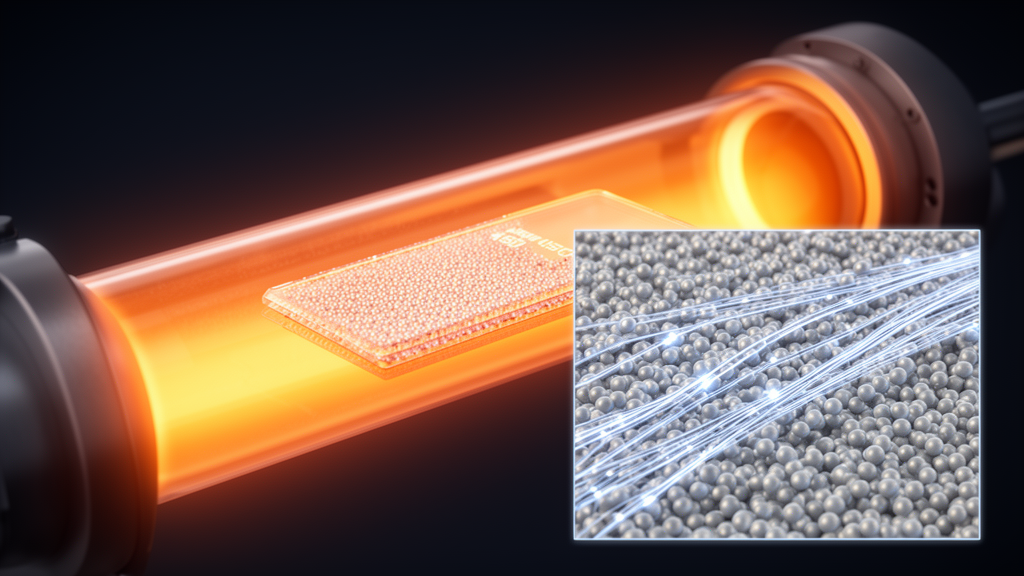
The team used spray pyrolysis, a deposition technique prized for its simplicity, low cost, scalability and vacuum-free operation, all of which suit large-area deposition. A 0.2 M solution of zinc acetate dihydrate in methanol served as the precursor. The first ZnO layer was sprayed onto borosilicate glass at a substrate temperature of 350 °C over 50 spray cycles applied in sets of ten, then held on the hot plate for an hour. Selected samples were then intermediate-annealed at either 400 °C or 450 °C for one hour in a furnace ramped at 6.6 °C per minute and cooled in open air. The second layer was subsequently deposited at 280 °C using the same cycle scheme, and the completed films were held at that temperature for another hour. A nozzle-to-substrate distance of 30 cm and compressed air at 2 bar as carrier gas completed the recipe.
Optically, all the films performed respectably, showing good transparency in the visible and near-infrared regions. But the intermediate annealing clearly left its mark. The as-deposited bilayer film exhibited the highest average transmittance of the three bilayer samples at 93.9 percent. After intermediate annealing of the first layer at 400 °C, average transmittance of the final bilayer fell to 84.9 percent, recovering partially to 88.0 percent at 450 °C. Because all three bilayer samples share the same architecture and comparable thicknesses, around 60 to 65 nanometres, the authors attribute this variation to the intermediate annealing itself rather than to a longer optical path. The bilayer films also showed higher reflectance than single-layer films, a behaviour linked to the additional interface and optical interference introduced by the second layer, and reflectance increased slightly with intermediate annealing temperature.
The optical bandgap, extracted from Tauc plots of the absorption data, barely moved. Bilayer values shifted only from 3.29 eV for the as-deposited film to 3.28 eV after 400 °C intermediate annealing and back to 3.29 eV at 450 °C, a variation of just 0.01 eV that the authors describe as insignificant. Bilayer bandgaps sat slightly below those of the single-layer films, which ranged from 3.32 down to 3.30 eV, a slight reduction the authors connect to the increased film thickness after the second deposition. All values were consistent with previously reported ZnO thin film bandgaps.
Electrically, the story was more dramatic. Single-layer ZnO films, roughly 30 to 34 nanometres thick, showed sheet resistances in the thousands of ohms per square, between 1576.4 and 1918.5 Ω/□, with non-linear current-voltage behaviour. The bilayer films conducted far better, with the as-deposited and 400 °C intermediate-annealed samples nearly tied at 200.0 and 200.3 Ω/□ respectively, and the 450 °C sample plunging to 54.1 Ω/□, a reduction of roughly 73 percent relative to the 400 °C film. The authors caution, however, that the bilayer films are also thicker, so the bilayer-versus-single-layer difference cannot be attributed solely to the architecture. The bilayer current-voltage curves were more linear than the single-layer ones but not perfectly so, leading the authors to describe the behaviour as near-ohmic rather than ohmic, and they note that possible contributions from film-electrode contacts cannot be separated from the film’s intrinsic electrical response with the measurements performed.
Combining transparency and resistance into the Haacke figure of merit, which weights average optical transmittance against sheet resistance, the 450 °C intermediate-annealed bilayer emerged as the clear winner at 5.13 × 10⁻³ Ω⁻¹, ahead of the as-deposited bilayer at 2.67 × 10⁻³ and well ahead of the 400 °C sample at 0.97 × 10⁻³, whose transmittance loss was not matched by any resistance benefit. Against the wider literature, the undoped bilayer’s figure of merit exceeded those reported for fluorine-doped ZnO made by ultrasonic spray pyrolysis, Sn-Co co-doped ZnO made by chemical pneumatic spray pyrolysis, and AZO/Cu mesh/AZO structures, while remaining below doped and metal-inserted architectures such as Al-doped ZnO/Ag/Al-doped ZnO, ZnO/Cu/ZnO and Ga-doped ZnO. The authors frame the result as significant precisely because it was achieved with undoped ZnO using a scalable, cost-effective, vacuum-free technique.
X-ray diffraction added an intriguing complication. All films showed the (100), (002), (101) and, in bilayers, (110) reflections of hexagonal wurtzite ZnO, with lattice parameters within the reported range. But the structural trend ran counter to the electrical one. Raising the intermediate annealing temperature from 400 °C to 450 °C broadened the diffraction peaks, with the FWHM of the (100) reflection growing from 0.5571° to 0.9433°, the apparent Scherrer crystallite size shrinking from 14.83 to 8.76 nm, microstrain rising from 8.490 × 10⁻³ to 14.373 × 10⁻³, and dislocation density climbing from 4.545 × 10⁻³ to 13.032 × 10⁻³ nm⁻². In other words, the film with the lowest sheet resistance showed the most structural broadening, so the resistance reduction does not correlate directly with improved crystalline ordering. Because Hall measurements and compositional or defect-sensitive analyses were not performed, the mechanism behind the conductivity improvement cannot be determined from the present data, and the contributions of carrier concentration and mobility remain unquantified.
Surface characterisation filled in the morphological picture. Scanning electron microscopy of the as-deposited bilayer revealed a granular morphology with closely distributed grains of varying sizes and shapes. Atomic force microscopy over 1.6 × 1.6 to 2.0 × 2.0 μm² scan areas yielded average roughness values of 2.3 nm for the as-deposited single layer, 2.1 nm for the as-deposited bilayer and 2.8 nm for the 400 °C intermediate-annealed bilayer, figures the authors describe as indicative of local topography since each came from a single scan area. AFM data for the 450 °C bilayer sample were not available. The low roughness values are consistent with prior reports of compact, homogeneous spray-pyrolysed ZnO surfaces. Taken together, the study establishes intermediate annealing temperature as a genuine processing lever for undoped bilayer ZnO, one that shifted optical transmittance, left the bandgap essentially untouched, and produced a striking, mechanistically unresolved drop in sheet resistance at 450 °C under the conditions investigated.
Subject of Research: Effect of intermediate annealing temperature on spray-pyrolyzed undoped bilayer ZnO thin films
Article Title: Effect of intermediate annealing temperature on the structural, optical, morphological and electrical properties of spray-pyrolyzed bilayer ZnO thin films
Article References: Babalola, A. V., Gurku, U. M., Sarki, M. U., Idris, M. M., Mundi, A. A., Ewa, I. I., Owoeye, V. A., Emegha, J. O., & Victoria, O. T. (2026). Effect of intermediate annealing temperature on the structural, optical, morphological and electrical properties of spray-pyrolyzed bilayer ZnO thin films. Results in Optics, Article 101203. https://doi.org/10.1016/j.rio.2026.101203
Image Credits: AI Generated
DOI: 10.1016/j.rio.2026.101203
Keywords: ZnO thin films, spray pyrolysis, bilayer ZnO, intermediate annealing, transparent conducting oxide, sheet resistance, Haacke figure of merit, optical bandgap, X-ray diffraction, undoped ZnO, thin film annealing, optical transmittance
News Source: Denise Maddox. (October 29, 2026). Intermediate Annealing at 450 °C Cuts Resistance of Spray-Pyrolyzed Bilayer ZnO Films. Scienmag.