

• HOME
  • NEWS
  • EXPLORE
    • CAREER
      • Companies
      • Jobs
    • EVENTS
    • iGEM
      • News
      • Team
    • PHOTOS
    • VIDEO
    • WIKI
  • BLOG
  • COMMUNITY
    • FACEBOOK
    • INSTAGRAM
    • TWITTER
Thursday, April 2, 2026
BIOENGINEER.ORG
No Result
View All Result
  • Login
  • HOME
  • NEWS
  • EXPLORE
    • CAREER
      • Companies
      • Jobs
        • Lecturer
        • PhD Studentship
        • Postdoc
        • Research Assistant
    • EVENTS
    • iGEM
      • News
      • Team
    • PHOTOS
    • VIDEO
    • WIKI
  • BLOG
  • COMMUNITY
    • FACEBOOK
    • INSTAGRAM
    • TWITTER
  • HOME
  • NEWS
  • EXPLORE
    • CAREER
      • Companies
      • Jobs
        • Lecturer
        • PhD Studentship
        • Postdoc
        • Research Assistant
    • EVENTS
    • iGEM
      • News
      • Team
    • PHOTOS
    • VIDEO
    • WIKI
  • BLOG
  • COMMUNITY
    • FACEBOOK
    • INSTAGRAM
    • TWITTER
No Result
View All Result
Bioengineer.org
No Result
View All Result
Home NEWS Science News Biology

Interactive protein posttranslational modifications regulate stress responses

Bioengineer by Bioengineer
July 28, 2017
in Biology
Reading Time: 2 mins read
0
Share on FacebookShare on TwitterShare on LinkedinShare on RedditShare on Telegram
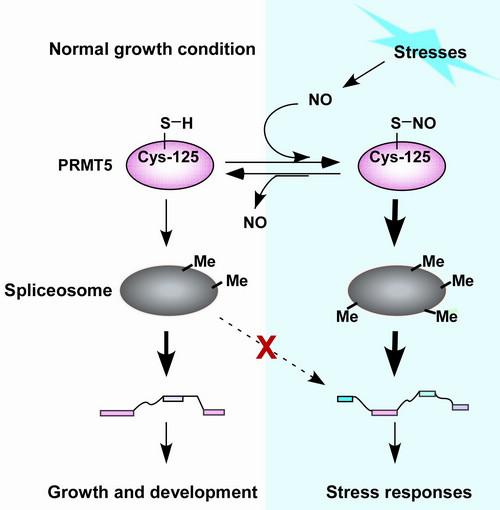
IMAGE

Credit: IGDB

Methylation and nitric oxide (NO)-based S-nitrosylation are highly conserved protein posttranslational modifications that regulate diverse biological processes, including abiotic stress responses. However, little is known about the underlying molecular mechanisms.

Dr. ZUO Jianru's group at the Institute of Genetics and Developmental Biology (IGDB) of the Chinese Academy of Sciences identified PRMT5, a protein arginine methyltransferase, as an S-nitrosylated protein in a nitroproteomics study in Arabidopsis. PRMT5 is a highly conserved enzyme that catalyzes arginine symmetric dimethylation of various proteins, including key components of the spliceosome.

Subsequently, in collaboration with the groups of CAO Xiaofeng (IGDB), BAO Shilai (IGDB), and KONG Zhaosheng (Institute of Microbiology), they discovered that NO positively regulates the methyltransferase activity of PRMT5 through S-nitrosylation at Cys-125 in response to abiotic stresses.

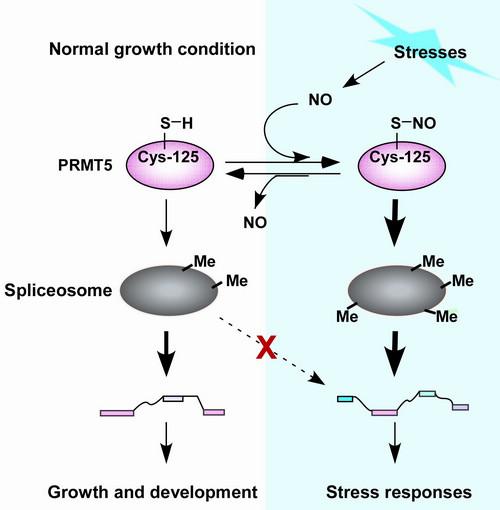
Consequently, S-nitrosylation at Cys-125 of PRMT5 enhances arginine symmetric dimethylation, leading to proper splicing-specific pre-mRNA of stress-related genes and eventually boosting the tolerance to stress. Importantly, S-nitrosylation at Cys-125 is essential for PRMT5-regulated stress responses mediated by NO.

These findings define a molecular link through which plants transduce stress-triggered NO signals to protein methylation machinery in response to environmental alterations.

The results of this research, entitled "Nitric oxide regulates protein methylation during stress responses in plants", were recently published online in Molecular Cell.

###

This study was supported by grants from the National Natural Science Foundation of China, the Strategic Priority Research Program of the Chinese Academy of Sciences, the State Key Laboratory of Plant Genomics, and a postdoctoral fellowship from the China Postdoctoral Science Foundation and the Chinese Academy of Sciences.

Media Contact

Zuo Jianru
[email protected]

http://english.cas.cn/

Original Source

http://english.cas.cn/newsroom/research_news/201707/t20170726_181325.shtml http://dx.doi.org/10.1016/j.molcel.2017.06.031


Share12Tweet8Share2ShareShareShare2

Related Posts

Newly Discovered Chronic Pain Circuit Unveils Potential Avenues for Innovative Treatments

Newly Discovered Chronic Pain Circuit Unveils Potential Avenues for Innovative Treatments

April 2, 2026
DNA Transforms from Blueprint to Active Field Agent

DNA Transforms from Blueprint to Active Field Agent

April 2, 2026

UBC Okanagan Study Reveals How Trees Visually Signal Their Spring Rehydration

April 1, 2026

Rising Temperatures from Climate Change Associated with Reduced Newborn Size

April 1, 2026
Please login to join discussion

POPULAR NEWS

  • blank

    Revolutionary AI Model Enhances Precision in Detecting Food Contamination

    96 shares
    Share 38 Tweet 24
  • Imagine a Social Media Feed That Challenges Your Views Instead of Reinforcing Them

    1007 shares
    Share 398 Tweet 249
  • Promising Outcomes from First Clinical Trials of Gene Regulation in Epilepsy

    51 shares
    Share 20 Tweet 13
  • Popular Anti-Aging Compound Linked to Damage in Corpus Callosum, Study Finds

    44 shares
    Share 18 Tweet 11

About

We bring you the latest biotechnology news from best research centers and universities around the world. Check our website.

Follow us

Recent News

Parkinson’s Mutations Cause Lipid Defects, Rescued

Flexible Axon Sheath Enables Complex CNS Myelination

New Research Reveals Unexpected Findings About Urban Peruvians

Subscribe to Blog via Email

Enter your email address to subscribe to this blog and receive notifications of new posts by email.

Join 78 other subscribers
  • Contact Us

Bioengineer.org © Copyright 2023 All Rights Reserved.

Welcome Back!

Login to your account below

Forgotten Password?

Retrieve your password

Please enter your username or email address to reset your password.

Log In
No Result
View All Result
  • Homepages
    • Home Page 1
    • Home Page 2
  • News
  • National
  • Business
  • Health
  • Lifestyle
  • Science

Bioengineer.org © Copyright 2023 All Rights Reserved.
