Clostridioides difficile (C. difficile) is a bacterium that can infect the large intestine, with symptoms ranging from diarrhea to life-threatening colon damage. A study publishing May 11th in PLOS Biology by Ophelia Venturelli at University of Wisconsin-Madison, USA, and colleagues suggests that between-species interactions within the gut microbiome may impact the efficacy of antibiotics aimed at treating C. difficile infections.
Credit: Ophelia Venturelli (CC BY 4.0, https://creativecommons.org/licenses/by/4.0/)
Clostridioides difficile (C. difficile) is a bacterium that can infect the large intestine, with symptoms ranging from diarrhea to life-threatening colon damage. A study publishing May 11th in PLOS Biology by Ophelia Venturelli at University of Wisconsin-Madison, USA, and colleagues suggests that between-species interactions within the gut microbiome may impact the efficacy of antibiotics aimed at treating C. difficile infections.
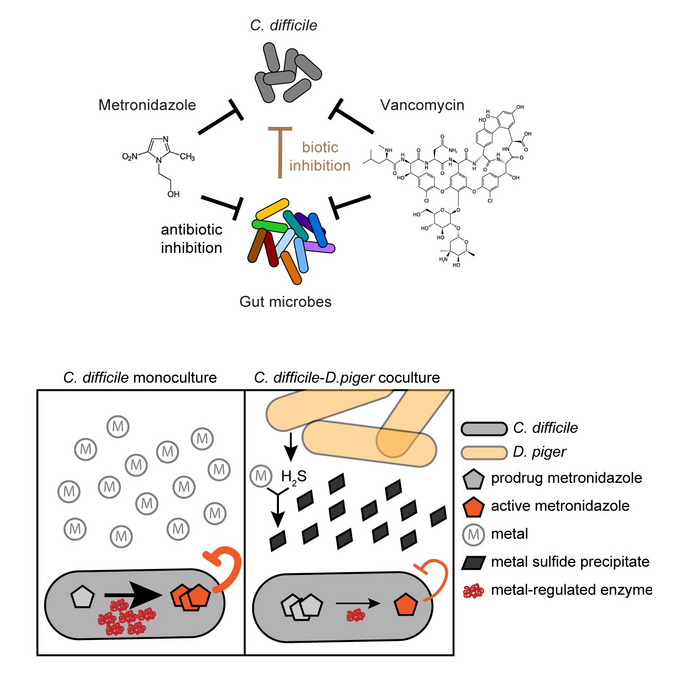
C. difficile infections occur in the context of complex resident gut communities. However, antibiotic treatments aimed at eliminating the bacterium are designed based on C. difficile’s measured susceptibility to drugs in monoculture without considering its interactions with other bacteria. In order to better understand susceptibility-altering microbial interactions across different microbial communities, researchers performed experiments to test the effectiveness of two antibiotics used to treat C. difficile infections, vancomycin and metronidazole, in a diverse human gut community. To identify the ecological principles underlying the interspecies interactions, they built a computational model to understand the interplay of microbial interactions and antibiotics on C. difficile growth.
The researchers found that bacterial species that are more susceptible to the tested antibiotics than C. difficile allow C. difficile to grow in the absence of ecological competition, and increase the abundance of C. difficile in the presence of sub-lethal concentrations of metronidazole. The authors also found that the presence of a specific bacterial species makes C. difficile tolerant to metronidazole. The study was limited to only two antibiotics, so future research should prioritize how interspecies interactions may affect the efficacy of other clinically relevant drugs.
According to the authors, “These results provide key insights into ecological principles and molecular mechanisms influencing antibiotic susceptibility in this health-relevant system. Our work demonstrates that pathogen growth can be altered by inter-species interactions across a wide range of antibiotic concentrations, which should be considered in the design of antibiotic treatments.”
Venturelli adds, “The human gut pathogen Clostridioides difficile (C. difficile) is embedded in a dense and diverse human gut community that influences its colonization ability, growth and functions. Using a bottom-up community assembly approach, we demonstrate that C. difficile‘s response to clinically relevant antibiotics can be altered by an antibiotic-induced reduction in the strength of bacterial competition or global shifts in C. difficile‘s cellular state in the presence of the commensal gut species Desulfovibrio piger.”
#####
In your coverage, please use this URL to provide access to the freely available paper in PLOS Biology: http://journals.plos.org/plosbiology/article?id=10.1371/journal.pbio.3002100
Citation: Hromada S, Venturelli OS (2023) Gut microbiota interspecies interactions shape the response of Clostridioides difficile to clinically relevant antibiotics. PLoS Biol 21(5): e3002100. https://doi.org/10.1371/journal.pbio.3002100
Author Countries: United States
Funding: see manuscript
Journal
PLoS Biology
DOI
10.1371/journal.pbio.3002100
Method of Research
Experimental study
Subject of Research
Cells
COI Statement
Competing interests: The authors have declared no competing interests exist.