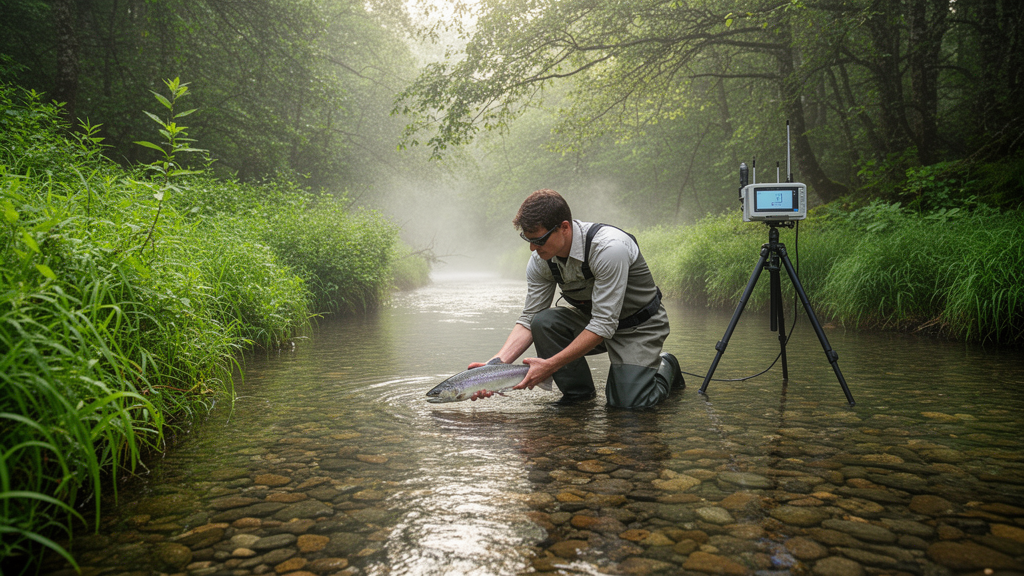
When restoration crews rebuild a stream, plant trees along a floodplain, or knock down a dam, the assumption is that salmon and steelhead will eventually respond. But how much is habitat restoration actually contributing to salmon population recovery? That question has driven the expansion of research and monitoring programs whose goal is to understand and quantify the contribution watershed management and habitat protection is making to salmon populations. One component of this evaluation effort has been the establishment of a network of watersheds where habitat treatments are coupled with intensive, long-term monitoring to evaluate physical and biological responses to these treatments. These sites have been labeled Intensively Monitored Watersheds, or IMWs, and a new editorial published in Frontiers in Ecology and Evolution by George Robert Pess, Peter Bisson, Robert Bilby, and Greer Maier synthesizes more than six decades of evidence from this approach, drawing on a dedicated Research Topic of studies from across the Pacific Northwest and beyond.
The logic behind IMWs is straightforward but demanding. Data required to evaluate the ecological response to habitat actions are expensive to collect and must be gathered over many years to provide confidence in their conclusions. Because they are costly to implement, IMWs occur in only a few select locations, with the goal of enabling enough data collection over a sufficient period to develop an understanding of fish and habitat response that can be applied more broadly to restoration efforts. In essence, each IMW functions as a watershed-scale experiment: treated watersheds are compared against reference watersheds, restoration actions are implemented at meaningful scales, and fish populations are tracked through their full life cycles. It is one of the few tools available for empirically quantifying the contribution habitat restoration can make to salmon population recovery.
The IMW approach is not new. It has been used for over six decades to evaluate aquatic ecosystem response to land use practices and habitat restoration. The Alsea Watershed Study, initiated in the 1950s, evaluated the response of coho salmon and cutthroat trout to alternative logging methods in three small watersheds on the Oregon coast. Results from this study provided much of the technical rationale for the establishment of forestry regulations intended to protect aquatic habitat in the Pacific Northwest. In the 1970s, an ambitious watershed-level project was initiated at Carnation Creek on Vancouver Island, British Columbia, that evaluated the response of hydrology, water quality, and salmonid fish populations to logging of a previously unlogged watershed. The results of that study led to a revision of the forestry code for British Columbia and influenced revisions to forestry practice rules in other areas of the Pacific Northwest. In the early 2000s, multiple IMWs were established in the Pacific Northwest to evaluate the response of habitat and fish populations to freshwater and estuarine salmon habitat restoration efforts, and similar long-term studies have been undertaken in other parts of the world where salmon recovery is an important societal objective.
The approach as it has been applied is not without flaws and complications. Logistical challenges to implementing study designs due to differences between treated and reference watersheds, complexity of statistical study designs, permitting, funding, and implementing habitat treatments have all been identified over the years. Despite these difficulties, IMWs have generated information useful for improving restoration strategies, and the editorial argues that the lessons emerging from them are more valuable than ever as climate change intensifies the pressures on freshwater ecosystems.
Perhaps the most striking finding across the Research Topic is how long ecological signals take to emerge. Tschaplinski and colleagues found that over a 55-year time frame at Carnation Creek there was a mixture of beneficial and harmful effects on salmonid populations from forestry activities. Effects included increased juvenile coho salmon growth and survival shortly after logging, which decades later transitioned to declines in survival due to habitat changes such as landslides, high volumes of sediment transport, and loss of large logjams. Kocik and colleagues quantified how the persistence of low marine survival rates over two decades impacted the response of juvenile Atlantic salmon to restorative actions, demonstrating that even the best freshwater habitat cannot compensate indefinitely for poor conditions at sea. Restoration signals from various types of habitat improvement actions, expressed as increased juvenile survival and life history diversity, took a decade to become apparent in Washington’s Asotin Creek and Elwha River and in the Russian River in California, as documented by Bennett and colleagues, Obedzinski and colleagues, and Peters and colleagues. Continuous, multi-year monitoring can identify ecological patterns, relationships, and processes that short-term post-restoration monitoring simply cannot reveal.
The studies also converge on the importance of process-based restoration, which facilitates wood recruitment, floodplain connectivity, and retention of sediment and nutrients and food web connections, and can increase habitat complexity and result in desirable watershed-scale outcomes. Large-scale restoration activities that enable beneficial watershed transformation include dam and barrier removals, large wood additions, beaver dam analogs, and floodplain reconnections, which support re-establishing natural habitat-forming processes. Rather than treating individual symptoms, such as poor pool frequency or simplified channels, process-based restoration aims to restart the physical and biological engines that create and maintain habitat over time. The IMW evidence suggests these watershed-scale transformations are the actions most likely to produce measurable, lasting fish responses.
Life history diversity emerges as another central theme. Restoration can lead to increased variation in life history pathways, which in turn improves population resilience. Restorative actions that increase habitat complexity can result in a re-awakening of life history diversity in salmon and steelhead populations, with fish once again expressing a wider portfolio of juvenile movement patterns, timing of ocean entry, and adult return strategies. Life history patterns are shaped by habitat as well as life history plasticity and can help to buffer some impacts from various land uses. The editorial is explicit on the monitoring implication: programs should include tracking salmon and steelhead life history diversity and not just emphasize population abundance. A population that expresses many life history pathways is more resilient than one that funnels all of its juveniles through a single strategy, even if the abundance counts look similar.
Following juvenile salmon movements is a valuable part of monitoring activities, and nearly every study in the Research Topic relied on some form of movement tracking. Monitoring different movement patterns helps identify times of the year when key resources are in short supply in a watershed. Lack of resources can initiate movement of the fish that in the long term may be detrimental to their survival, as juveniles that migrate early in search of better conditions often encounter habitats that cannot support them. Juvenile movement patterns can be key indicators of habitat deficiencies and can be used to adaptively change restoration strategies to better address factors causing early migration and constraining salmon and steelhead production. In this sense, the timing of fish movement functions as a diagnostic signal, revealing which parts of a watershed are failing to deliver the food, space, or thermal refuge that growing salmonids require.
Environmental variability can overshadow restoration-related signals, making it difficult to reach conclusions within study time limits, as Krueger and colleagues found. Droughts, floods, and marine heatwaves can swamp the statistical footprint of even well-designed habitat actions. However, restoration can also enhance resilience to climate stresses by recovering habitat complexity and buffering hydrologic extremes, even amid drought or warming trends. Evaluating the complex interaction of climate-induced variation and response to restoration actions using watershed monitoring programs often requires the use of multiple lines of evidence, or metrics, assessed over a sufficient time frame. The editorial also stresses that implementing IMWs successfully is based on more than just the science. The long-term success of restoration and restoration monitoring programs depends on institutional stability, collaborative partnerships, shared data infrastructure, and a willingness to iteratively adapt management and monitoring strategies. These social and ecological insights are as essential as the biological findings, underscoring that watershed restoration is a scientific, people, and organizational endeavor.
Finally, the editorial delivers a sober message about scale. It takes more than just a few habitat restoration projects and brief post-treatment monitoring to document a population response at the watershed scale. Restoration needs to take place across the majority of the watershed, sufficient fish must be returning to spawn, hatchery practices must allow for natural utilization of habitats, and climatic factors must be identified and mitigated to the extent possible; quantifying the recovery of salmon populations needs more than just a few habitat actions. Looking forward, the authors argue that if long-term, intensive monitoring at the scale of a watershed is to survive, IMWs must adapt to and fit the needs of their stakeholders, and the linkages between IMW results and funding and management decisions need to be thoughtfully examined. Lack of evidence for a desired outcome after restoration should not be seen as a failure of the IMW approach, but rather an indication that restoration may be focusing on the wrong habitat factors or in the wrong location, that the restoration actions were not sufficient to create meaningful change, or that habitat may not have been limiting the population in the first place. This type of information is essential to success in salmon recovery as priorities and approaches are learned and adapted. The authors envision a future with a more integrated framework of science and practice, including new technology such as remotely sensed data to detect trends in watershed condition, with support for adaptive management and long-term monitoring improving restoration programs and creating meaningful improvements in salmon recovery.
Subject of Research: Salmon restoration ecology
Article Title: Editorial: Intensively monitored watersheds – a tool to help us understand how ecological processes function and are effected by stream and watershed restoration
Article References: Editorial: Intensively monitored watersheds – a tool to help us understand how ecological processes function and are effected by stream and watershed restoration. (n.d.). https://doi.org/10.3389/fevo.2026.2016751
Image Credits: AI Generated
DOI: 10.3389/fevo.2026.2016751
Keywords: Editorial, Intensively, monitored, watersheds, tool, help, understand, ecological, processes, function, effected, stream
News Source: Drew Townsend. (October 15, 2026). Intensively Monitored Watersheds Reveal How Salmon Restoration Really Works. Scienmag.