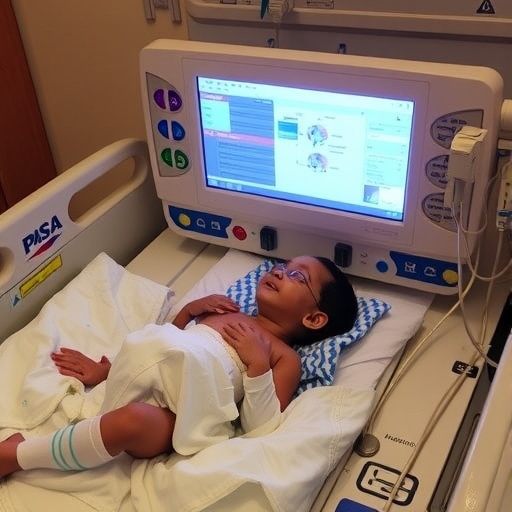
In a groundbreaking study published recently in the Journal of Perinatology, an innovative method to enhance neonatal respiratory care has been explored with promising implications for healthcare systems in low- and middle-income countries. The research centers on the integration of a novel bubble Continuous Positive Airway Pressure (bCPAP) system into the Neonatal Intensive Care Unit (NICU) of a public referral hospital in Mysuru, India. This development marks a significant stride toward improving survival rates and care quality for premature and respiratory-compromised infants in resource-constrained environments.
The necessity for effective respiratory support in neonates, particularly in preterm infants exhibiting respiratory distress syndrome, is well documented. Conventional CPAP machines, despite their efficacy, often remain out of reach for hospitals operating under limited infrastructure and budgetary constraints. This study’s focus on a novel bCPAP system underscores a technological innovation designed with scalability, cost-effectiveness, and adaptability in mind, tailored specifically to such challenging healthcare settings.
The design of this novel bCPAP system integrates advanced engineering principles with local clinical needs. Utilizing an economical setup, the system comprises a compact and portable unit capable of delivering consistent airway pressure to neonates, thus preventing alveolar collapse and ensuring oxygenation efficacy. Importantly, the device operates with minimal electricity consumption, an essential feature considering the often-unreliable power supply in many public hospitals in developing regions.
From a biomedical perspective, the device’s mechanism involves the generation of continuous positive pressure by bubbling exhaled air through a water column, a proven technique to maintain positive airway pressure without the complexity of conventional ventilators. The novelty lies in the system’s ability to precisely control pressure levels tailored to each infant’s requirements, thereby offering individualized respiratory support, which is crucial for optimizing neonatal outcomes.
The pilot implementation at the Mysuru public referral hospital’s NICU was a focal point of this research. Teams undertook comprehensive training protocols for healthcare providers, ensuring proficient operation and maintenance of the new system. Feedback loops from medical staff informed iterative refinements, a vital process that not only enhances device usability but also fosters clinician confidence and ownership over the technology’s adoption.
Clinical outcomes reported from this feasibility study reveal encouraging trends. Neonates treated with the novel bCPAP system exhibited improved oxygen saturation levels and reduced incidences of ventilator-associated complications. Crucially, the intervention was associated with a decrease in the need for mechanical ventilation, which often involves higher risks and costs. These outcomes signal a potential paradigm shift in how neonatal respiratory support is delivered in resource-limited settings.
Moreover, the study addressed infrastructural compatibility, evaluating battery backup options and sterilization protocols to sustain infection control standards without compromising device functionality. These considerations exemplify the researchers’ holistic approach, encompassing not only the technological dimensions but also operational sustainability and clinical safety.
The impact of integrating such a system extends beyond immediate clinical benefits. Economically, the affordability and durability of the bCPAP device translate to significant cost savings for healthcare facilities, potentially allowing for greater patient throughput and expanded neonatal care coverage. Socially, improved neonatal survival rates contribute to enhanced community health indices and reduce the long-term burden of neonatal morbidity.
One of the study’s notable aspects was its emphasis on collaborative partnerships, involving engineers, clinicians, hospital administrators, and policymakers. This multidisciplinary framework facilitated the alignment of the device’s technical specifications with the hospital’s operational realities and strategic healthcare goals, exemplifying a model for successful implementation science.
Furthermore, the researchers underscore the replicability of their approach in similar hospital settings across India and other low- and middle-income regions. They advocate for scaling up production and distribution through public health initiatives, highlighting the potential for this novel bCPAP system to become a standardized component of neonatal care protocols globally.
Importantly, the paper discusses challenges encountered during the integration process, such as initial resistance due to unfamiliarity with the technology, infrastructural limitations, and training demands. These insights provide critical guidance for institutions considering similar adoptions, ensuring that anticipated obstacles can be proactively managed.
Ethical considerations also formed a core component of this investigation. By prioritizing patient safety, informed consent, and equitable access to the intervention, the researchers align with the tenets of medical ethics and public health responsibility, ensuring that innovation benefits all strata of society.
The technical ingenuity, clinical validation, and pragmatic implementation strategies highlighted in this study offer a beacon of hope for neonatal care innovation tailored to under-resourced environments. As neonatal mortality remains a formidable challenge globally, such pioneering solutions underline the indispensable role of technology-driven, context-sensitive interventions.
Looking ahead, the authors suggest further randomized controlled trials to robustly quantify clinical efficacy and long-term outcomes of neonates supported by the novel bCPAP system. They emphasize the need for cumulative data to inform policy frameworks and mobilize resources toward widespread adoption.
In conclusion, the feasibility study of the novel bCPAP system in a Mysuru public referral hospital’s NICU distinctly demonstrates the transformative potential of frugal innovation in healthcare. By bridging technological gaps and operational constraints, the research charts a compelling course for enhancing neonatal respiratory support and ultimately saving countless vulnerable lives in similar settings worldwide.
Subject of Research: Neonatal respiratory support systems and their integration in resource-limited NICUs.
Article Title: Feasibility of integration of a novel bCPAP system into the NICU of a Public Referral Hospital in Mysuru, India.
Article References:
Rauschendorf, P.K., Badin, S., Rangaswamy, S.S. et al. Feasibility of integration of a novel bCPAP system into the NICU of a Public Referral Hospital in Mysuru, India. J Perinatol (2026). https://doi.org/10.1038/s41372-026-02627-8
Image Credits: AI Generated
DOI: 10.1038/s41372-026-02627-8 (17 March 2026)
Tags: bCPAP integration in NICUcost-effective neonatal ventilationengineering solutions for neonatal healthcareimproving survival rates in premature infantsneonatal care in Mysuru Indianeonatal respiratory care innovationnovel bubble CPAP system for neonatesportable CPAP machines for NICUrespiratory distress syndrome treatment in neonatesrespiratory support for preterm infantsscalable respiratory devices for low-resource settingstechnology for neonatal intensive care