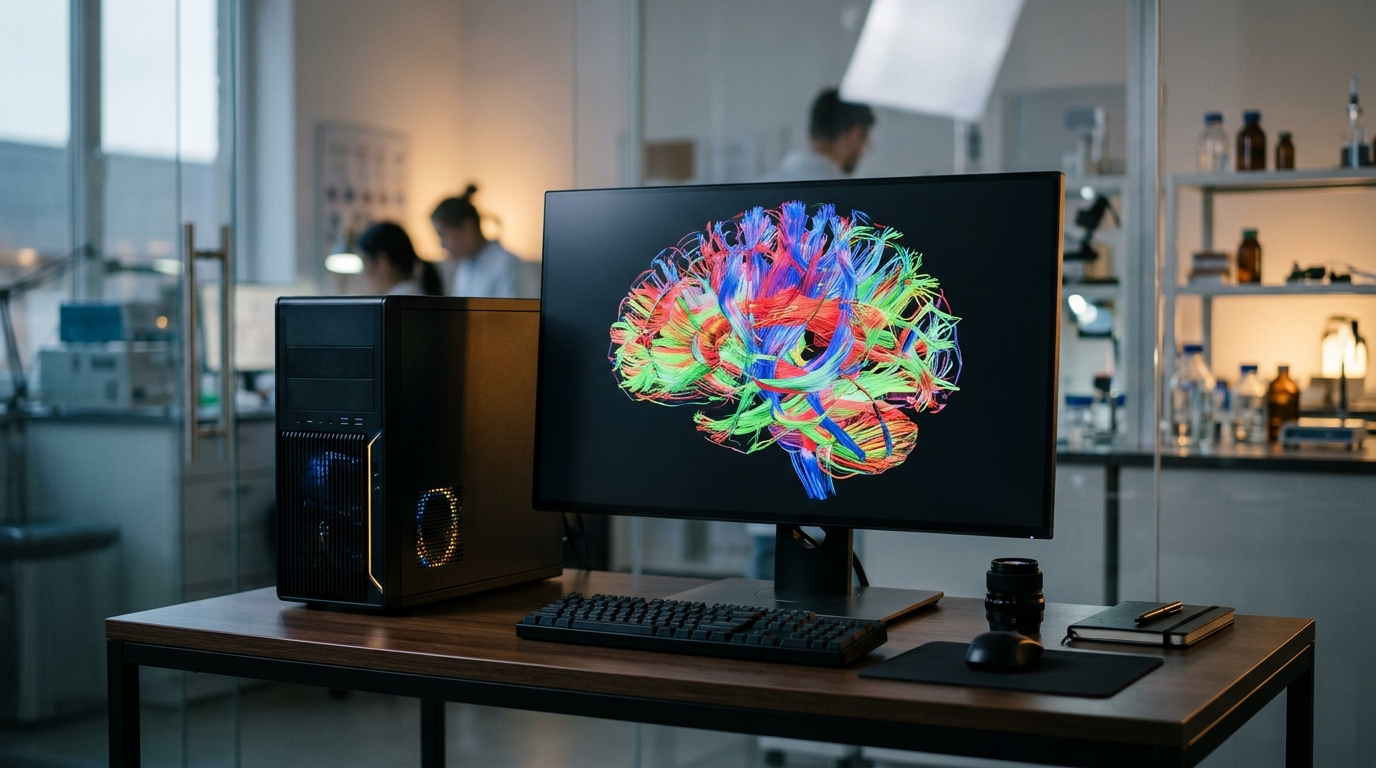
Integrating artificial intelligence into neuroscience is changing how researchers engage with data, improving the understanding of the brain and leading to better ways of training computational models. These findings are presented in Washington, D.C., at Neuroscience 2026, the annual meeting of the Society for Neuroscience, which serves as a major source of emerging news regarding brain science and health.
The human brain contains approximately 86 billion nerve cells that form trillions of connections. To better analyze this dynamic and complex biological system, neuroscientists are increasingly turning to artificial intelligence tools. These technologies provide the analytical capability needed to process vast amounts of data, uncover complex patterns, and simulate intricate brain processes, while biological insights into the workings of the brain simultaneously offer inspiration for improving computational models.
Among the individual research findings presented, Guanglong Sun of Tsinghua University reported on investigations comparing artificial neural networks with fruit flies. This work revealed a shared learning principle between the computational models and the biological organisms for forming flexible, robust memories.
Addressing accessibility in analytical tools, Vivek Swarup of the University of California, Irvine, presented a new free, open-source artificial intelligence application. The tool enables neuroscientists without programming experience to analyze complex genomic data by asking questions in plain English.
In the area of research infrastructure, Oliver Ruebel of Lawrence Berkeley National Laboratory highlighted ongoing efforts across the scientific community to collaboratively develop data standards. These shared frameworks are intended to break down data silos, streamline laboratory workflows, and shape the future of brain data sharing.
Event moderator Satrajit Ghosh, PhD, a computational neuroscientist at the Massachusetts Institute of Technology who uses neuroimaging and machine learning to build predictive models for human health, emphasized that bidirectional connections between neuroscience and artificial intelligence have a long history. Ghosh noted that the reported findings show how artificial intelligence can help scientists understand relationships between brain structure and function, as well as appreciate connections between genes, environments, learning, and behavior across species.
Beyond individual project demonstrations, the overarching interplay between artificial intelligence and neuroscience is advancing the fundamental understanding of both biological brains and artificial systems. As researchers apply these methodologies to accelerate scientific discovery, artificial intelligence applications across neuroscience show transformative potential to advance ongoing research and directly impact people’s lives. The dual focus highlights how investigating complex biological neural mechanisms provides valuable insights that guide the improvement and refinement of computational models, while advanced analytical frameworks simultaneously enhance the investigation of living systems.
The featured presentations will take place as part of the official program for Neuroscience 2026, with a dedicated press event scheduled for Tuesday, November 17, 2026, from 10:00 to 11:00 a.m. EST. The session is scheduled to convene at the Walter E. Washington Convention Center in Room 202B, alongside real-time online streaming access for registered media participants. Members of the press seeking complete access to conference events and briefings, whether attending in person or remotely, must request formal media credentials. A comprehensive schedule detailing the full lineup of press events is available through EurekAlert!
The scientific studies and computational developments presented across the sessions received crucial financial support from national funding agencies, including the National Institutes of Health, alongside support from private funding organizations. This collaborative backing sustains diverse efforts ranging from cross-species memory modeling and genomic inquiry to the collective establishment of shared data standards. For readers, educators, and researchers seeking additional perspective on the intersection of artificial intelligence and brain science, further background information is available through BrainFacts.
The annual conference is organized and hosted by the Society for Neuroscience, a professional organization comprising nearly 30,000 basic scientists and clinicians devoted to the study of the brain and the nervous system. Recognized globally as the world’s largest source of emerging news about brain science and health, the society provides an expansive forum for disseminating new research findings. Through its annual meeting, the organization continues to facilitate dialogue among clinicians and basic scientists working to understand the nervous system and explore the transformative capacities of modern computational tools.
Subject of Research: Integration of artificial intelligence tools in neuroscience research and computational modeling
Article Title: Using artificial intelligence to accelerate neuroscience research
Article References: Using artificial intelligence to accelerate neuroscience research. Original publication (Bibliographic details unavailable.)
Image Credits: AI Generated
DOI: Not provided
Keywords: neuroscience, artificial intelligence, Society for Neuroscience, Neuroscience 2026, computational models, neural networks, fruit flies, memory formation, genomic data, data standards, open-source software, brain data sharing, neuroimaging, machine learning, Tsinghua University, University of California Irvine, Lawrence Berkeley National Laboratory, Massachusetts Institute of Technology
News Source: Cassandra Pierce. (November 14, 2026). Integrating Artificial Intelligence into Neuroscience Accelerates Brain Research and Model Training. Scienmag.