A prototype digital health platform that combines wearable monitoring, conversational coaching and clinician-facing review was rated generally usable by 10 healthy volunteers in a controlled laboratory study, but frequent breakdowns showed that integration remained fragile across connected features. Participants produced a mean System Usability Scale (SUS) score of 76.1, with a 95% confidence interval from 65.4 to 86.8, while the short NASA Task Load Index (NASA-TLX) indicated low-to-moderate workload at 26.7. These results describe a facilitated, single-session usability evaluation, not clinical performance, long-term engagement or benefits for people with chronic diseases.
The system, called the Digital Health Navigator, or DiNa, was designed around three linked functions: monitoring physiological and behavioural data, supporting patient activation and self-management, and giving clinicians or care coordinators a shared view for retrospective review. Its Android application supports goals, medication and symptom records, meal logging, reminders and health trends. A web dashboard provides multi-patient monitoring and patient-specific records, while a modular backend connects the mobile interface, dashboard and data-processing services through shared storage and event records. The authors describe this as a system-level attempt to reduce fragmentation, in which a single patient-generated event can inform coaching and remain available for clinical review.
DiNa also includes an embodied conversational agent that speaks with users in voice or text through a rendered digital human. The agent is separated from the software that presents it and can invoke tools to log meals, retrieve history, manage goals, create reminders or query health data. Its context includes active goals, recent logs, wearable summaries and durable memory entries. Educational responses are grounded through retrieval-augmented generation using a curated collection of 147 topics from Healthify and Diabetes New Zealand, with retrieved passages linked to named sources. A lightweight Llama Guard 4 classifier screens incoming requests and generated responses, while additional rules prohibit recommendations to adjust medication or insulin and require escalation for emergencies, severe glycaemia and self-harm. The researchers did not clinically evaluate these guardrails or formally measure fidelity to motivational interviewing and cognitive behavioural therapy techniques.
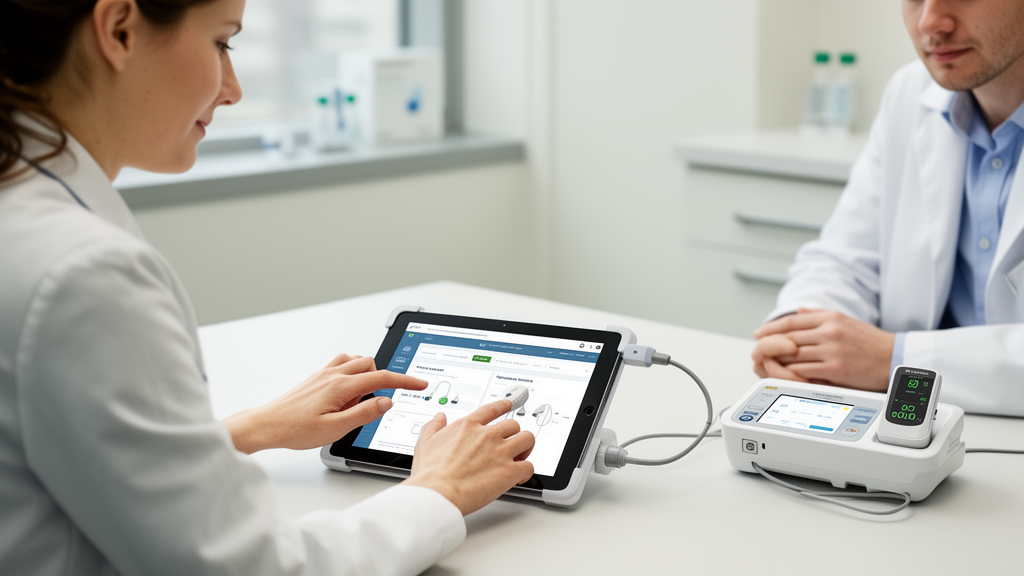
Ten university-community volunteers—five women and five men with a mean age of 27.6 years—tested the platform in moderated sessions lasting approximately 45 to 60 minutes. None had a diagnosed chronic disease, although each regularly used at least one health or fitness tracking application. Eight of the 10 did not regularly log meals, while most tracked physical activity at least several times per week; mean confidence in learning new health applications was 3.7 out of 5. Participants first explored the application, then completed tasks covering goal setting, meal logging with a photograph, meal-history review, goal-related coaching and access to health trends. Researchers measured task completion, completion time, observed errors and moderator interventions, then collected usability, workload and three five-point acceptability ratings and conducted exit interviews. Reflexive thematic analysis and a second coding pass focused on touchpoints spanning two or more platform components.
Most individually administered tasks reached or approached completion. All 10 participants logged a meal, all completed the meal-history task when it was administered, and all completed the health-trends task when reached. Goal setting was completed by nine participants who received the task. The coaching task was completed by nine of 10, with one participant requiring the facilitator to take over. Some tasks were not administered when sessions exceeded the allotted time: goal setting and meal-history review were each omitted once, while health trends were omitted three times. Although overall workload was modest, mental demand averaged 41.7 and effort 32.7, exceeding frustration at 22.8, temporal demand at 14.3 and physical demand at 9.9. Perceived performance on the NASA-TLX was 38.8. Acceptability was more mixed than the usability score: mean willingness to use the system over the following month was 3.4 out of 5, mean willingness to recommend it was 3.8, and perceived usefulness for supporting health and fitness goals was 4.2.
Video observations revealed what the questionnaire ratings could not. Eight of the 10 coaching sessions required an unmute prompt or facilitator rescue because participants initially did not realize that the microphone was off. Four participants encountered meal-logging mismatches involving food misclassification, incorrect portions or a failed state update; one photographed kiwi was recorded as a mandarin, one cake slice appeared as two meals, and a deletion confirmation was not reflected in the visible log. Across 152 cross-component interaction points, 109 worked or were recovered during the session and 43 remained unresolved. Coach-to-goal interactions worked or were recovered in all 27 cases, while only 14 of 30 touchpoints connecting goals with logging, monitoring or review were successfully completed or recovered. The protocol also did not test a complete chain from logging a meal and setting a goal, through coaching that used both, to review, because meal review occurred before the coaching task.
Five themes emerged from the interviews. High-frequency logging created friction: participants liked photograph-based capture because it avoided manual nutritional calculation, whereas lengthy forms led some to bypass manual entry or delegate logging to the conversational agent. Participants with advanced tracking habits instead wanted ingredient-level precision and calorie visibility. Goal setting was also poorly matched to expectations. Users wanted goals that could vary by day, contain multiple criteria, run for a defined period and be reviewed later, while the prototype often imposed fixed structures. In one session, a request to use exercise for stress was reframed as mindfulness, which the participant rejected. Ambiguous labels such as “Commit,” “Confirm” and “Describe,” along with unclear information locations, further reduced confidence. Subtitle timing, synchronisation and overlap with interface elements also interrupted some conversations.
The conversational coach was approachable for lightweight tasks but often seemed generic, repetitive or insufficiently corrective. Participants valued the ability to describe a meal conversationally instead of completing a form, and they expected advice to draw visibly on their goals, logs and previous conversations. Transcript coding found that about half of coach turns enacted a behaviour-change technique and about one-third drew on the participant’s own data or statements. Goal setting, action planning, goal review, self-monitoring and feedback were accepted more readily than generic information and instruction; generic health content accounted for half of all observed rejections. Participants also expected the coach to disagree when appropriate and explain its reasoning, rather than remaining uniformly affirmative. The findings indicate in-session acceptability of these techniques among volunteers, not evidence that the coaching changed behaviour or improved clinical outcomes.
Technical measurements reinforced the interaction findings. Across five sequential single-user repeats, ordinary REST operations for creating goals, retrieving meal history and trends had mean response times of 34.1 to 47.3 milliseconds. Meal persistence averaged one second because a 4.9-second response raised the mean above its 42.2-millisecond minimum. Text coaching over WebSocket was the dominant interactive delay, taking 3.61 to 11.08 seconds and averaging 6.46 seconds. This latency was consistent with the coaching task having the longest completion time and with participants being unsure whether the agent was processing their speech. A separate burst of requests triggered an HTTP 429 rate-limit response, revealing a condition that clients must handle. The wearable pathway was not exercised in the usability sessions, and the Dexcom continuous-glucose-monitor integration carries an approximately three-hour vendor delay and is therefore used for retrospective pattern analysis rather than real-time alerts. DiNa does not duplicate the regulated Dexcom application’s safety-critical glucose warnings.
These findings position integrated care technology as technically promising but not yet ready for inference about clinical usefulness. The platform’s central strength is that one event can be reused across self-tracking, coaching and coordinator review without manual transfer. Yet that same coupling means a local error can weaken confidence in the entire system. The researchers identify several design priorities: make meal-recognition outputs easy to correct, represent goals as flexible and evolving, expose the user data underlying conversational responses, and display clear listening, processing and saved states. Future testing should evaluate chained workflows, clinician dashboards, wearable synchronisation and concurrent system load with adults who have chronic conditions and varied levels of health or digital literacy. The present mean SUS score should be treated as an early reference point from a favourable volunteer sample, not as an estimate of usability, acceptance or effectiveness in clinical care.
Subject of Research: Formative usability evaluation of an integrated digital health platform for chronic care support
Article Title: Design and formative usability evaluation of a prototype integrated digital health platform for chronic care support
Article References: Nanthakumar, K., Gupta, K., Nia, A. F., Dempsey, S., Saffaryazdi, N., Nassani, A., Broadbent, E., Tawhai, M., & Maso Talou, G. (2026). Design and formative usability evaluation of a prototype integrated digital health platform for chronic care support. Frontiers in Digital Health, 8, 1780895. https://doi.org/10.3389/fdgth.2026.1780895
Image Credits: AI Generated
DOI: 10.3389/fdgth.2026.1780895
Keywords: digital health, chronic care management, usability evaluation, conversational agents, wearable sensors, large language models, health coaching, patient monitoring, care coordination, system integration, Design, formative
News Source: Ophelia Keating. (October 22, 2026). Integrated digital health prototype shows generally good usability in healthy volunteers. Scienmag.