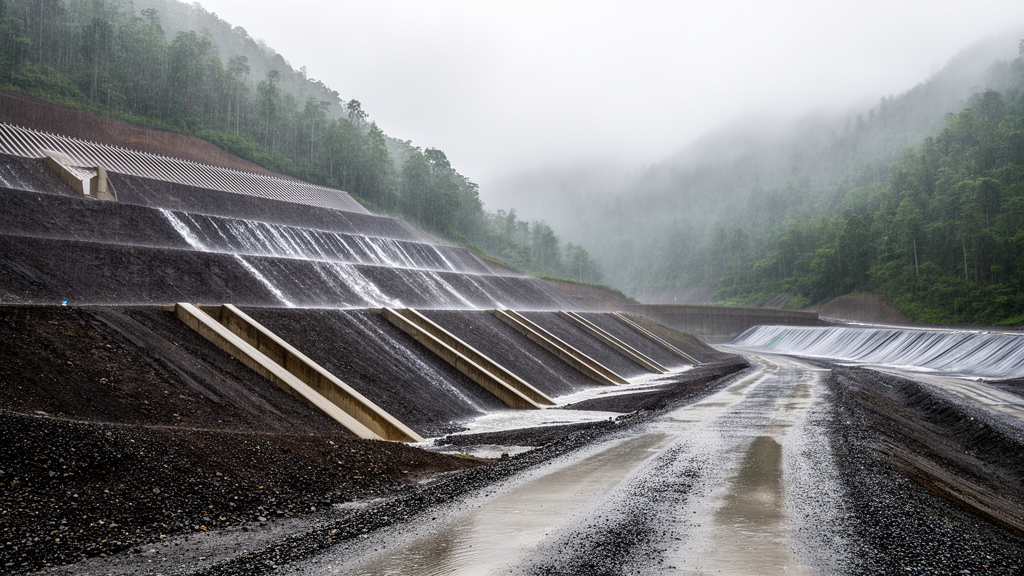
A newly published engineering investigation demonstrates that combining multi-phase numerical simulations, historical incident data, and published literature through game-theory weighting and five-element set pair analysis creates an effective diagnostic framework for assessing valley-type landfill slope instability. Valley-type landfills are distinct hydro-geological facilities engineered by constructing containment dams across downstream natural valleys, offering significant municipal solid waste capacity, economic efficiency, and environmental protection for rapidly expanding urban populations. However, unlike traditional soil slopes or plain-type landfills, valley-type facilities remain vulnerable to severe stability hazards driven by elevated internal leachate levels, complex variations in liquid and gas pressures, steep underlying backslope geometry, and weakened shear interfaces along basal containment liners. To address the challenge of quantifying how these interacting parameters influence catastrophic slope movement, a research team developed a comprehensive ten-indicator evaluation system distributed across five key geotechnical categories: landfill geometric configuration, waste shear strength, liner-interface shear strength, internal liquid-gas conditions, and rainfall infiltration rate.
The physical mechanisms governing valley-type municipal solid waste landfills center on two primary failure modes: internal shear failure propagating directly through the compacted waste mass and basal sliding failure occurring along geosynthetic barrier interfaces. To capture these complex failure modes accurately, the authors established ten distinct physical indicators: the landfill slope gradient, waste fill height, foundation backslope gradient, waste internal friction angle, waste cohesion, liner-interface internal friction angle, liner-interface cohesion, normalized leachate level, normalized landfill-gas pressure, and rainfall infiltration rate. The normalized leachate level is defined as the height of the internal fluid column measured from the landfill base relative to total waste height, while normalized gas pressure scales gas pressure against hydrostatic pressure at an equivalent depth. Because backslope inclination persists throughout construction and active operations, technical standards such as CJJ 176–2012 indicate that basal slope inclinations exceeding approximately ten degrees markedly increase sliding susceptibility along basal liner systems, establishing a critical reference threshold for steep valley terrain.
To explore the sensitivity of landfill slope stability across diverse operating conditions, the researchers deployed an L81 orthogonal experimental design examining nine parameter levels across the ten evaluation indicators. Each orthogonal case was systematically simulated using a coupled multi-phase and multi-component model that treated the waste body as a deformable porous medium, directly solving for pore-water pressure, landfill-gas transport, moisture saturation, skeleton deformation, and biochemical degradation before calculating slope safety factors via shear strength reduction.
Statistical evaluations of the resulting eighty-one numerical simulations revealed precise linear correlations between individual site parameters and the calculated factor of safety. The Pearson correlation coefficients confirmed that waste internal friction angle and waste cohesion exhibited the strongest positive correlations with slope safety at zero-point-five zero two and zero-point-four four two, respectively, while residual liner-interface friction angle and cohesion yielded smaller positive coefficients of zero-point-one five zero and zero-point-two four seven. Conversely, landfill height demonstrated the strongest negative correlation at negative zero-point-four four four, followed by landfill slope gradient at negative zero-point-two five six, normalized leachate level at negative zero-point-two three three, backslope inclination at negative zero-point-two zero three, rainfall infiltration rate at negative zero-point-one seven nine, and normalized landfill-gas pressure at negative zero-point-one one two. Range analysis across the calculated mean factors of safety demonstrated that the internal friction angle of the waste mass generated the largest sensitivity swing, whereas normalized landfill gas pressure exhibited the smallest variation.
To convert continuous numerical data into discrete risk categories, the framework established a standardized five-level stability grading scheme comprising Level I for very stable conditions, Level II for stable slopes, Level III for marginally stable facilities, Level IV for unstable embankments, and Level V for very unstable structures. These five levels were benchmarked against a control factor of safety of one-point-two zero, which represents the standard regulatory threshold for third-level landfill slopes subjected to heavy rainfall events. For the backslope gradient, the boundary values separating Levels I through V were established at seven, nine, eleven, and thirteen degrees, where gradients below seven degrees yield safety factors well above one-point-two zero and gradients above eleven degrees trigger unstable classifications. For liner-interface shear strength, the friction angle thresholds were defined at twenty-three, twenty, seventeen, and fourteen degrees, while interface cohesion boundaries were established at eighteen, fifteen, twelve, and nine kilopascals, matching established engineering guidelines.
To resolve the inherent limitations of relying on a single weighting method, the research team derived three independent weight vectors from different analytical perspectives. The first vector, derived from numerical parameter sensitivity, assigned weights of zero-point-one nine to waste friction angle, zero-point-one seven to waste cohesion, zero-point-one five to leachate level, zero-point-one three to waste height, zero-point-one one to slope gradient, zero-point-zero nine to liner cohesion, zero-point-zero seven to liner friction, zero-point-zero five to backslope gradient, zero-point-zero three to rainfall, and zero-point-zero one to gas pressure. The second vector was extracted from seventy-three documented worldwide landfill failure cases spanning 1972 to 2024, in which rainfall and elevated leachate levels were the most frequent contributing triggers, resulting in weights of zero-point-one nine for rainfall, zero-point-one seven for leachate level, and zero-point-one four each for waste strength properties. The third vector reflected literature attention across more than one hundred peer-reviewed stability studies, assigning peak weights to leachate level and slope gradient.
The three independent weight vectors were subsequently synthesized into an integrated composite weight distribution using game-theory combination weighting, which mathematically minimizes deviations among disparate data sources. The resulting optimal combination coefficients yielded final composite weights that prioritized normalized leachate level at zero-point-one six four three, followed closely by waste internal friction angle at zero-point-one six one six and waste cohesion at zero-point-one four eight six. Rainfall infiltration rate received the fourth highest weight at zero-point-one one zero one, with landfill slope gradient ranking fifth at zero-point-one zero seven nine. Landfill height followed at zero-point-zero eight three zero, while liner-interface cohesion and liner-interface friction angle were assigned zero-point-zero seven one zero and zero-point-zero six seven seven, respectively. Gas pressure and backslope gradient received the lowest composite weights at zero-point-zero five seven zero and zero-point-zero two eight eight, reflecting their lower representation in general failure reports despite their localized mechanical significance.
The classification module implements five-element set pair analysis, a mathematical technique that quantifies the degree of identity, discrepancy, and opposition between actual field measurements and predefined stability benchmarks. For each parameter, a connection degree is formulated across five ordered components, governed by discrepancy coefficients of positive one-half, zero, and negative one-half, alongside a fixed opposition coefficient of negative one. By multiplying the individual connection degrees of all ten parameters by their game-theory composite weights, the model computes an overall connection degree ranging between negative one and positive one. When applied to the eighty-one development simulations, the composite connection degrees exhibited strong internal consistency with safety factors: Level I cases averaged a connection degree of zero-point-six four and safety factors sixteen percent above the one-point-two zero reference, while Level IV cases averaged negative zero-point-three four with safety factors nine percent below the regulatory threshold.
The practical engineering utility of the integrated framework was validated using a documented valley-type municipal solid waste landfill exhibiting severe slope distress in previous field monitoring investigations. The study site featured a landfill slope height of fifty-two meters, a slope gradient of fourteen degrees, a backslope gradient of sixteen-point-five degrees, waste cohesion of eight-point-five kilopascals, and a waste friction angle of twenty-six-point-seven degrees. Basal geosynthetic clay liner and geomembrane testing indicated interface cohesion of eight kilopascals and an interface friction angle of twenty-five degrees, alongside an elevated leachate ratio of zero-point-eight zero and a gas pressure ratio of zero-point-four zero. Field monitoring had recorded substantial ground movement, including cumulative horizontal surface displacement of two thousand one hundred thirty-two millimeters over a single month and deep-layer displacement rates of eleven millimeters per day. Under a severe seventy-millimeter-per-day rainfall scenario, the framework yielded a comprehensive connection degree of negative zero-point-two three, categorizing the landfill as Level IV Unstable, which closely aligned with field observations.
The framework was further tested against remediation outcomes following the installation of a vertical compressed-air well drainage system at the monitored landfill site. Field measurements confirmed that active pumping successfully lowered the normalized leachate ratio from zero-point-eight zero down to zero-point-five six, which caused the single-indicator connection degree for leachate to rise from negative one-point-zero zero to negative zero-point-three zero. Under the seventy-millimeter-per-day heavy rainfall scenario, the comprehensive connection degree improved from negative zero-point-two three to negative zero-point-one one, successfully upgrading the facility classification from Level IV Unstable to Level III Marginally Stable. Under dry conditions, the connection degree rose from negative zero-point-zero one to positive zero-point-one one, while remaining within Level III. The authors note that while these results confirm engineering applicability, the framework relies on development simulations and a single monitored facility, and future applications should incorporate site-specific adjustments for unique geotechnical conditions.
Subject of Research: Geotechnical engineering framework for assessing slope instability in valley-type municipal solid waste landfills
Article Title: A valley-type landfill instability assessment framework based on set pair analysis and game-theory-based integrated weighting
Article References: Zheng, Q.-T., Guan, M.-N., Xu, Y., Zhang, M.-L., & Zhang, X.-L. (2026). A valley-type landfill instability assessment framework based on set pair analysis and game-theory-based integrated weighting. Results in Engineering, 32, Article 113860. https://doi.org/10.1016/j.rineng.2026.113860
Image Credits: AI Generated
DOI: 10.1016/j.rineng.2026.113860
Keywords: landfill stability, valley-type landfills, set pair analysis, game theory weighting, slope stability, leachate management, geotechnical engineering, municipal solid waste, valley-type, landfill, instability, assessment
News Source: Denise Maddox. (November 10, 2026). Integrated Assessment Model Evaluates Valley Landfill Slope Stability Under Heavy Rainfall. Scienmag.