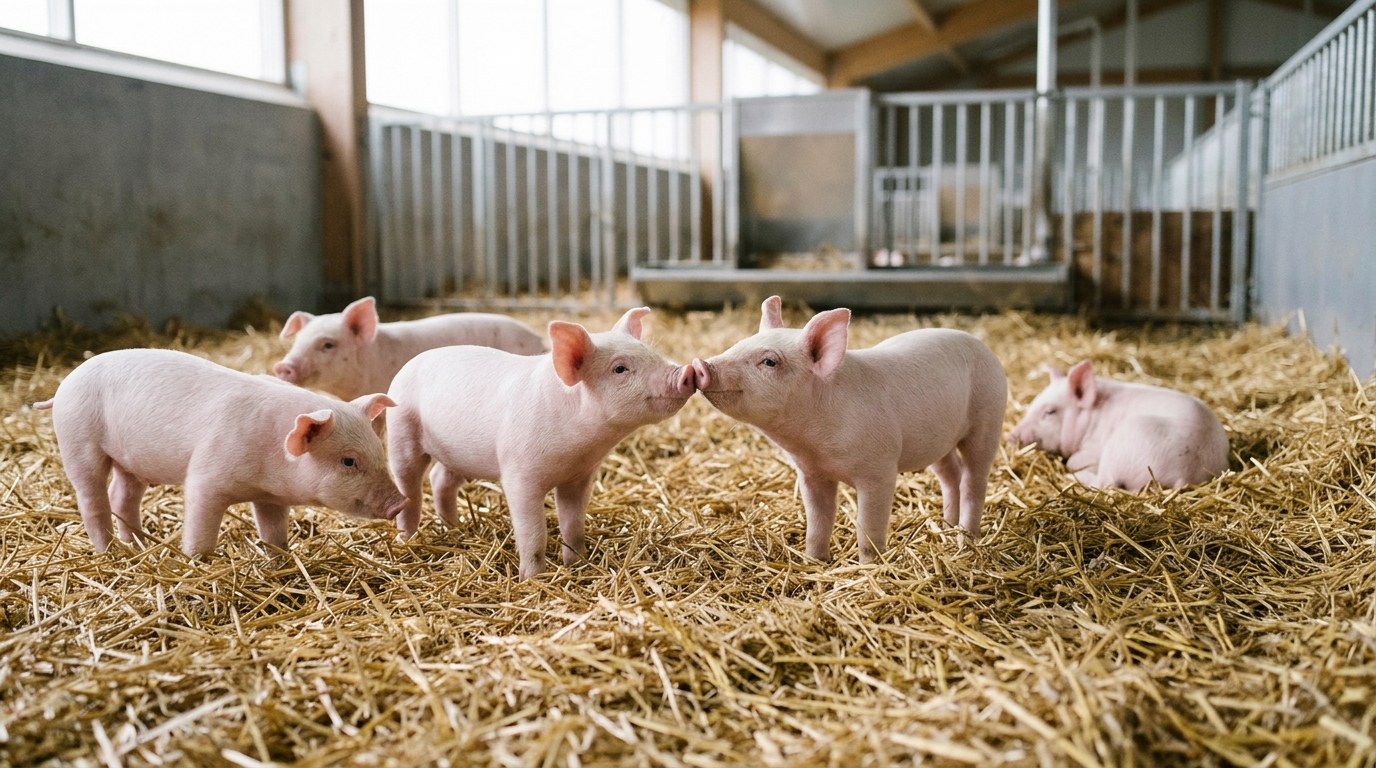
Early life socialisation among piglets improves their long-term social skills and reduces aggressive behaviour up until slaughter, according to a systematic review published in Porcine Health Management. Author Irene Camerlink evaluated the documented outcomes of co-mingling young pigs during their early development, determining that bringing together two to three litters during a biologically relevant developmental window yields lasting behavioural benefits. While previous research has yielded conflicting conclusions regarding whether such management practices enhance agricultural output, the comprehensive evidence demonstrates that early social interaction reliably mitigates aggressive encounters throughout the animals’ lives.
The practice and scientific investigation of early life socialisation, defined as the co-mingling of piglets prior to weaning, has been actively pursued since the late nineties. Although numerous individual investigations have reported that pre-weaning socialisation helps young pigs navigate subsequent regrouping events, published findings have historically remained contradictory, particularly regarding the technique’s effects on production performances and overall growth efficiency.
To resolve these discrepancies, the systematic review established a structured synthesis of the scientific literature following standard PRISMA reporting guidelines. The rigorous screening process resulted in the inclusion of fifty-four peer-reviewed research articles evaluating early life socialisation in pigs. In order to ensure a standardized and reliable comparison among the collected experimental designs and outcome measures, studies examining group lactation systems were deliberately excluded from the review dataset, isolating the specific effects of controlled piglet co-mingling.
A central analytical finding of the review is that published investigations diverge into two distinct functional categories that have previously gone unacknowledged in the literature. One category of studies assesses socialisation primarily as a method to improve welfare by preventing the need for regrouping stress at weaning. A second distinct category seeks to enhance the pigs’ foundational social skills by co-mingling piglets during a biologically relevant window of development, regardless of any future mixing events. Because this methodological divergence significantly influences experimental designs and reported findings, it represents a critical factor for researchers comparing outcomes across the field.
Across the evaluated studies, the timing of socialisation proved essential to achieving consistent behavioural advantages. Co-mingling piglets at a biologically relevant developmental age, identified between ten and sixteen days postnatally, consistently produced positive long-term effects on social interactions. The review concluded that mixing two to three litters during this critical window is expected to improve social competence and reduce fighting through to slaughter. Conversely, the impact of early socialisation on overall growth performance was found to be negligible; although positive growth responses occasionally occur, they do not represent a predictable or guaranteed outcome.
Beyond behaviour and growth, the systematic evaluation examined physiological, internal, and maternal health indicators associated with early co-mingling. Comparisons between socialised piglets and control groups revealed no major differences across cognitive testing, physiological stress measures, immunological parameters, gastrointestinal tract function, or gut microbiota composition. Furthermore, the synthesis determined that sows do not experience adverse long-term consequences when their litters are socialised, although researchers note that ongoing monitoring for potential udder lesions remains an appropriate management precaution.
The review concludes that commercial producers adopting early life socialisation should implement the strategy to advance animal welfare rather than relying on it to boost production yields. By facilitating socialisation between two and three litters at ten to sixteen days of age, producers can foster more cohesive social groups and substantially lower aggression. However, notable knowledge gaps remain regarding practical farm deployment, particularly in adapting socialisation protocols to modern agricultural settings characterized by exceptionally large litter sizes.
Subject of Research: Effects of early life socialisation on pig welfare and performance
Article Title: Early life socialisation in pigs: a systematic review
Article References: Camerlink, I. (2026). Early life socialisation in pigs: a systematic review. Porcine Health Management. https://doi.org/10.1186/s40813-026-00539-9
Image Credits: AI Generated
DOI: 10.1186/s40813-026-00539-9
Keywords: early life socialisation, piglets, co-mingling, pig welfare, systematic review, PRISMA guidelines, social behaviour, aggression reduction, weaning transition, regrouping, growth performance, sow health, udder lesions, microbiota, gastrointestinal tract, immunological parameters, porcine health management, litter size
News Source: Ophelia Keating. (November 17, 2026). Early Piglet Socialisation Reduces Aggression Up Until Slaughter Systematic Review Finds. Scienmag.