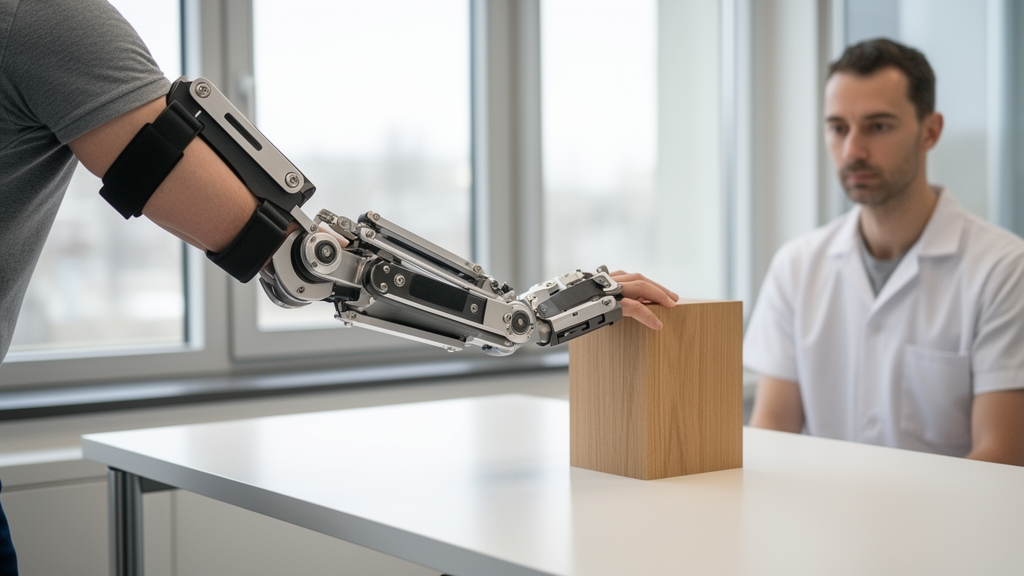
A wearable robotic exoskeleton can objectively quantify upper limb movement qualities in stroke survivors by integrating robotic kinematics with standard clinical motor assessment tasks, according to a study published in the Journal of NeuroEngineering and Rehabilitation. The research evaluated how wearable robotic tracking can provide continuous, high-resolution kinematic metrics that align directly with traditional clinical observations of motor impairment.
Stroke represents a major cause of long-term adult disability, leaving approximately 80 percent of survivors with upper extremity motor impairments. While clinical tools like the Fugl-Meyer Assessment are widely implemented to evaluate recovery, they rely heavily on ordinal scoring scales and subjective human observation. Rehabilitation robots capture detailed kinematic data, but their clinical utility has historically been limited by an absence of standardized testing protocols and difficulty translating robotic measurements into actionable clinical insights.
To establish an objective and clinically interpretable measurement system, researchers evaluated movement performance in ten healthy individuals and ten stroke survivors. Participants wore the HARMONY exoskeleton while completing seven standardized upper extremity movement tasks. The testing sequence comprised six tasks drawn from the upper extremity Fugl-Meyer Assessment alongside one additional elbow movement task.
The investigators developed a trajectory pattern discrepancy score calculated from the root mean square error between individual joint trajectories and normative kinematic averages recorded from healthy participants. This score was evaluated to determine how closely robotic trajectory deviations matched established clinical impairment metrics and whether the measurement demonstrated consistent reproducibility across trials.
Analysis of the kinematic data revealed that the trajectory pattern discrepancy score had a strong negative correlation with clinical Fugl-Meyer Assessment upper extremity scores, reaching an r value of -0.93 with statistical significance at p < 0.01. Furthermore, repeated measurements confirmed high test-retest reliability for the metric, demonstrating an intraclass correlation coefficient of 0.98.
The team also conducted kinematic synergy analysis using non-negative matrix factorization to examine alterations in multi-joint coordination across participants. The number of identified kinematic synergies decreased significantly as motor impairment severity increased, showing a correlation coefficient of r = 0.79 (p < 0.01) between synergy reduction and clinical impairment severity.
Kinematic synergy analysis offered a mechanistic explanation for diminished individual joint control following stroke. Post-stroke movement patterns were characterized by the merging of healthy kinematic patterns into linear combinations, the preservation of certain synergies, or the complete loss of healthy synergies, which manifested clinically as pathological joint coupling and impaired joint isolation.
The authors concluded that combining exoskeleton technology with conventional clinical tasks establishes a standardized assessment framework that bridges the gap between robotic kinematics and clinical interpretability. The framework provides an approach for motor impairment phenotyping that could help guide targeted, personalized rehabilitation protocols for stroke survivors.
By evaluating ten healthy participants alongside ten stroke survivors across seven standardized tasks, the researchers demonstrated that root mean square error calculations between individual joint trajectories and normative averages yield reproducible movement measures. This trajectory discrepancy metric captures kinematic differences without relying on the subjective observation or ordinal scoring typical of conventional clinical tools. The high test-retest reliability confirms that wearable exoskeletons can collect stable, objective movement data during standardized assessment routines.
Simultaneously, applying non-negative matrix factorization to multi-joint coordination reveals structural alterations that occur after stroke. The observed loss or merging of healthy kinematic synergies into linear combinations provides a mechanistic basis for pathological joint coupling and diminished individual joint control. Connecting these kinematic synergies and trajectory deviations directly with impairment severity helps bridge the gap between objective robotic tracking and intuitive clinical interpretation to support personalized rehabilitation.
Subject of Research: Automated robotic quantification of post-stroke upper extremity motor impairment
Article Title: Automated quantification of movement qualities in the human upper extremity after stroke using a wearable robot
Article References: Hong, Y. N. G., Kim, K., Li, S., O’Malley, M. K., Deshpande, A. D., & Roh, J. (2026). Automated quantification of movement qualities in the human upper extremity after stroke using a wearable robot. Journal of NeuroEngineering and Rehabilitation. https://doi.org/10.1186/s12984-026-02191-4
Image Credits: AI Generated
DOI: 10.1186/s12984-026-02191-4
Keywords: stroke rehabilitation, wearable robotics, exoskeleton, HARMONY exoskeleton, upper extremity impairment, Fugl-Meyer Assessment, kinematic synergy, non-negative matrix factorization, joint trajectories, motor recovery, biomechanics, neurorehabilitation, trajectory pattern discrepancy score, pathological joint coupling, clinical assessment, motor control
News Source: Cassandra Pierce. (November 19, 2026). Wearable Exoskeleton Accurately Quantifies Upper Limb Motor Impairment After Stroke. Scienmag.