• HOME
  • NEWS
  • EXPLORE
    • CAREER
      • Companies
      • Jobs
    • EVENTS
    • iGEM
      • News
      • Team
    • PHOTOS
    • VIDEO
    • WIKI
  • BLOG
  • COMMUNITY
    • FACEBOOK
    • INSTAGRAM
    • TWITTER
Thursday, June 25, 2026
BIOENGINEER.ORG
No Result
View All Result
  • Login
  • HOME
  • NEWS
  • EXPLORE
    • CAREER
      • Companies
      • Jobs
        • Lecturer
        • PhD Studentship
        • Postdoc
        • Research Assistant
    • EVENTS
    • iGEM
      • News
      • Team
    • PHOTOS
    • VIDEO
    • WIKI
  • BLOG
  • COMMUNITY
    • FACEBOOK
    • INSTAGRAM
    • TWITTER
  • HOME
  • NEWS
  • EXPLORE
    • CAREER
      • Companies
      • Jobs
        • Lecturer
        • PhD Studentship
        • Postdoc
        • Research Assistant
    • EVENTS
    • iGEM
      • News
      • Team
    • PHOTOS
    • VIDEO
    • WIKI
  • BLOG
  • COMMUNITY
    • FACEBOOK
    • INSTAGRAM
    • TWITTER
No Result
View All Result
Bioengineer.org
No Result
View All Result
Home NEWS Science News Chemistry

Insights into lithium metal battery failure open doors to doubling battery life

Bioengineer by Bioengineer
February 8, 2021
in Chemistry
Reading Time: 2 mins read
0
IMAGE
Share on FacebookShare on TwitterShare on LinkedinShare on RedditShare on Telegram

IMAGE

Credit: XU Gaojie

Lithium metal batteries could double the amount of energy held by lithium-ion batteries, if only their anodes didn’t break down into small pieces when they were used.

Now, researchers led by Prof. CUI Guanglei from the Qingdao Institute of Bioenergy and Bioprocess Technology (QIBEBT) of the Chinese Academy of Sciences (CAS) have identified what causes lithium metal batteries (LMBs) to “self-destruct” and proposed a way to prevent it. The findings were published in Angewandte Chemie on Jan. 19.

This offers hope of radically enhancing the energy held in batteries without any increase in their size, and at reduced cost.

In fact, LMBs were the original concept for long-lasting batteries, but their anodes break down into small pieces – a microstructure known as “pulverization”. The LMBs thus quickly stop working when being cycled through. Lithium-ion batteries were actually a compromise: tweaking the LMB concept prevented the anode failure by using graphite anode, but at a cost of much lower energy storage levels.

One of the problems facing LMB development has been a lack of understanding, and even controversy over, why the anode fails. Conventionally, it is argued that tiny tree-branchlike structures of lithium called dendrites form during cycling of the battery. In addition, the pulverization structure always appears in any failed LMB.

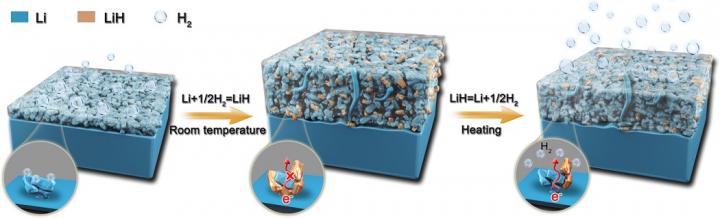
What has been contentious though is whether lithium hydride (LiH) is present in the pulverization structure. LiH has poor electrical conductivity, but it is also very brittle, which would explain the pulverization. In the past, one group of researchers had identified LiH as a distinct type of dendrite, but another group found nothing along these lines.

However, both research groups had only used simplified versions of an LMB. To properly investigate what is going on, the QIBEBT research team ran a practical LMB under typical operating conditions.

Using a type of mass spectrometry (an analytical tool that allows identification of unknown compounds), the researchers were able to confirm that LiH did indeed become the dominant compound on the anode as the battery was being used.

But more importantly, they found that this chemical reaction is temperature sensitive: it only happens at room temperature, and the process can be reversed if the temperature rises above this level.

This suggests ways that the production of LiH can be prevented, either via heat treatment or a pressure treatment producing the same effect, or a combination of the two. Additional options include suppressing the production of hydrogen ions, or the placement of interface materials that can protect the lithium from the hydrogen.

“Coming out of this study, the next step is to produce some form of really good lithium protection,” said CUI Guanglei, lead author and a scientist with QIBEBT, “which should then deliver on the long-held promise of practical applications of the ‘holy grail’ of lithium metal batteries.”

###

Media Contact
CHENG Jing
[email protected]

Original Source

http://english.cas.cn/

Related Journal Article

http://dx.doi.org/10.1002/anie.202013812

Tags: Chemistry/Physics/Materials SciencesEnergy/Fuel (non-petroleum)
Share12Tweet8Share2ShareShareShare2

Related Posts

AI and Physics Collaborate to Design Advanced Hydrogen Storage Materials

June 25, 2026

International Team Including Dresden Scientists Develops Novel Designer Proteins for Advanced Study of Living Tissue

June 25, 2026

New Study Uncovers Key Factors Driving Water Chemistry in Nanoscale Environments

June 25, 2026

Plasma Technology Extends Catalyst Lifespan in Hydrogen Production

June 24, 2026
Please login to join discussion

POPULAR NEWS

  • Saying Goodbye to PGY-6: Pediatric Fellowship Realities

    103 shares
    Share 41 Tweet 26
  • Multi-Hospital Study Reveals Long Covid Burden Is Twice as High as Current Estimates

    92 shares
    Share 36 Tweet 23
  • Detection of EDCs in Breast Milk and Infant Urine Up to Six Months Highlights Early Exposure Risks

    77 shares
    Share 31 Tweet 19
  • New Drug Candidate Developed at McMaster Shows Potential for Treating Brain Cancer

    58 shares
    Share 23 Tweet 15

About

We bring you the latest biotechnology news from best research centers and universities around the world. Check our website.

Follow us

Recent News

Tracking Lanthanide-Labeled Microplastics in Plants

POSTECH Researchers Slash Cost of Reconstituted Cell-Free Systems by 95%

AI and Physics Collaborate to Design Advanced Hydrogen Storage Materials

Subscribe to Blog via Email

Success! An email was just sent to confirm your subscription. Please find the email now and click 'Confirm' to start subscribing.

Join 82 other subscribers
  • Contact Us

Bioengineer.org © Copyright 2023 All Rights Reserved.

Welcome Back!

Login to your account below

Forgotten Password?

Retrieve your password

Please enter your username or email address to reset your password.

Log In
No Result
View All Result
  • Homepages
    • Home Page 1
    • Home Page 2
  • News
  • National
  • Business
  • Health
  • Lifestyle
  • Science

Bioengineer.org © Copyright 2023 All Rights Reserved.