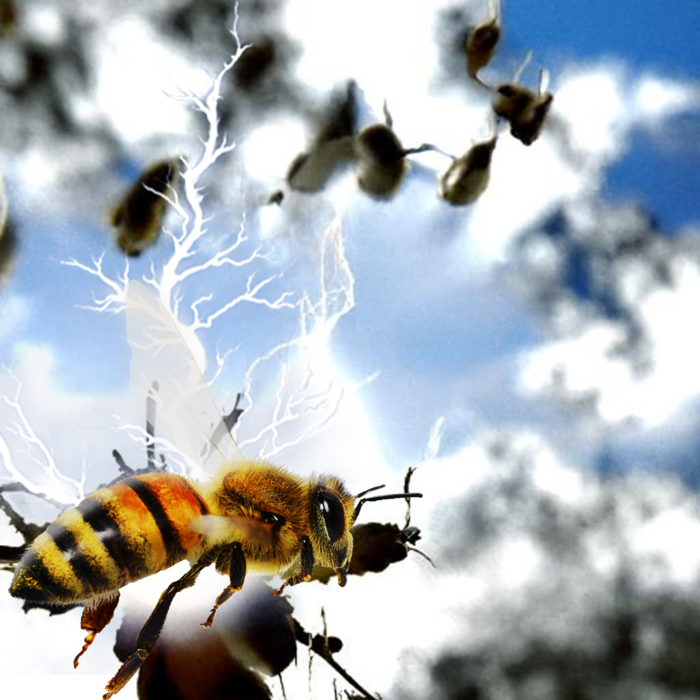
By measuring the electrical fields near swarming honeybees, researchers have discovered that insects can produce as much atmospheric electric charge as a thunderstorm cloud. This type of electricity helps shape weather events, aids insects in finding food, and lifts spiders up in the air to migrate over large distances. The research, appearing on October 24 in the journal iScience, demonstrates that living things can have an impact on atmospheric electricity.
Credit: Ellard Hunting
By measuring the electrical fields near swarming honeybees, researchers have discovered that insects can produce as much atmospheric electric charge as a thunderstorm cloud. This type of electricity helps shape weather events, aids insects in finding food, and lifts spiders up in the air to migrate over large distances. The research, appearing on October 24 in the journal iScience, demonstrates that living things can have an impact on atmospheric electricity.
“We always looked at how physics influenced biology, but at some point, we realized that biology might also be influencing physics,” says first author Ellard Hunting, a biologist at the University of Bristol. “We’re interested in how different organisms use the static electric fields that are virtually everywhere in the environment.”
As with most living creatures, bees carry an innate electric charge. Having found that honeybee hive swarms change the atmospheric electricity by 100 to 1,000 volts per meter, increasing the electric field force normally experienced at ground level, the team developed a model that can predict the influence of other species of insects.
“How insect swarms influence atmospheric electricity depends on their density and size,” says co-author Liam O’Reilly, a biologist at the University of Bristol. “We also calculated the influence of locusts on atmospheric electricity, as locusts swarm on biblical scales, sizing 460 square miles with 80 million locusts in less than a square mile; their influence is likely much greater than honeybees.”
“We only recently discovered that biology and static electric fields are intimately linked and that there are many unsuspected links that can exist over different spatial scales, ranging from microbes in the soil and plant-pollinator interactions to insect swarms and perhaps the global electric circuit,” says Ellard.
“Interdisciplinarity is valuable here—electric charge can seem like it lives solely in physics, but it is important to know how aware the whole natural world is of electricity in the atmosphere,” says co-author Giles Harrison, an atmospheric physicist from the University of Reading.
###
Financial support provided by the Swiss National Science Foundation and the European Research Council.
iScience, Hunting et al., “Observed electric charge of insect swarms and their contribution to atmospheric electricity.” https://www.cell.com/iscience/fulltext/S2589-0042(22)01513-9
iScience (@iScience_CP) is an open-access journal from Cell Press that provides a platform for original research and interdisciplinary thinking in the life, physical, and earth sciences. The primary criterion for publication in iScience is a significant contribution to a relevant field combined with robust results and underlying methodology. Visit: http://www.cell.com/iscience. To receive Cell Press media alerts, contact [email protected].
Journal
iScience
DOI
10.1016/j.isci.2022.105241
Method of Research
Observational study
Subject of Research
Animals
Article Title
Observed electric charge of insect swarms and their contribution to atmospheric electricity
Article Publication Date
24-Oct-2022