• HOME
  • NEWS
  • EXPLORE
    • CAREER
      • Companies
      • Jobs
    • EVENTS
    • iGEM
      • News
      • Team
    • PHOTOS
    • VIDEO
    • WIKI
  • BLOG
  • COMMUNITY
    • FACEBOOK
    • INSTAGRAM
    • TWITTER
Monday, August 31, 2026
BIOENGINEER.ORG
No Result
View All Result
  • Login
  • HOME
  • NEWS
  • EXPLORE
    • CAREER
      • Companies
      • Jobs
        • Lecturer
        • PhD Studentship
        • Postdoc
        • Research Assistant
    • EVENTS
    • iGEM
      • News
      • Team
    • PHOTOS
    • VIDEO
    • WIKI
  • BLOG
  • COMMUNITY
    • FACEBOOK
    • INSTAGRAM
    • TWITTER
  • HOME
  • NEWS
  • EXPLORE
    • CAREER
      • Companies
      • Jobs
        • Lecturer
        • PhD Studentship
        • Postdoc
        • Research Assistant
    • EVENTS
    • iGEM
      • News
      • Team
    • PHOTOS
    • VIDEO
    • WIKI
  • BLOG
  • COMMUNITY
    • FACEBOOK
    • INSTAGRAM
    • TWITTER
No Result
View All Result
Bioengineer.org
No Result
View All Result
Home NEWS Science News Biology

Insect eyes inspire new solar cell design from Stanford

Bioengineer by Bioengineer
August 31, 2017
in Biology
Reading Time: 3 mins read
0
Share on FacebookShare on TwitterShare on LinkedinShare on RedditShare on Telegram
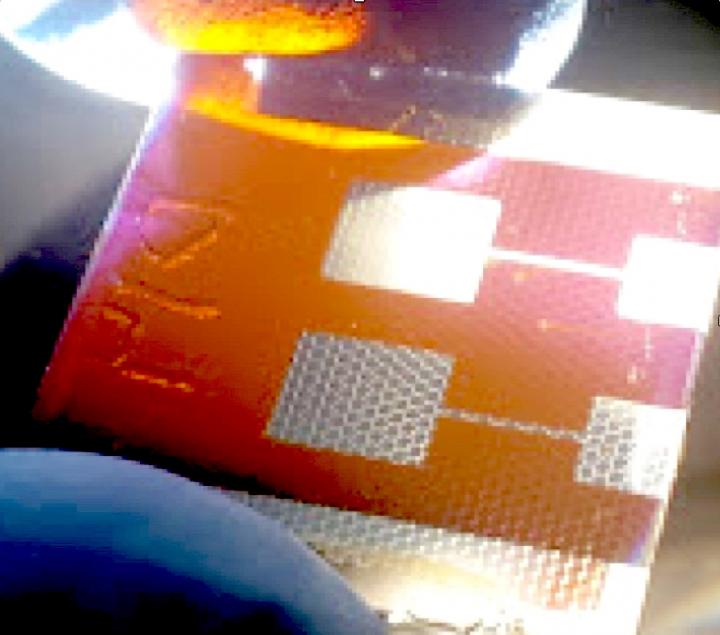
IMAGE

Credit: Dauskardt Lab/Stanford University

Packing tiny solar cells together, like micro-lenses in the compound eye of an insect, could pave the way to a new generation of advanced photovoltaics, say Stanford University scientists.

In a new study, the Stanford team used the insect-inspired design to protect a fragile photovoltaic material called perovskite from deteriorating when exposed to heat, moisture or mechanical stress. The results are published in the journal Energy & Environmental Science (E&ES).

"Perovskites are promising, low-cost materials that convert sunlight to electricity as efficiently as conventional solar cells made of silicon," said Reinhold Dauskardt, a professor of materials science and engineering and senior author of the study. "The problem is that perovskites are extremely unstable and mechanically fragile. They would barely survive the manufacturing process, let alone be durable long-term in the environment."

Most solar devices, like rooftop panels, use a flat, or planar, design. But that approach doesn't work well with perovskite solar cells.

"Perovskites are the most fragile materials ever tested in the history of our lab," said graduate student Nicholas Rolston, a co-lead author of the E&ES study. "This fragility is related to the brittle, salt-like crystal structure of perovskite, which has mechanical properties similar to table salt."

Eye of the fly

To address the durability challenge, the Stanford team turned to nature.

"We were inspired by the compound eye of the fly, which consists of hundreds of tiny segmented eyes," Dauskardt explained. "It has a beautiful honeycomb shape with built-in redundancy: If you lose one segment, hundreds of others will operate. Each segment is very fragile, but it's shielded by a scaffold wall around it."

Using the compound eye as a model, the researchers created a compound solar cell consisting of a vast honeycomb of perovskite microcells, each encapsulated in a hexagon-shaped scaffold just 0.02 inches (500 microns) wide.

"The scaffold is made of an inexpensive epoxy resin widely used in the microelectronics industry," Rolston said. "It's resilient to mechanical stresses and thus far more resistant to fracture."

Tests conducted during the study revealed that the scaffolding had little effect on the perovskite's ability to convert light into electricity.

"We got nearly the same power-conversion efficiencies out of each little perovskite cell that we would get from a planar solar cell," Dauskardt said. "So we achieved a huge increase in fracture resistance with no penalty for efficiency."

Durability

But could the new device withstand the kind of heat and humidity that conventional rooftop solar panels endure?

To find out, the researchers exposed encapsulated perovskite cells to temperatures of 185 degrees Fahrenheit (85 degrees Celsius) and 85 percent relative humidity for six weeks. Despite these extreme conditions, the cells continued to generate electricity at relatively high rates of efficiency.

Dauskardt and his colleagues have filed a provisional patent for the new technology. To improve efficiency, they are studying new ways to scatter light from the scaffold into the perovskite core of each cell.

"We are very excited about these results," he said. "It's a new way of thinking about designing solar cells. These scaffold cells also look really cool, so there are some interesting aesthetic possibilities for real-world applications."

###

The other co-lead authors of the E&ES study are Stanford postdoctoral scholars Brian Watson and Adam Printz.

Media Contact

Mark Shwartz
[email protected]
650-723-9296
@stanford

ZZZ – DO NOT EDIT – News Page

Related Journal Article

http://dx.doi.org/10.1039/C7EE02185B

Share13Tweet8Share2ShareShareShare2

Related Posts

Methylation puts parasites in motion

Methylation puts parasites in motion

August 31, 2026
Desiccation promotes DNA damage and rifampin resistance in Mycobacterium tuberculosis

Desiccation promotes DNA damage and rifampin resistance in Mycobacterium tuberculosis

August 31, 2026

Gastrointestinal Parasitism in Cattle and Water Buffaloes in Pakistan: Prevalence and Associated Risk Factors

August 31, 2026

Development of HPLC–PDA method for steviol glycosides analysis in food matrices

August 31, 2026
Please login to join discussion

POPULAR NEWS

  • β-Sitosterol from Ipomoea carnea Jacq. As a promising anti-inflammatory agent: Evidence from in silico modeling and in vitro validation

    29 shares
    Share 12 Tweet 7
  • Design, fabrication and characterization of a wearable Fiber Bragg grating sensor for cardiorespiratory monitoring using finger plethysmography

    29 shares
    Share 12 Tweet 7
  • KAIST opens the era of industrial-scale microbial foods, proposing growth strategies for the next-generation protein market

    29 shares
    Share 12 Tweet 7
  • Virologist awarded $2 million NIH grant to investigate how virus-infected cells live and die

    29 shares
    Share 12 Tweet 7

About

We bring you the latest biotechnology news from best research centers and universities around the world. Check our website.

Follow us

Recent News

β-Sitosterol from Ipomoea carnea Jacq. As a promising anti-inflammatory agent: Evidence from in silico modeling and in vitro validation

Design, fabrication and characterization of a wearable Fiber Bragg grating sensor for cardiorespiratory monitoring using finger plethysmography

KAIST opens the era of industrial-scale microbial foods, proposing growth strategies for the next-generation protein market

Subscribe to Blog via Email

Enter your email address to subscribe to this blog and receive notifications of new posts by email.

Join 85 other subscribers
  • Contact Us

Bioengineer.org © Copyright 2023 All Rights Reserved.

Welcome Back!

Login to your account below

Forgotten Password?

Retrieve your password

Please enter your username or email address to reset your password.

Log In
No Result
View All Result
  • Homepages
    • Home Page 1
    • Home Page 2
  • News
  • National
  • Business
  • Health
  • Lifestyle
  • Science

Bioengineer.org © Copyright 2023 All Rights Reserved.