Credit: Picture: V. Baranov
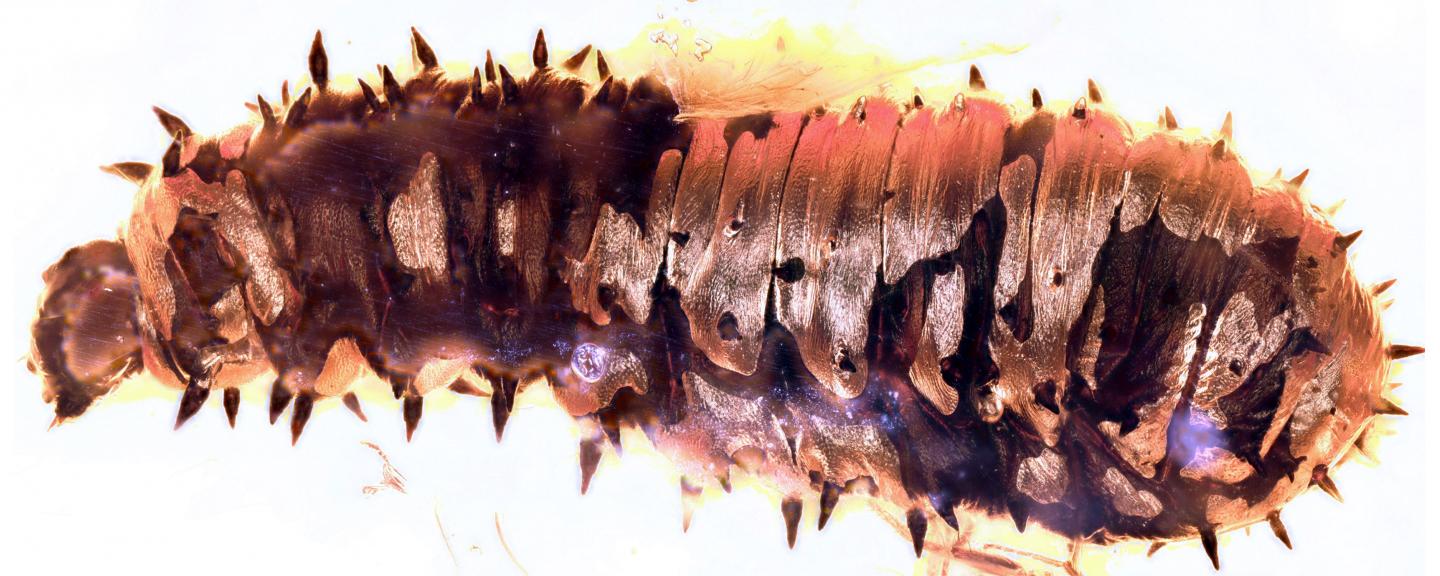
Scientists at Ludwig-Maximilians-Universitaet (LMU) in Munich have shown that the incidence of midge and fly larvae in amber is far higher than previously thought. The new finds shed light on insect evolution and the ecology in the Baltic amber forest during the Eocene epoch.
In the Eocene epoch – between 56 and 33.9 million years ago – much of Northern Europe was covered by a huge forest, now referred to as the Baltic amber forest. The forest was probably dominated by pines and oaks, but also comprised representatives of many other deciduous species and conifers, including tropical taxa. The resins produced by the forest account for all of Europe’s amber, including the samples in which the LMU zoologists Viktor Baranov, Mario Schädel and Joachim T. Haug have now discovered many examples of entrapped midge and fly larvae. In a paper published in the online journal PeerJ, they point out that these finds refute the widespread notion that amber is devoid of such fossils. Their analysis also provides new evidence in relation to the ecology of the amber forests of Eocene age, which supports a new interpretation of this habitat as a warm to temperate seasonal humid forest ecosystem. Flies and midges (Diptera) make up one of the most diverse groups of insects found in Germany. Their larval forms are an important element of many ecosystems and play a significant role in, for example, the decomposition and recycling of biomass. In spite of their ecological prominence, little is known about the evolution of dipteran larvae, and the fossilized specimens that have so far come to light – in particular those characteristic of terrestrial ecosystems – have so far been little studied. The authors of the new study have now identified more than 100 larvae in amber inclusions assembled by collectors in Northern Germany. The samples described come from either the Baltic or the Bitterfeld section of the amber forest. Most of the dipterans identified, belong to the group known as
Bibionomorpha, whose evolutionary history extends over a period of more than 200 million years. With a total of 35 specimens, the group most frequently represented is the genus Mycetobia, which belongs to the Family Anisopodidae (whose members are commonly known as window gnats). Thanks to the abundance of this material, the researchers were able to reconstruct the relative growth rate of these larvae based on the length and width of the head capsule. The results confirmed that these gnats went through four larval stages, just like the present-day representatives of the same group. In addition, their overall morphology is very similar to that of extant window gnats. “Since the morphologies of the other fossil bibionomorphan larvae are also very reminiscent of their recent relatives, we can safely assume that they occupied habitats similar to those of our contemporary forms,” says Baranov, first author of the new paper. The presence of large numbers of Mycetobia larvae among the specimens examined therefore implies that Europe’s amber forests were characterized by moist conditions and an abundance of decaying organic matter. Moreover, the researchers also discovered the first fossilized larva that could be assigned to the Pachyneura (Diptera, Pachyneuridae), and recent are associated with dead wood in undisturbed woodland. “Within the scientific community, a new interpretation of Europe’s amber forests is currently emerging. This is based on paleobotanical and isotope evidence which suggests that these woods constituted a warm-to-temperate seasonal ecosystem. Our findings provide further support for this picture,” Baranov explains. He and his colleagues argue that it is quite conceivable that, under the climatic conditions prevailing in Europe during the Eocene, a subtropical, seasonal forest would have supplied abundant amounts of decaying organic matter in the form of leaf litter and dead plants and animals, as well as bacterial biofilms and fungi. In any case, the dipteran larvae provide an independent source of information that can be used to reconstruct the nature of the paleohabitats. “Perhaps our most surprising find is a larva which we identified as a representative of a previously unknown group,” says Baranov. While this larva belongs among the march flies (Diptera, Bibionidae), it exhibits a very unusual combination of morphological characters which finds no parallel among modern representatives of this group.” In Baranov’s opinion, the specimen may document an experimental phase of their evolution, during which different lineages independently “discovered” similar sets of morphological traits.
###
Media Contact
Dr. Kathrin Bilgeri
[email protected]
0049-892-180-3423
Original Source
https:/
Related Journal Article
http://dx.