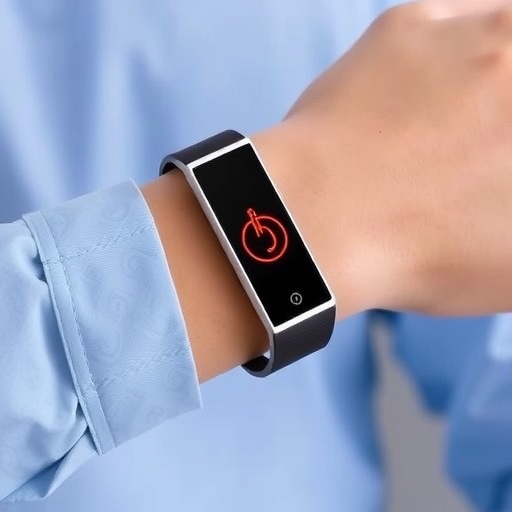
In a groundbreaking study that could revolutionize emergency cardiac care, researchers in the Netherlands have developed a smart wrist-worn device capable of accurately detecting cardiac arrest during medical procedures. This innovative technology harnesses an advanced photoplethysmography algorithm to continuously monitor vital signs unobtrusively, offering promise for real-world applications aimed at improving survival rates for out-of-hospital cardiac arrests.
The study involved 49 adult patients undergoing clinical interventions to correct abnormal heart rhythms, specifically targeting those with life-threatening arrhythmias such as ventricular fibrillation (VF) and pulseless ventricular tachycardia (pVT). These arrhythmias were deliberately induced during treatment to provide a controlled setting for validating the device’s performance. Ventricular fibrillation, characterized by chaotic electrical activity in the heart’s ventricles, is among the most critical and fatal arrhythmias, often leading to sudden cardiac death without immediate intervention.
This DETECT-1b study demonstrated that the smart wristband detected cardiac arrest events with remarkable accuracy—achieving detection rates of 92% across all shockable rhythms, including 100% accuracy for ventricular fibrillation and 90% for pulseless ventricular tachycardia. The device operates by employing photoplethysmography, a light-based measurement technique that detects volumetric changes in blood flow in the microvascular bed of tissue, specifically in the wrist. This approach enables continuous, noninvasive monitoring, distinguishing it from conventional wearable devices primarily designed for fitness tracking or sporadic health monitoring.
One of the pivotal achievements of this research lies in externally validating an algorithm using real patient data under clinical conditions. Previous works predominantly focused on simulations or healthy volunteers, but this study confirms the algorithm’s robustness in detecting critical arrhythmias when blood circulation ceases abruptly. Given that many cardiac arrests occur unwitnessed outside hospital settings, a device that can serve as a “digital witness” and instantly notify emergency responders has enormous potential to transform patient outcomes.
A striking feature of the wristband’s algorithm is its low false-positive rate. Over more than 125 hours of data recording, only nine false alarms were registered—a critical parameter when considering the feasibility of deploying such technology widely. Excessive false positives can overwhelm emergency services and deter user trust, but these findings suggest a balanced sensitivity and specificity profile that could translate into effective real-world alerts.
The implications for healthcare are profound. When cardiac arrest strikes, every second counts. The current standard of care relies heavily on bystanders recognizing arrest symptoms and intervening promptly with cardiopulmonary resuscitation (CPR) or defibrillation. Unfortunately, many arrests go unwitnessed, reducing survival chances dramatically. An automated wristband alert system could bridge this gap, summoning medical teams and trained lay rescuers immediately, thus shortening response times significantly.
Researchers envision integrating this smart technology wristband with emergency dispatch centers and volunteer responder networks. This integration could ensure that alerts reach the nearest responders in real time, facilitating swift deployment of automated external defibrillators (AEDs) and life-saving interventions. Such a networked approach aligns with current trends toward digital health ecosystems, which leverage wearable technology data to enhance clinical decision-making and community health responsiveness.
While the findings are promising, the study acknowledges limitations inherent in its controlled clinical environment. The device’s performance in everyday life, where factors like motion artifacts, variable lighting, and diverse physiological conditions could affect measurements, remains to be rigorously tested. Future research will be necessary to evaluate reliability and usability in ambulatory settings with broader demographics.
Technically sophisticated yet compact, this wristband embodies the convergence of biomedical engineering, data science, and clinical expertise. Its photoplethysmography system utilizes precise photonic sensors to detect arterial pulse waveforms at the wrist, converting optical signals into digital data streams. These data are processed by machine learning algorithms trained to discriminate between normal and pathological cardiac rhythms, enabling the rapid identification of emergent cardiac arrest scenarios.
Moreover, this device forms part of a larger collaborative initiative known as the DETECT project, uniting multiple hospitals and industry partners in the Netherlands. This consortium aims to refine the wrist-worn technology for routine use, creating an ecosystem where wearable sensors seamlessly integrate with healthcare infrastructure, enhancing cardiovascular emergency response capabilities.
Experts outside the study hail these results as a paradigm shift. Dr. Cameron Dezfulian of Baylor College of Medicine notes the significance not only in detection accuracy but also in the algorithm’s impressive false-positive rates, highlighting its potential to surpass previous attempts in the field. However, he also stresses the need for further research, especially addressing cardiac arrest types like pulseless electrical activity, which remain underrepresented in current validation datasets.
If successfully translated from clinical validation to widespread public use, this technology could democratize cardiac arrest detection and response. It holds promise to save countless lives by overcoming the critical temporal barriers that currently limit survival following sudden cardiac arrest, especially outside healthcare facilities.
This study thus represents a watershed moment in digital cardiology, blending cutting-edge sensor technology with artificial intelligence to meet one of the most challenging problems in emergency medicine. As wearable health devices continue to evolve, their role could transform from passive fitness trackers to active, lifesaving monitors equipped with intelligent algorithms capable of autonomous emergency detection and intervention alerting.
Subject of Research:
Automated detection of cardiac arrest utilizing a photoplethysmography algorithm in a smart wrist-worn wearable device during induced shockable cardiac arrest events.
Article Title:
Automated Cardiac Arrest Detection Using Wrist-Worn Photoplethysmography: External Validation in Patients With Induced Shockable Cardiac Arrest (DETECT-1b)
News Publication Date:
19-May-2026
Web References:
American Heart Association – Circulation: Arrhythmia and Electrophysiology
What is Cardiac Arrest? – AHA
Keywords:
Cardiac arrest detection, wearable health technology, photoplethysmography, ventricular fibrillation, pulseless ventricular tachycardia, smart wristband, continuous vital sign monitoring, emergency response, machine learning in healthcare, digital health innovation, cardiovascular emergency, automated external defibrillator integration.