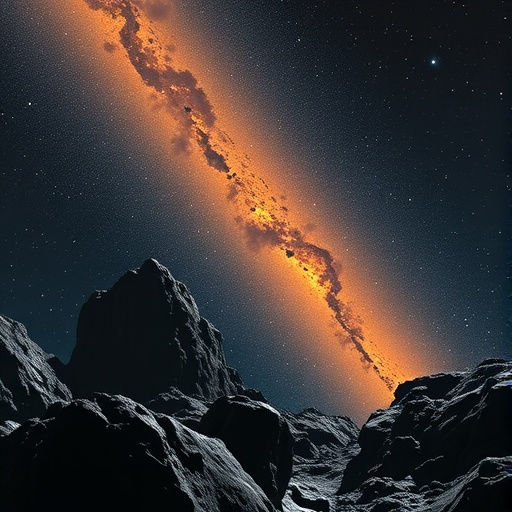
In a revolutionary leap for the field of astrobiology, researchers have unveiled a novel framework designed to detect extraterrestrial life by analyzing emergent patterns across populations of planets, rather than hunting for traditional biosignatures on individual worlds. Spearheaded by Specially Appointed Associate Professors Harrison B. Smith and Lana Sinapayen, affiliated with Japan’s Earth-Life Science Institute (ELSI) and the National Institute for Basic Biology respectively, this innovative approach sidesteps the conventional pitfalls of biosignature ambiguity by leveraging statistical correlations induced by panspermia and terraforming processes.
Astrobiologists have long grappled with the challenge of distinguishing life-produced signals from abiotic planetary phenomena. Conventional methods that depend on detecting specific molecular markers—such as oxygen, methane, or other gases—are frequently complicated by false positives, where non-biological processes mimic or even generate these signatures. While technosignatures, indicative of advanced civilizations, present a promising alternative, their reliance on speculative assumptions about extraterrestrial intelligence’s behavior and technological footprint undermines their robustness. Against this backdrop, Smith and Sinapayen propose a fundamentally different strategy that recognizes life as a collective agent influencing planetary environments over cosmic scales.
The cornerstone of their methodology lies in “agnostic biosignatures,” which do not mandate preconceived knowledge of life’s precise biochemical makeup or functionalities. Instead, the model rests on two broad, yet plausible, premises: life has the capacity to migrate between planetary bodies—a process aligned with the panspermia hypothesis—and that it can exert terraforming effects significant enough to modify observable planetary characteristics. This shift from seeking isolated bio-indicators to studying life’s heterogenous footprint across star systems opens a new avenue to probe the cosmos for living systems.
Smith and Sinapayen employed agent-based computational simulations to explore how biological colonization might propagate across exoplanetary clusters and how life-driven terraforming could correlate planetary features spatially and compositionally. These simulations revealed that life’s expansion induces distinctive statistical regularities in environmental traits among neighboring planets far beyond the expectation of random distributions. Intriguingly, these biosignature patterns manifest at a population level, even when individual planets lack definitive biochemical markers, heralding a paradigm where the signature of life emerges from interplanetary relationships rather than isolated planetary states.
Beyond theoretical detection, the researchers have developed algorithms capable of isolating clusters of exoplanets most likely influenced by biotic activity. By analyzing multidimensional data encompassing planetary observables and spatial proximities, these clustering techniques efficiently pinpoint populations exhibiting statistically significant similarities indicative of shared biological modification. This population-centric model emphasizes reliability, deliberately minimizing false alarms, thereby optimizing the allocation of precious telescope resources for subsequent detailed study.
A central advantage of this framework lies in its agnostic nature: it neither presupposes that alien life mirrors terrestrial biochemistry nor demands the identification of specific molecular evidence. Instead, it harnesses universal behaviors—dispersal and environmental transformation—that life might manifest irrespective of its origin. As Professor Smith elaborates, “We can search for life not by specifying its form or composition but by detecting its capacity to traverse and reshape worlds.” This epistemological pivot addresses crucial uncertainties inherent in extrapolating Earth-based biomarkers to exotic life forms.
The implications for upcoming astronomical surveys are profound. With next-generation observatories poised to catalog myriad exoplanets, the traditional model of fire-and-forget searches for individual biosignatures will likely prove insufficient. Smith and Sinapayen’s approach equips astronomers with statistical tools to holistically analyze planetary ensembles, making it a potent method when biosignatures are faint, equivocal, or confounded by non-biological processes. This population-level analysis could become indispensable for interpreting the deluge of data expected in the near future.
However, the methodology is not without its demands. A rigorous understanding of the baseline diversity of lifeless planets is paramount to discriminating genuine biological patterns from natural planetary heterogeneity. This necessitates comprehensive modeling of planetary formation and evolution free of biotic influence, a task that intersects with planetary science, astrophysics, and geochemistry. Future incorporation of detailed galactic dynamics and astrophysical processes promises to refine the predictive power and applicability of the model.
Despite relying on simulated data, this pioneering work lays a conceptual foundation for a transformative class of life-detection techniques that transcend classical biosignature dependency. By capturing the large-scale ecological footprint of life dispersed throughout planetary systems, the method acknowledges that life’s cosmic imprint might be most conspicuous not on solitary planets but in the statistical echoes reverberating across star clusters.
Dr. Lana Sinapayen emphasizes another critical facet: “Even if extraterrestrial life is biochemically alien, its broad ecological patterns—spreading through panspermia and remodeling environments—may still be legible. Recognizing these universal dynamics is essential to broadening the search for life.” This philosophical openness considerably expands the horizons of astrobiological inquiry.
As the scientific community prepares for a new era defined by vast quantities of exoplanetary data, frameworks like that developed by Smith and Sinapayen signal a promising shift. Life detection may evolve from a narrow search for specific molecules to a sophisticated statistical interrogation of planetary populations that collectively whisper the secrets of biology writ large across the galaxy.
This research heralds a future where astrobiology embraces complexity and uncertainty with new analytical tools, balancing the inherent unknowns of life’s cosmic manifestations. While the road ahead involves embedding this conceptual model within observational realities, the promise it holds for unveiling alien biospheres is both profound and exhilarating.
Subject of Research: Not applicable
Article Title: An Agnostic Biosignature Based on Modeling Panspermia and Terraforming
News Publication Date: 9-Apr-2026
Web References: http://dx.doi.org/10.3847/1538-4357/ae4ee3
References: Harrison B. Smith and Lana Sinapayen, An Agnostic Biosignature Based on Modeling Panspermia and Terraforming, The Astrophysical Journal, DOI: 10.3847/1538-4357/ae4ee3
Image Credits: Harrison B. Smith
Keywords: Astrobiology, Evolutionary methods, Modeling, Exoplanetary science, Planetary astronomy, Planetary systems, Planets, Space probes
Tags: agnostic biosignatures in astrobiologyastrobiology without molecular markerschallenges in traditional biosignature identificationcollective planetary life influencedetecting life beyond Earth without assumptionsEarth-Life Science Institute researchemergent patterns in planetary systemsextraterrestrial life detection methodsfalse positives in life detectioninnovative astrobiology frameworkspanspermia and terraforming effectsstatistical analysis of planetary populations