• HOME
  • NEWS
  • EXPLORE
    • CAREER
      • Companies
      • Jobs
    • EVENTS
    • iGEM
      • News
      • Team
    • PHOTOS
    • VIDEO
    • WIKI
  • BLOG
  • COMMUNITY
    • FACEBOOK
    • INSTAGRAM
    • TWITTER
Sunday, May 10, 2026
BIOENGINEER.ORG
No Result
View All Result
  • Login
  • HOME
  • NEWS
  • EXPLORE
    • CAREER
      • Companies
      • Jobs
        • Lecturer
        • PhD Studentship
        • Postdoc
        • Research Assistant
    • EVENTS
    • iGEM
      • News
      • Team
    • PHOTOS
    • VIDEO
    • WIKI
  • BLOG
  • COMMUNITY
    • FACEBOOK
    • INSTAGRAM
    • TWITTER
  • HOME
  • NEWS
  • EXPLORE
    • CAREER
      • Companies
      • Jobs
        • Lecturer
        • PhD Studentship
        • Postdoc
        • Research Assistant
    • EVENTS
    • iGEM
      • News
      • Team
    • PHOTOS
    • VIDEO
    • WIKI
  • BLOG
  • COMMUNITY
    • FACEBOOK
    • INSTAGRAM
    • TWITTER
No Result
View All Result
Bioengineer.org
No Result
View All Result
Home NEWS Science News Chemistry

Innovative mechanobiology research expands understanding of cells

Bioengineer by Bioengineer
May 9, 2019
in Chemistry
Reading Time: 3 mins read
0
IMAGE
Share on FacebookShare on TwitterShare on LinkedinShare on RedditShare on Telegram

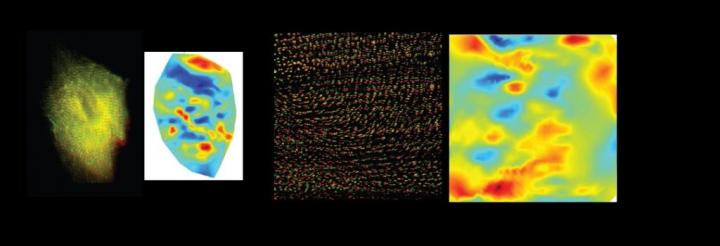
New technology allows researchers to probe cell changes without disturbing the cell’s physiology
IMAGE

Credit: Cell Reports

Researchers have developed a new technology that allows them to probe cell changes without disturbing the cell’s physiology – a major advancement that helps scientists look more closely at cell changes to solve human health problems, according to a new paper in Cell Reports.

This technology, known as deformation microscopy, allows scientists to more accurately assess the interplay between biological systems and the mechanical environment in treating musculoskeletal, cardiac and neural diseases.

Colorado State University Professor Soham Ghosh served as the first author on the paper, along with several researchers from University of Colorado Boulder.

Advancements in regenerative medicine and developmental-biology-inspired technology have the potential to target major human health obstacles. With the team’s discovery, scientists can get a clearer understanding of how the physical changes in cells contribute to cell development – an area of study known as mechanobiology.

Before joining CSU in fall 2018, Ghosh and his colleagues at CU Boulder developed the technology to non-invasively probe the mechanics of the biological system in high resolution using an image-based formula. The results were remarkable, unhindered images of the cell, and inside the cell nucleus, exposing the missing link between biological systems and the mechanical environment. By viewing and analyzing the cell and nucleus at high magnification, all the intricate structural architectures became visible. This helped researchers understand spatially detailed and dynamic cell deformation, which subsequently revealed how the subcellular and subnuclear regions behave in a normal physiological setting vs. a diseased setting.

Mechanical probing in biology has been prevalent for almost two decades. Previous technologies were invasive, disturbing the physiology of the cell. Deformation microscopy produces a high-precision, microscopic image-based strain map which can quantify the affliction a cell and nucleus can sustain, revolutionizing what was previously known about mechanobiology.

The paper was written by Ghosh, CU Professor Corey P. Neu, CU graduate student Benjamin Seelbinder and other contributors. “This technology can drive the field of mechanobiology at an unprecedented rate,” Ghosh said. “The technique has proven powerful in several applications and is opening new avenues of research.”

Ghosh will leverage a variation of deformation microscopy and other methods to quantify biological phenomena in cells in his Cellular Engineering and Mechanobiology Lab, to investigate questions surrounding single cell changes in relation to stem cell function. Researchers can investigate, for example, why our individual tissues are functionally different despite having the same genetic code. His lab will study the interaction between the cell’s immediate environment, epigenetics, and chromatin architectural organization of the cell nucleus.

“Deformation microscopy will take the research in my lab to new heights, and I look forward to discoveries that will soon unfold due to this groundbreaking advancement,” added Ghosh.

###

Link to paper: https://col.st/KjmGp

Media Contact
Anne Manning
[email protected]

Original Source

https://engr.source.colostate.edu/innovative-mechanobiology-research-expands-understanding-of-cells/

Related Journal Article

http://dx.doi.org/10.1016/j.celrep.2019.04.009

Tags: Biomedical/Environmental/Chemical EngineeringCell BiologyMechanical EngineeringMicrobiologyMolecular BiologyOpticsTechnology/Engineering/Computer Science
Share12Tweet8Share2ShareShareShare2

Related Posts

Miniature Sensor Uses Light to Detect Touch — Chemistry

Miniature Sensor Uses Light to Detect Touch

May 8, 2026
Iron Minerals Determine Whether Dissolved Organic Matter Fuels Microbes or Becomes Long-Term Carbon Storage — Chemistry

Iron Minerals Determine Whether Dissolved Organic Matter Fuels Microbes or Becomes Long-Term Carbon Storage

May 8, 2026

Kate Evans Appointed Associate Lab Director for Biological and Environmental Systems Science at ORNL

May 8, 2026

Advancing Multiscale Modeling and Overcoming Operational Challenges in Autothermal COâ‚‚-to-Methanol Reactors

May 8, 2026
Please login to join discussion

POPULAR NEWS

  • Research Indicates Potential Connection Between Prenatal Medication Exposure and Elevated Autism Risk

    840 shares
    Share 336 Tweet 210
  • New Study Reveals Plants Can Detect the Sound of Rain

    727 shares
    Share 290 Tweet 181
  • Scientists Investigate Possible Connection Between COVID-19 and Increased Lung Cancer Risk

    68 shares
    Share 27 Tweet 17
  • Salmonella Haem Blocks Macrophages, Boosts Infection

    61 shares
    Share 24 Tweet 15

About

We bring you the latest biotechnology news from best research centers and universities around the world. Check our website.

Follow us

Recent News

Evaluating Digoxin Use in Patients with Symptomatic Rheumatic Heart Disease

Evaluating the Effectiveness and Safety of Digitalis Glycosides in Treating Heart Failure

Urdu Fall Risk Questionnaire Adapted for Elderly

Subscribe to Blog via Email

Success! An email was just sent to confirm your subscription. Please find the email now and click 'Confirm' to start subscribing.

Join 82 other subscribers
  • Contact Us

Bioengineer.org © Copyright 2023 All Rights Reserved.

Welcome Back!

Login to your account below

Forgotten Password?

Retrieve your password

Please enter your username or email address to reset your password.

Log In
No Result
View All Result
  • Homepages
    • Home Page 1
    • Home Page 2
  • News
  • National
  • Business
  • Health
  • Lifestyle
  • Science

Bioengineer.org © Copyright 2023 All Rights Reserved.