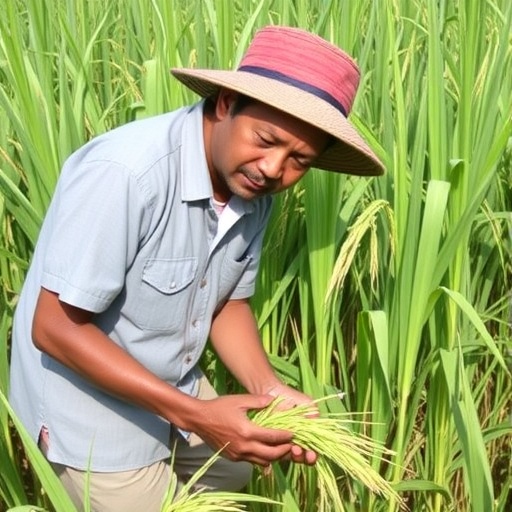
Rice, a staple food for more than half of the global population, faces increasing pressure due to rising demographics and shrinking arable land. Ensuring food security hinges on improving rice yields sustainably and efficiently. Hybrid rice technology has been pivotal in this pursuit, combining advantageous traits from two parental lines to produce offspring with superior growth, yield, and stress tolerance. However, the seed production process for hybrid rice remains laborious and costly, largely because it requires manual flag leaf cutting to facilitate pollination, a practice that damages the panicle and escalates labor demands.
A groundbreaking study published recently in the Journal of Integrative Agriculture introduces an innovative, labor-saving alternative that could revolutionize hybrid rice seed production. Researchers at the Rice Research Institute of the Anhui Academy of Agricultural Sciences, working in conjunction with the Key Laboratory of Rice Germplasm Innovation and Molecular Improvement, engineered a novel strain utilizing a mutant known as ym66. This mutant, born from radiation-mutagenized indica rice 93-11, exhibits distinctive phenotypic traits that overcome the need for manual leaf cutting, effectively saving labor while maintaining seed yield quality.
The ym66 mutant is characterized by its drastically reduced flag leaf size—about an 80% decrease in length and an 85% narrowing compared to conventional flag leaves. Additionally, these leaves display increased rigidity, fewer vascular veins, compressed vascular bundles, and programmed cell death at the cellular level. These anatomical changes, coupled with altered internode structure and smaller panicles, present a compact plant architecture suitable for streamlined seed production.
To uncover the genetic basis of this remarkable phenotype, the researchers employed genetic mapping and sequencing techniques, pinpointing a critical 6-base pair insertion mutation within the first exon of the OsGATA15 gene. Functional validation was achieved through CRISPR-Cas9 mediated knockout experiments, wherein suppression of OsGATA15 recapitulated the small flag leaf phenotype. Moreover, overexpression of OsGATA15 restored normal leaf morphology, confirming this gene as the causal determinant of the ym66 phenotype.
Leveraging the ym66 mutant, the team developed a restorer line named NP27, which inherits the short, narrow flag leaf traits and presents an optimized compact plant type. Beyond the altered morphology, NP27 exhibits enhanced agronomic characteristics such as increased grain weight, thicker stems, and sufficient pollen viability. This combination ensures robust hybrid seed production without compromising plant health or reproductive performance.
Through rigorous seed production assays involving sterile lines 1892s and 20y394, the NP27 restorer line demonstrated yields on par with traditional manual flag leaf cutting methods. Importantly, the tests confirmed that NP27’s unique flag leaf morphology facilitates effective pollination and hybrid seed formation without the need for labor-intensive leaf cutting. This breakthrough reduces operational costs by approximately 150 to 180 Chinese Yuan per mu, presenting a highly attractive economic incentive.
Furthermore, subsequent F₁ hybrids generated from NP27-based crosses revealed improved plant architecture and grain quality. This indicates not only labor and cost savings but also potential downstream benefits in hybrid rice cultivation, posing widespread implications for addressing food security challenges in rice-growing regions worldwide.
Senior author Dahu Ni highlighted the transformative potential of the ym66 mutant line, stating that NP27’s “leaf-cutting-free” approach modernizes hybrid rice seed production, dramatically cutting labor inputs and minimizing physical damage to plants—factors that historically limited expansion and efficiency.
This discovery embodies a strategic incorporation of mutation breeding, molecular biology, and classical genetics to solve a practical agricultural problem. By unraveling the function of OsGATA15 and its role in leaf development, the research not only propels hybrid rice production forward but also enriches the fundamental understanding of rice plant morphology regulation.
The study also addresses broader sustainability goals by reducing manual labor, which often involves strenuous daily tasks in rural farming communities. Automation or simplification of these processes empowers farmers, particularly in developing countries, to boost productivity without proportionally increasing labor costs or overexertion.
In conclusion, the novel deployment of the ym66 mutant and restorer line NP27 represents a leap forward in hybrid rice seed production technology. It combines genetic precision, agronomic efficiency, and cost-effectiveness to deliver a solution that promises to enhance global food security frameworks and meet the needs of growing populations using fewer resources. Future research into expanding this genetic strategy to other rice varieties could further amplify the impact of these findings.
Subject of Research: Not applicable
Article Title: A novel labor-saving strategy for hybrid rice seed production
Web References:
http://dx.doi.org/10.1016/j.jia.2026.03.019
Image Credits: Dahu Ni, Fengshun Song, et al.
Keywords: Agriculture, Economics, Plant sciences
Tags: Anhui Academy agricultural researchfood security through hybrid ricehybrid rice seed production innovationlabor-saving techniques in agricultureradiation-mutagenized indica ricereducing manual labor in seed productionrice breeding technology advancementsrice flag leaf modificationrice germplasm molecular improvementstress tolerance in hybrid ricesustainable rice yield improvementym66 mutant rice strain