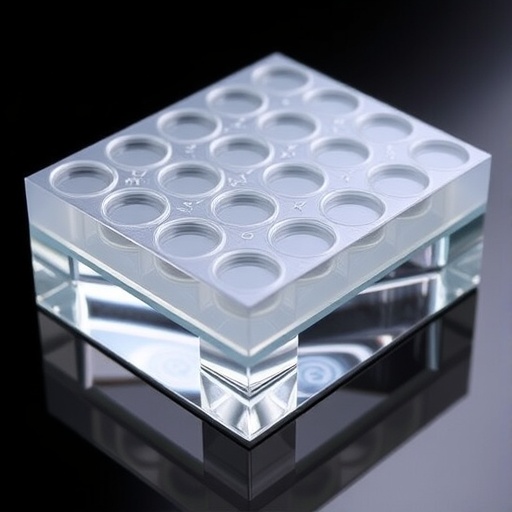
In the ongoing battle against environmental pollution, the challenge of efficiently separating oil from water remains one of the most urgent scientific and industrial frontiers. Traditional methods for treating oily wastewater and mitigating oil spills frequently suffer from problems such as membrane fouling, clogging, and declining performance over time, particularly when faced with complex mixtures containing various oil densities and microscopic droplets. Now, a breakthrough technology developed by a team of engineers and material scientists promises to herald a new era in selective oil-water separation through an innovative organic hydrogel surface capable of dynamic and highly efficient separation at unprecedented speeds.
At the heart of this development lies a meticulously engineered organic hydrogel coating embedded with laser-etched micro- and nanoscale structures. This “smart” surface is unlike any conventional membrane filter. It possesses the extraordinary ability to instantly detect the nature of fluids it contacts—distinguishing between oil and water—and respond by fundamentally altering its wettability properties accordingly. Such on-demand switching behavior ensures that only the desired phase, whether water or oil, permeates the surface while the other is effectively blocked.
When the surface encounters water, it shifts into a superhydrophilic state, exhibiting an intense affinity for water molecules. Simultaneously, underwater it becomes superoleophobic, robustly repelling oil droplets. This combination allows water to pass through rapidly while preventing oil infiltration. Conversely, when submerged in oil, the surface undergoes a remarkable inversion, becoming superoleophilic and underoil superhydrophobic. In this mode, oil permeates effortlessly whereas water is repelled and retained. This dynamic wettability transition is a direct outcome of the dual-component organic hydrogel material and its hierarchical micro-nano topography, which together facilitate rapid and reversible switching.
.adsslot_KChfLT74yt{width:728px !important;height:90px !important;}
@media(max-width:1199px){ .adsslot_KChfLT74yt{width:468px !important;height:60px !important;}
}
@media(max-width:767px){ .adsslot_KChfLT74yt{width:320px !important;height:50px !important;}
}
ADVERTISEMENT
One of the most impressive aspects of this technology is its staggering separation flux. Demonstrated values reach as high as 17,750 liters per square meter per hour, a throughput rate three to five times greater than existing membranes. Importantly, this exceptional flux does not come at the expense of separation efficiency. The hydrogel surface repeatedly achieves separation efficiencies exceeding 99.8%, maintaining performance even after continuous operation without cleaning. Such durability signals a fundamental advance in antifouling capability, addressing one of the most persistent operational obstacles encountered in wastewater treatment systems.
This advanced antifouling property stems from the unique surface chemistry and microstructure of the hydrogel, which effectively prevents the adhesion and accumulation of oil contaminants that typically cause membrane clogging. The result is a prolonged operational life and reduced need for maintenance or chemical cleaning, fundamentally lowering operational costs and environmental impacts. This characteristic is especially vital when dealing with industrial effluents or environmental cleanup tasks where downtime and chemical usage must be minimized.
Existing “smart” separation membranes often struggle with slow or weak responsiveness, limiting their practical utility—particularly in fluctuating environmental conditions or mixed-composition wastewater. By contrast, this hydrogel surface’s instantaneous wettability transformation equips it to handle complex oil-water mixtures containing diverse oils, from volatile light hydrocarbons to viscous heavy crudes. The material’s adaptability anticipates real-world industrial scenarios, where varied pollutants coexist and dynamic responses are essential.
The fabrication of this highly sophisticated material integrates precision laser micro-nano manufacturing with controlled hydrogel chemistry. Laser etching creates a surface replete with hierarchical structures, amplifying wettability effects and increasing surface area, which enhances separation performance. The dual-component hydrogel coating is engineered to chemically modify surface energy interactively with the surrounding fluid environment. Together, these features afford the hydrogel its intelligent selective permeability and remarkable mechanical robustness.
Beyond laboratory-scale demonstrations, the research team envisions significant industrial-scale applications. Factories treating oily wastewater onsite could employ these surfaces to streamline effluent management, potentially reducing reliance on bulky, energy-intensive treatment plants. Moreover, emergency response teams confronting oil spills in aquatic environments might deploy membranes based on this technology to quickly and effectively recover spilled oil, mitigating ecological damage.
Further development work is underway to broaden the operational range of these hydrogel surfaces. Researchers aim to tailor materials for resistance to extreme pH conditions, a critical factor when treating industrial wastewaters with highly acidic or alkaline properties. Additionally, efforts to enhance performance in handling stubborn emulsions—which are notoriously challenging to break—signal the versatility of this platform for a variety of industrial effluent compositions.
Perhaps most exciting is the prospect of scalable manufacturing. The use of laser micro-nano fabrication techniques potentially allows for continuous large-area production of these membranes, reducing costs and facilitating widespread adoption. This scalability, coupled with the outstanding antifouling and flux characteristics, outlines a compelling commercial pathway, transforming how industries approach wastewater treatment and pollution control.
This breakthrough also emphasizes the growing role of material intelligence in environmental engineering. By embedding sensory and adaptive features directly into separation membranes, the boundary between passive filtering and active molecular recognition blurs. The result is a new generation of materials that think and act autonomously, fine-tuning their properties in real time to optimize functionality.
In summary, the development of this pre-identified organic hydrogel surface represents a transformative advance in oil-water separation technology. Its ultrahigh flux, near-perfect separation efficiency, rapid and reversible wettability switching, and outstanding antifouling resistance address long-standing challenges that have hindered conventional filtration methods. As the research progresses toward real-world deployment, it holds the promise not only to improve industrial wastewater management but also to revolutionize environmental remediation strategies, accelerating the global fight against pollution with a smart, sustainable solution.
Subject of Research: Development of an organic hydrogel surface with dynamic wettability for selective and efficient oil-water separation.
Article Title: Micro-nano manufacturing of a pre-identified organic hydrogel surface for selective oil/water separation with ultra-high flux
News Publication Date: 22-Jul-2025
Web References:
http://dx.doi.org/10.1088/2631-7990/ade9fe
Image Credits: By Yun-yun Song, Jiang-shen Lu, Yang Zhang, Zhao-peng Yu, Yan Liu and Zhong-qiang Zhang
Keywords
Oil-water separation, organic hydrogel, superhydrophilic, superoleophobic, wettability switching, antifouling membrane, micro-nano structure, wastewater treatment, industrial effluents, membrane flux, oil spill remediation, laser micro-nano manufacturing
Tags: advanced hydrogel coatings for wastewater treatmentbreakthroughs in oil recovery techniquesdynamic wettability in separation technologyefficient oil-water separation methodsengineered surfaces for oil spill remediationhydrogel technology for oil-water separationinnovative materials for environmental pollutionovercoming membrane fouling in oil separationrapid oil-water separation solutionsresponsive materials in environmental engineeringsmart surfaces for fluid detectionsustainable technologies for industrial wastewater