Credit: by Andrea Fratalocchi
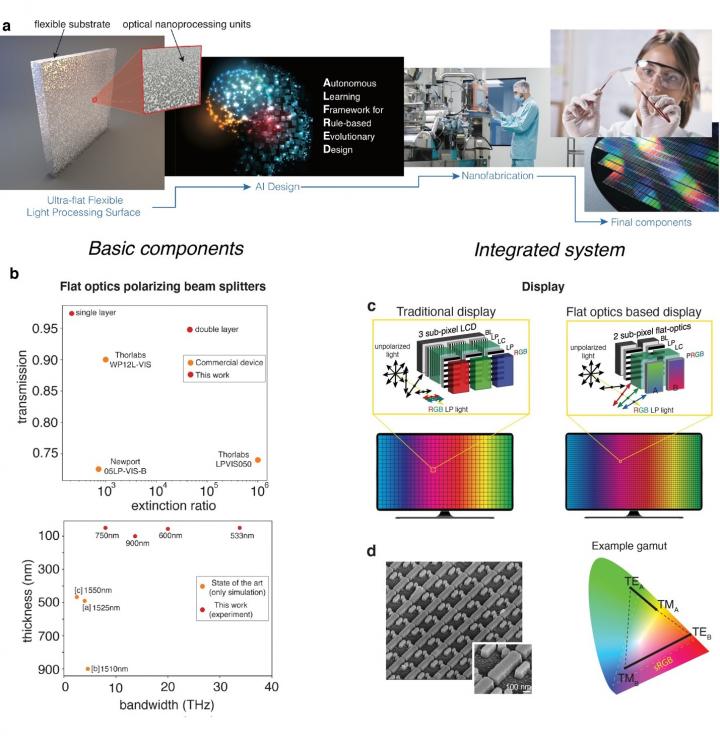
In a new paper published in Light Science & Application, the group led by Professor Andrea Fratalocchi from Primalight Laboratory of the Computer, Electrical and Mathematical Sciences and Engineering (CEMSE) Division, King Abdullah University of Science and Technology (KAUST), Saudi Arabia, introduced a new patented, scalable flat-optics technology manufactured with inexpensive semiconductors.
The KAUST-designed technology leverages on a previously unrecognized aspect of optical nanoresonators, which are demonstrated to possess a physical layer that is completely equivalent to a feed-forward deep neural network.
“What we have achieved,” explains Fratalocchi, “is a technological process to cover flat surfaces, which in optical jargon are called flat optics, with “physical” neural units that are able to process light as a neural network does with an electrical signal”
These innovative flat optics achieve near unity efficiencies (up to 99%) in the visible range in ultrathin surfaces, which provides broadband and vectorial light control in both transmission and reflection with the desired wavefront shape. Moreover, the silicon nanoshape surface is ultrathin (60 nanometers thick, 1 nm=1/1000000 of 1mm) and can be customized on flexible surfaces.
The program used to design the nanosurface runs on KAUST’s Shaheen-II supercomputer, a Cray XC40 delivering over 7.2 Pflop/s of theoretical peak performance, and is carried out with the Autonomous Learning Framework for Rule-based Evolutionary Design software developed by Fratalocchi and his team.
“We have developed a program that uses artificial intelligence to design the nanoresonators. The algorithm works using evolutionary techniques: in simple terms, the algorithm is able to train itself and improves its results after every cycle to produce surfaces of increasing efficiency every time that it is run. In our article, we showed experimental components with better performance than the current state of the art in flat-optics or from commercial devices available from leading companies, such as Thorlabs and Newport.”
The KAUST research team is currently planning to use flat optics to develop new flat devices that could revolutionize older technologies based on bulk optics. Among the innovations, Fratalocchi and his team are building a human-eye camera, a bio-sensor able to “read” cells infected with malaria and new types of displays.
“There are really endless applications,” explains Fratalocchi, “because almost all existing measurement systems, in principle, could be substituted by their cost-effective, compact flat-optics versions. We are developing a statistical learning approach that, for any given measurement task, designs a correspondent flat-surface that “encodes” the measure into a single optical image, or logogram. With this approach, the entire field of sensing and metrology could become natural language processing based on nonlinear logograms.”
“One of our current projects is a flat camera that can see even better than the human eye, which is limited by using only three primary receptors for color vision. We can also miniaturize any component, no matter how bulky,” adds Fratalocchi. “The key concept here is that a neural network is a universal approximator that can learn any function. For this reason, we can train our flat optics to perform any task, or a sequence of tasks currently performed by electronic systems, just in less space and at the speed of light.”
“With proper funding and resources,” concludes Fratalocchi, “in five to 10 year’s time, most of today’s bulky technology will have shrunk to pocket size, with a similar revolution that electronics experienced at the end of the last century.”
###
Media Contact
Andrea Fratalocchi
[email protected]
Related Journal Article
http://dx.