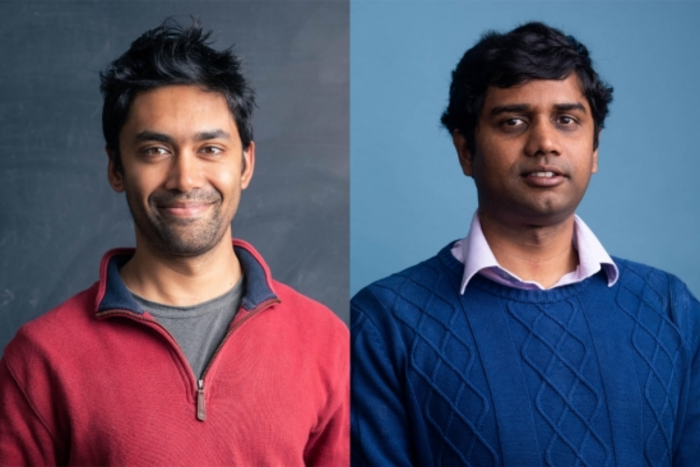
(Santa Barbara, Calif.) — UC Santa Barbara assistant professors Sagar Vijay and Tejaswi Nerella have been selected to receive prestigious research fellowships from the Alfred P. Sloan Foundation. Vijay and Nerella, both in the UC Santa Barbara Department of Physics, are among 126 early-career researchers from 54 institutions across the country to receive the award. The two-year, $75,000 fellowships are given annually in recognition of distinguished performance and unique potential to make substantial contributions to their field.
“I congratulate Sagar Vijay and Tejaswi Nerella on this exceptional honor,” said Pierre Wiltzius, UCSB’s Susan and Bruce Worster Dean of Science. “With these fellowships, they join a rarefied group of talented young scholars whose research shows great potential. Sloan Fellowships are among the most competitive awards given to early career researchers, and I look forward to the future discoveries these awards will support.”
Disentangling Entanglement
“I am honored to have been selected for a Sloan Research Fellowship,” Vijay said. “I am excited to use this award to advance our fundamental understanding of quantum entanglement and its macroscopic manifestations in both ordinary matter and programmable quantum devices.”
A theorist in the realm of condensed matter physics, Vijay is interested in the interactions of collections of atoms — interactions that can produce fascinating phenomena and states of matter. One of the most peculiar of these behaviors is entanglement, a fundamentally quantum mechanical event in which the measurements of two or more particles correlate and remain connected even at long distances.
“I try to understand the unique properties of matter resulting from quantum entanglement, and how the components inherent to experiments using programmable quantum devices can foster the emergence of quantum collective phenomena,” Vijay said
There are a variety of interesting collective behaviors that manifest, he said. One that captures his interest is a phenomenon in which particles, which are typically in constant motion, are rendered motionless — a counterintuitive situation in quantum physics.
“This immobility is a signature of an interesting pattern of many-body entanglement in this system,” Vijay said.
Another entanglement scenario he’s interested in is in matter that’s pushed far from equilibrium. This equilibrium typically happens in matter at its lowest energy state.
“Our common understanding of quantum mechanics is that it really presents itself at low temperatures,” he said. Indeed, ultracold temperatures strip away the energy (in the form of heat) that leads to classical motion and behaviors, leaving only quantum effects.
“But matter driven far away from equilibrium can show striking signatures of quantum mechanics, which arise in unconventional correlations,” Vijay said. “Understanding the organizing principles that explain quantum phenomena in this new regime, using tools from physics and quantum information theory, forms a key aim of my research.”
The Call of the ‘Standard Siren’
Credit: Photo Credit: MATT PERKO
(Santa Barbara, Calif.) — UC Santa Barbara assistant professors Sagar Vijay and Tejaswi Nerella have been selected to receive prestigious research fellowships from the Alfred P. Sloan Foundation. Vijay and Nerella, both in the UC Santa Barbara Department of Physics, are among 126 early-career researchers from 54 institutions across the country to receive the award. The two-year, $75,000 fellowships are given annually in recognition of distinguished performance and unique potential to make substantial contributions to their field.
“I congratulate Sagar Vijay and Tejaswi Nerella on this exceptional honor,” said Pierre Wiltzius, UCSB’s Susan and Bruce Worster Dean of Science. “With these fellowships, they join a rarefied group of talented young scholars whose research shows great potential. Sloan Fellowships are among the most competitive awards given to early career researchers, and I look forward to the future discoveries these awards will support.”
Disentangling Entanglement
“I am honored to have been selected for a Sloan Research Fellowship,” Vijay said. “I am excited to use this award to advance our fundamental understanding of quantum entanglement and its macroscopic manifestations in both ordinary matter and programmable quantum devices.”
A theorist in the realm of condensed matter physics, Vijay is interested in the interactions of collections of atoms — interactions that can produce fascinating phenomena and states of matter. One of the most peculiar of these behaviors is entanglement, a fundamentally quantum mechanical event in which the measurements of two or more particles correlate and remain connected even at long distances.
“I try to understand the unique properties of matter resulting from quantum entanglement, and how the components inherent to experiments using programmable quantum devices can foster the emergence of quantum collective phenomena,” Vijay said
There are a variety of interesting collective behaviors that manifest, he said. One that captures his interest is a phenomenon in which particles, which are typically in constant motion, are rendered motionless — a counterintuitive situation in quantum physics.
“This immobility is a signature of an interesting pattern of many-body entanglement in this system,” Vijay said.
Another entanglement scenario he’s interested in is in matter that’s pushed far from equilibrium. This equilibrium typically happens in matter at its lowest energy state.
“Our common understanding of quantum mechanics is that it really presents itself at low temperatures,” he said. Indeed, ultracold temperatures strip away the energy (in the form of heat) that leads to classical motion and behaviors, leaving only quantum effects.
“But matter driven far away from equilibrium can show striking signatures of quantum mechanics, which arise in unconventional correlations,” Vijay said. “Understanding the organizing principles that explain quantum phenomena in this new regime, using tools from physics and quantum information theory, forms a key aim of my research.”
The Call of the ‘Standard Siren’
As Vijay peers deep into the quantum world, Nerella turns his attention to the heavens. As a theoretical astrophysicist, his explorations involve gravitational waves and cosmology. He scours data collected by gravitational wave detectors such as LIGO and VIRGO for ripples in spacetime caused by collisions of massive and dense compact objects like black holes and neutron stars.
“After finding these events, can we understand the properties of the systems that produce them?” said Nerella, who is ultimately interested in using these detections to figure out how the compact bodies were assembled in the first place. “Black holes and neutron stars are essentially the endpoints of stars that we see in the universe today,” Nerella continued. “We want to connect observations of ‘living’ stars to their endpoints, and understand how they got there. These are as yet unanswered questions, but we are starting to find enough of these signals to be able to piece together details about their evolutionary history, and how it is sculpted by the environments they live in.”
In addition to gaining insight on the lives of stars, observations of these systems can be used to measure the universe itself, Nerella added.
“These systems are so-called ‘standard sirens,” he said. In the same way that astronomers can use the brightness of celestial objects with known luminosity (standard candles) to determine their distance from Earth, he explained, they can use the amount of energy emitted by gravitational waves to figure out how far black holes and neutron stars are. “This is a new way of establishing distances in the universe,” he said.
“Getting the Sloan Research Fellowship is a great honor, and at the same time, it motivates me to push my research program further,” Nerella said. “With the support from this award, I hope to expand the gravitational-wave discovery space and use our detections to answer fundamental questions in other areas of astronomy, such as stellar- and galaxy-evolution and cosmology.”
A Sloan Research Fellowship is one of the most prestigious awards available to young researchers, in part because so many past fellows have gone on to become towering figures in science. Renowned physicists Richard Feynman and Murray Gell-Mann were Sloan Research Fellows, as was mathematician John Nash, one of the fathers of modern game theory. Fifty-six fellows have received a Nobel Prize in their respective field, 17 have won the Fields Medal in mathematics, and 22 have won the John Bates Clark Medal in economics, including every winner since 2007.