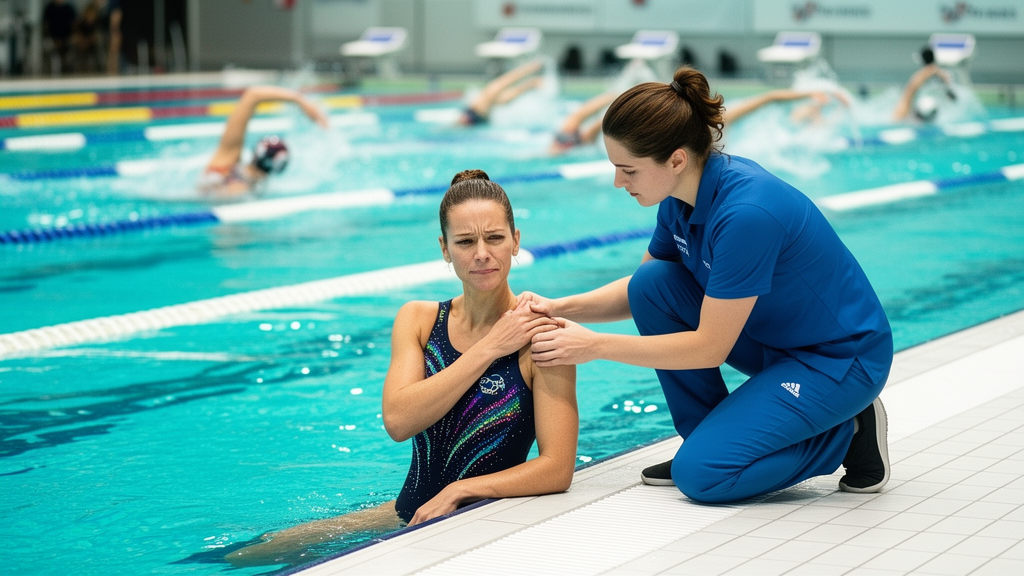
Injury incidence in female artistic swimmers rose with age in a prospective longitudinal study published in BMC Sports Science, Medicine and Rehabilitation, with the burden of injuries — measured in days lost per 1,000 hours — highest in the oldest age categories. The research, led by Ane Begoñe Rincón, Alfonso Trinidad and Alejandro López-Valenciano, tracked injury patterns across four age categories over up to two seasons of monitoring.
The study followed 390 unique swimmers across clubs in four categories: under 12 years (215 athletes), 12 to 14 years (102), 15 to 18 years (33), and senior or master athletes aged 19 and over (40). In total, 121 swimmers were followed across both seasons, producing 511 athlete-seasons of observation. Injuries were recorded in four clubs over two seasons, from 2023 to 2025, and in two clubs over one season, 2024 to 2025.
Across the whole sample, 70 injuries were recorded in 65 swimmers. The youngest group, the under-12s, recorded 24 injuries at an incidence of 0.23 injuries per 1,000 hours, with a 95 percent confidence interval of 0.15 to 0.34, and an injury burden of 8.49 days lost per 1,000 hours. In the 12-to-14 category, 26 injuries were recorded at 0.42 injuries per 1,000 hours (95 percent CI 0.27 to 0.61), with a burden of 8.00 days lost per 1,000 hours.
The pattern shifted sharply in the older groups. Among 15-to-18-year-olds, 13 injuries occurred at an incidence of 0.70 per 1,000 hours (95 percent CI 0.37 to 1.20), and the burden more than doubled to 18.00 days lost per 1,000 hours. In the senior and master category, seven injuries were recorded at 1.18 injuries per 1,000 hours (95 percent CI 0.47 to 2.44), with the highest burden of all at 29.61 days lost per 1,000 hours. The wide confidence intervals in the older, smaller groups mean these estimates carry considerable uncertainty, but the direction of the trend is consistent across both incidence and burden.
The mechanism of injury stood out as a defining feature of the sport. Most injuries — 80.0 percent — were caused by non-contact mechanisms, meaning they occurred without direct contact with another athlete, a striking figure in a sport that combines acrobatic lifts, holds and synchronized movements in the water. This suggests that the physical demands of artistic swimming itself, rather than collisions, drive most of the injury risk.
By body region, the lower limbs were the most affected, accounting for 45.7 percent of injuries. Within the lower limbs, the knee was the most frequently affected site in every age category, with incidence rising from 0.04 injuries per 1,000 hours in the under-12s to 0.06 in the 12-to-14 group, 0.11 in the 15-to-18 group, and 0.34 among senior and master athletes. The authors also identified the injuries carrying the greatest burden: knee sprains and shoulder fractures.
Injury type varied with age. Muscle and tendon injuries were the most frequent type in the under-12 category, accounting for 37.5 percent of injuries, whereas joint and ligament injuries predominated among senior and master athletes at 42.9 percent. In the two middle categories, muscle and tendon injuries and joint and ligament injuries were equally frequent, at 23.1 percent in the 12-to-14 group and 30.8 percent in the 15-to-18 group.
The study’s authors frame their findings as a basis for prevention. Their conclusions suggest that preventive strategies should particularly consider the most common diagnoses observed, namely non-contact injuries, sprains, and muscle strains, tears and ruptures. Because the analysis is observational and descriptive, it identifies patterns and associations rather than testing whether any specific intervention reduces injury risk; the reported incidences describe what occurred in the monitored clubs during the study seasons.
With incidence and burden both increasing across age categories, the dataset offers clubs and coaches age-specific benchmarks for how often injuries occur and how much time they cost, while highlighting the knee and shoulder as sites where the heaviest burdens accumulate.
Subject of Research: Injury incidence and burden in female artistic swimmers across age categories
Article Title: Epidemiology of injuries and injury burden in artistic swimmers: a longitudinal prospective study
Article References: Rincón, A. B., Trinidad, A., & López-Valenciano, A. (2026). Epidemiology of injuries and injury burden in artistic swimmers: a longitudinal prospective study. BMC Sports Science, Medicine and Rehabilitation. https://doi.org/10.1186/s13102-026-02202-w
Image Credits: AI Generated
DOI: 10.1186/s13102-026-02202-w
Keywords: artistic swimming, injury epidemiology, injury burden, prospective study, knee injuries, non-contact injuries, female athletes, youth sport, sprains, sports medicine, Epidemiology, injuries
News Source: Beatrice Stafford. (October 29, 2026). Injuries rise with age in female artistic swimmers, prospective study finds. Scienmag.