Soft tissue defects caused by trauma, tumor removal, or congenital conditions remain one of the most stubborn challenges in reconstructive medicine. Fat grafts shrink, synthetic fillers eventually fade, and engineered tissues often fail to develop the blood supply they need to survive. Now, a team of researchers reporting in the Journal of Advanced Research has unveiled an injectable system that tackles the problem at its biological root: rather than transplanting whole tissue, the approach delivers tiny regenerative packages called matrix-bound nanovesicles, extracted from human fat, inside a carefully engineered hydrogel scaffold designed to release them slowly over weeks.
The study centers on a long-standing puzzle in regenerative medicine. Decellularized adipose matrix, a scaffold material stripped of cells from donor fat tissue, has shown a remarkable ability to spur new fat formation at transplantation sites while provoking little immune rejection. Yet its performance has been inconsistent, with new fat cells appearing only near blood vessels at the edges of grafts. The researchers hypothesized that the true active ingredients were not the scaffold’s structural fibers themselves but nanoscale vesicles embedded within the extracellular matrix, known as matrix-bound nanovesicles, or MBVs. These vesicles, first identified in various tissue scaffolds, carry protective cargoes of microRNAs, proteins, and lipids that allow the matrix to communicate with surrounding cells.
To test this idea, the team isolated adipose-derived MBVs using two fundamentally different processing routes. One batch came from chemically decellularized fat tissue, treated with detergents and oxidizing agents; the other came from mechanically concentrated fat extracellular matrix, produced by homogenization and fine filtration. Under the transmission electron microscope, both types displayed the characteristic cup-shaped, bilayer-membrane morphology of extracellular vesicles, with most particles measuring under 200 nanometers in diameter. But the similarities ended there. The mechanically derived vesicles, dubbed M-AT-MBVs, were recovered at roughly 7.1 times the yield of their chemically prepared counterparts from the same amount of starting tissue, suggesting that harsh chemical processing destroys a substantial fraction of these nanoscale messengers.
Functional testing in the laboratory revealed even starker differences. When human adipose-derived stem cells were cultured with the vesicles, both types pushed the cells toward fat formation, but the mechanically derived vesicles produced significantly stronger upregulation of PPAR-gamma, a master regulator of adipogenesis, approaching the levels seen with a commercial differentiation cocktail. The mechanically derived vesicles also outperformed in migration assays, speeding wound closure in stem cell monolayers. In parallel experiments with human umbilical vein endothelial cells, the same vesicles stimulated the formation of tubular networks on Matrigel, a standard proxy for new blood vessel growth, again with the mechanically prepared particles showing clear superiority.
Identifying the active ingredient was only half the battle. Free vesicles injected into the body would diffuse away and degrade before they could orchestrate meaningful tissue formation, so the researchers engineered a delivery vehicle. Using a capillary microfluidic platform, they fabricated uniform hydrogel microspheres from methacrylated hyaluronic acid, a photo-crosslinkable derivative of a natural matrix component. Because the bare microsphere surface offered few binding sites for vesicles, the team coated the spheres with polydopamine, an adhesive polymer inspired by mussel proteins. The coating transformed the carriers: vesicle loading more than doubled, reaching 17.35 micrograms of protein per milligram of microspheres, and release kinetics shifted from an early burst to a sustained drip extending beyond three weeks.
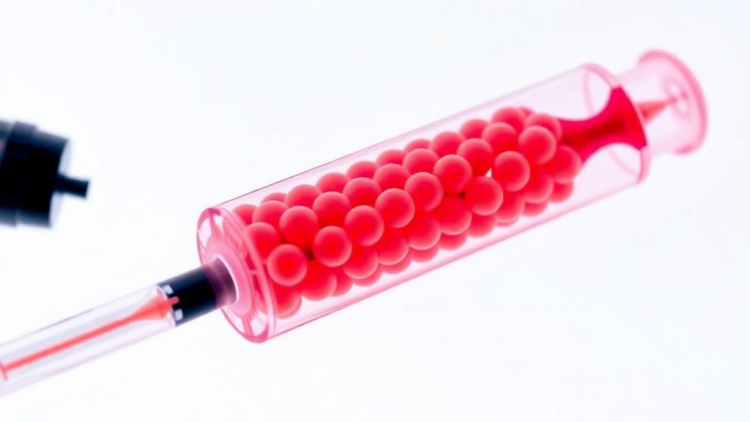
The complete system assembles these elements into an injectable composite. Vesicle-loaded, polydopamine-coated microspheres are suspended in a hybrid hydrogel combining the decellularized adipose matrix with the crosslinkable hyaluronic acid derivative. The formulation flows smoothly through a needle with an inner diameter of just 250 micrometers, then sets rapidly under ultraviolet light followed by thermal gelation at body temperature. Rheological testing confirmed the material’s viscosity and elastic properties are suitable for precise placement at target anatomical sites. In laboratory co-cultures, hydrogels loaded with the mechanically derived vesicles again outperformed all controls, driving fat differentiation, endothelial tube formation, and cell migration.
The decisive test came in living animals. Thirty-six nude mice received subcutaneous injections of four hydrogel formulations: with empty uncoated microspheres, with empty coated microspheres, with chemically derived vesicles, or with mechanically derived vesicles. Over eight weeks, all grafts shrank, as implanted materials invariably do, but the degree of loss told a striking story. Grafts without vesicles retained only about 36 to 40 percent of their original volume, while both vesicle-loaded formulations preserved roughly 55 to 57 percent. Histological examination showed no necrosis, infection, or rejection in any group, and the vesicle-containing grafts filled with perilipin-positive fat cells bearing the large, single lipid droplets characteristic of mature adipocytes.
Blood vessel formation followed a similar pattern. Grafts carrying mechanically derived vesicles displayed abundant CD31-positive vascular structures at every time point, following a biphasic course in which dense networks of small vessels formed early and then matured into a moderate, stable density. Immunofluorescence and gene expression analysis confirmed that the vesicle-loaded grafts, particularly those with mechanically derived particles, showed elevated levels of adipogenic regulators including PPAR-gamma, CEBP-alpha, and FABP-4 throughout the observation period, while empty-microsphere controls lagged far behind.
To explain why the mechanically derived vesicles worked better, the researchers sequenced their microRNA cargo. The two vesicle populations carried distinct profiles, with 752 microRNAs detected in the mechanically derived particles versus 394 in the chemically derived ones, and only 325 shared species. Among the microRNAs significantly enriched in the superior particles was miR-143, a molecule previously linked to enhanced fat cell formation and blood vessel growth through suppression of the MAPK signaling pathway. Western blot analysis of the grafts confirmed the prediction: phosphorylation of the key MAPK kinases ERK, JNK, and p38 was reduced in grafts receiving mechanically derived vesicles, consistent with miR-143-mediated pathway inhibition steering cells toward fat differentiation.
The work represents a conceptual shift in how scientists approach extracellular matrix biomaterials. Rather than treating decellularized scaffolds as opaque black boxes of biological signals, the study isolates the specific nanoscale effectors responsible for regeneration and delivers them in a controlled, sustained fashion. The authors caution that important hurdles remain: vesicle isolation is time-consuming and resource-intensive, the microspheres had not fully degraded by the end of the eight-week study, and the system has so far been tested only in healthy animals rather than in compromised tissue environments such as diabetic or irradiated wounds. Direct functional validation of miR-143’s role is also still needed. Even so, the demonstration that processing method determines both the yield and the potency of matrix-bound nanovesicles, and that a microsphere-hydrogel composite can exploit them to build vascularized fat tissue, points toward a future in which soft tissue reconstruction relies not on what surgeons can transplant, but on what biomaterials can be instructed to grow.
Subject of Research: Sustained delivery of adipose matrix-bound nanovesicles via microsphere-loaded hybrid hydrogels for adipose tissue engineering
Article Title: An injectable microsphere-reinforced system for sustained delivery of Adipo-MBV in adipose tissue engineering
Article References: Xu, M., Chen, J., Sun, Y., Yang, H., Ji, H., Xu, T., Lu, F., & He, Y. (2026). An injectable microsphere-reinforced system for sustained delivery of Adipo-MBV in adipose tissue engineering. Journal of Advanced Research, 88, 977-994. https://doi.org/10.1016/j.jare.2026.01.058
Image Credits: AI Generated
DOI: Not provided
Keywords: adipose tissue engineering, matrix-bound nanovesicles, extracellular matrix, hyaluronic acid hydrogel, microspheres, polydopamine, drug delivery, adipogenesis, angiogenesis, miR-143, MAPK pathway, regenerative medicine
Cite Scienmag News
APA
MLA
Chicago
Ophelia Keating. (October 2, 2026). Injectable Microspheres Deliver Regenerative Nanovesicles to Rebuild Soft Tissue. Scienmag. https://scienmag.com/injectable-microspheres-deliver-regenerative-nanovesicles-to-rebuild-soft-tissue/
Ophelia Keating. “Injectable Microspheres Deliver Regenerative Nanovesicles to Rebuild Soft Tissue.” Scienmag, 2 October 2026, https://scienmag.com/injectable-microspheres-deliver-regenerative-nanovesicles-to-rebuild-soft-tissue/. Accessed 2 October 2026.
Ophelia Keating. “Injectable Microspheres Deliver Regenerative Nanovesicles to Rebuild Soft Tissue.” Scienmag. October 2, 2026. https://scienmag.com/injectable-microspheres-deliver-regenerative-nanovesicles-to-rebuild-soft-tissue/
Copy citation
Download RIS
Tags: adipogenesisadipose tissue engineeringangiogenesiscontrolled release biomaterialsDrug deliveryextracellular matrixextracellular matrix nanovesiclesfat graft regenerationhyaluronic acid hydrogelimmune-compatible regenerative approachinjectable hydrogel delivery systemMAPK pathwaymatrix-bound nanovesiclesmicrospheresminimally invasive regenerative therapymiR-143nanovesicle-mediated tissue repairpolydopamineRegenerative Medicineregenerative nanovesiclessoft tissue reconstructionTissue engineering scaffolds