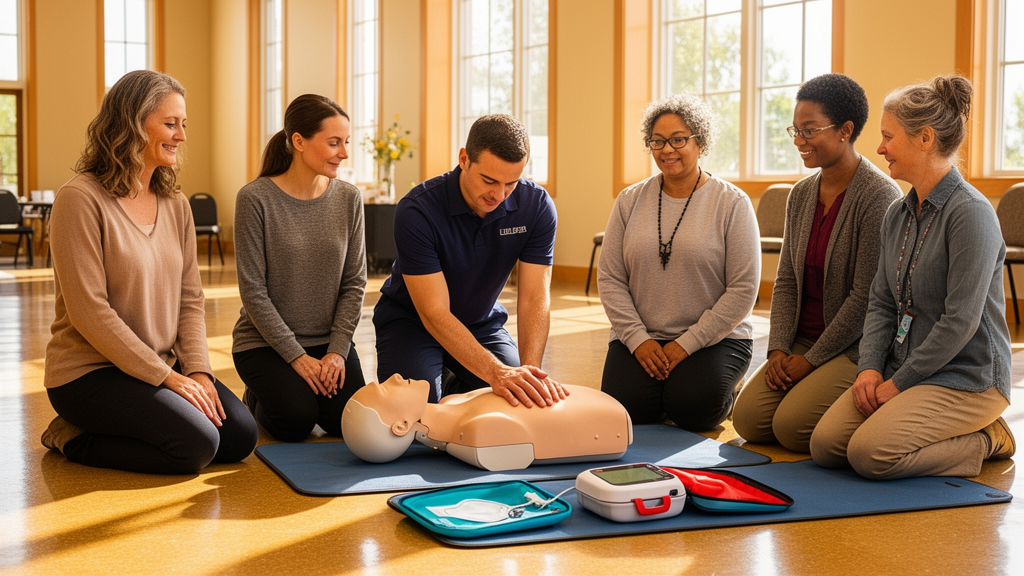
An initial realist programme theory has identified how, why, in which contexts, and with what impacts public health interventions can successfully engage members of minoritized ethnic groups in cardiopulmonary resuscitation training. The systematic review outlines key contextual factors and mechanisms necessary to improve training access across socioeconomically disadvantaged communities.
Members of the public play an essential role in improving survival following an out-of-hospital cardiac arrest by contacting emergency medical services, initiating cardiopulmonary resuscitation, and deploying a defibrillator. However, certain regions in England characterized by higher rates of out-of-hospital cardiac arrest and lower rates of lay rescuer intervention are predominantly socioeconomically disadvantaged and ethnically diverse, highlighting persistent disparities in resuscitation skills and intervention decisions.
To investigate these disparities, researchers conducted a realist evidence synthesis that integrated published academic literature with primary empirical data. These primary data were gathered across four dedicated workshops conducted with South Asian and Black African and Caribbean communities residing in socioeconomically disadvantaged areas of England.
The resulting initial programme theory is formulated as eight distinct context-mechanism-outcome configurations. By combining initial realist programme theories with formal behaviour change theory, the investigators developed a framework explaining how specific intervention resources and community responses interact within particular contexts to yield positive training access outcomes.
The synthesis organizes the necessary interventions into three sequential chronological stages that must be resolved to facilitate participation. These stages comprise gaining community access while actively overcoming mistrust toward individuals viewed as outsiders or establishment figures, resolving practical and contextual obstacles that impede attendance, and establishing an instructional setting that encourages active engagement through behaviour change techniques designed for deeper learning.
Building trusting, collaborative partnerships with influential and trusted community voices emerged as a vital foundation spanning all chronological stages of the framework. Furthermore, successful training relies on establishing an environment that pairs practical skills instruction with culturally informed two-way discussions of community concerns and structured rehearsals for navigating potential barriers to emergency action.
The study provides a nuanced theoretical basis regarding what strategies work, for whom, and under what circumstances to facilitate cardiopulmonary resuscitation training access in underserved populations. The authors noted that this framework is designed to inform the design, implementation, and evaluation of future community-level resuscitation initiatives, with the underlying synthesis registered under ISRCTN identifier ISRCTN90350842.
Subject of Research: Access to cardiopulmonary resuscitation training in underserved communities
Article Title: Facilitating access to cardiopulmonary resuscitation training in high-risk underserved communities: a realist evidence synthesis
Article References: Hawkes, C. A., Malone, J.-R., Keenan, O., Staniszewska, S., Vlaev, I., Perkins, G., Parsons, N., Mustafa, Y., Khalifa, E., Howe, D., & Lin, Y.-L. (2026). Facilitating access to cardiopulmonary resuscitation training in high-risk underserved communities: a realist evidence synthesis. BMC Public Health. https://doi.org/10.1186/s12889-026-29372-z
Image Credits: AI Generated
DOI: 10.1186/s12889-026-29372-z
Keywords: cardiopulmonary resuscitation, CPR training, out-of-hospital cardiac arrest, realist evidence synthesis, initial realist programme theory, context-mechanism-outcome configurations, underserved communities, socioeconomic disadvantage, minoritized ethnic groups, South Asian communities, Black African and Caribbean communities, lay rescuer CPR, defibrillator use, behaviour change techniques, emergency medical services, community trust, health disparities, public health interventions
News Source: Ophelia Keating. (November 16, 2026). Initial Programme Theory Outlines What Might Facilitate Resuscitation Training in Underserved Communities. Scienmag.