


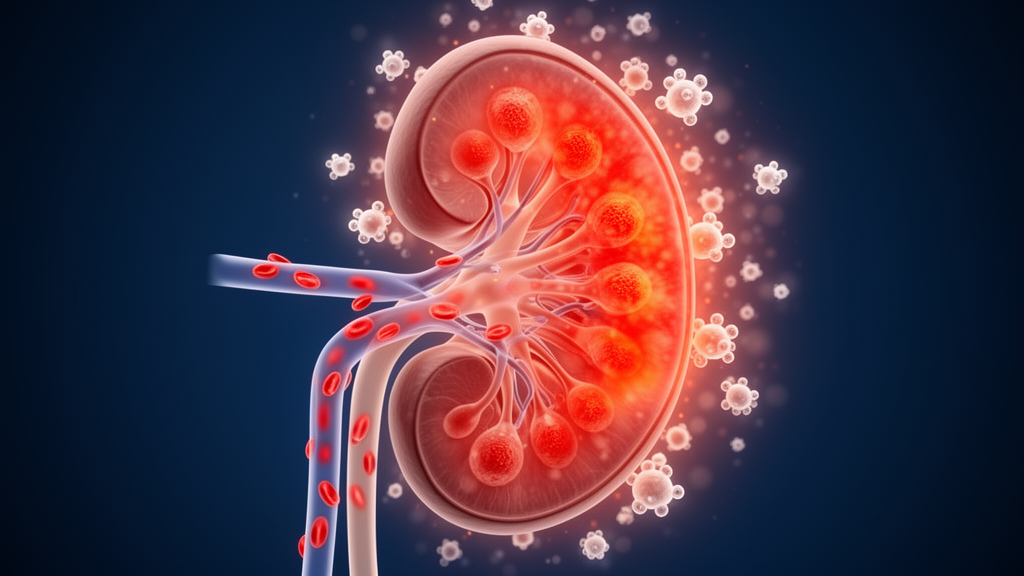
Adults with diabetes who have both persistent low-grade inflammation and anemia face substantially higher odds of impaired kidney function and faster kidney function decline, according to a study published in BMC Endocrine Disorders. The research, based on data from the China Health and Retirement Longitudinal Study (CHARLS), examined the combined effect of these two common conditions, which the authors describe as a phenotype that had remained unclear until now.
The cross-sectional analysis included 2,363 diabetes patients, while a sub-cohort of 547 patients was followed longitudinally from 2011 to 2015. Residual inflammation was defined as a high-sensitivity C-reactive protein level of at least 2.0 mg/L, and anemia was defined according to World Health Organization criteria. The outcomes studied were prevalent impaired kidney function in the cross-sectional analysis and rapid kidney function decline in the longitudinal analysis.
Each condition on its own was associated with impaired kidney function, but the combination showed the strongest association. Adults with both residual inflammation and anemia had roughly three and a half times the odds of impaired kidney function compared with those without either condition, with an odds ratio of 3.61 (95% confidence interval: 2.16 to 5.99; P < 0.001). The analysis used logistic and linear regression, restricted cubic splines, and subgroup and sensitivity analyses.
The longitudinal findings were more striking. In the 547-patient sub-cohort, the combined phenotype conferred the highest risk of rapid kidney function decline, with an odds ratio of 6.42 (95% confidence interval: 2.18 to 18.34; P < 0.001). Notably, the combined group was the only one associated with a steeper decline in estimated glomerular filtration rate, showing a difference of -8.68 mL/min/1.73 m² (95% confidence interval: -15.72 to -1.64; P = 0.011). Neither isolated inflammation nor isolated anemia alone was linked to a steeper eGFR decline in this analysis.
Sensitivity analyses and restricted cubic spline models supported the robustness of these associations, according to the authors. The study was conducted in a nationally representative Chinese sample, and the authors note that the findings are observational, meaning they show associations rather than proving that treating inflammation or anemia would slow kidney decline.
The authors conclude that coexisting residual inflammation and anemia are associated with a higher prevalence of kidney function impairment and a more rapid kidney function decline among diabetic patients. They suggest that addressing both conditions concurrently, as an integrated clinical phenotype, may better mitigate kidney function decline than considering either condition in isolation.
Subject of Research: The combined association of residual inflammation and anemia with kidney function in adults with diabetes
Article Title: Combined residual inflammation and anemia in relation to kidney function among adults with diabetes: a CHARLS-based cross-sectional and longitudinal study
Article References: Yang, W., Zhao, J., Yu, M., Li, Q., Li, R., Gao, X., Lin, C., Zhai, Z., Huang, X., & Wu, B. (2026). Combined residual inflammation and anemia in relation to kidney function among adults with diabetes: a CHARLS-based cross-sectional and longitudinal study. BMC Endocrine Disorders. https://doi.org/10.1186/s12902-026-02577-4
Image Credits: AI Generated
DOI: 10.1186/s12902-026-02577-4
Keywords: diabetes, kidney function, residual inflammation, anemia, eGFR decline, CHARLS, chronic kidney disease, C-reactive protein, cross-sectional study, longitudinal study, Combined, residual
News Source: Jerry Hayes. (October 29, 2026). Inflammation plus anemia linked to faster kidney decline in diabetes. Scienmag.



