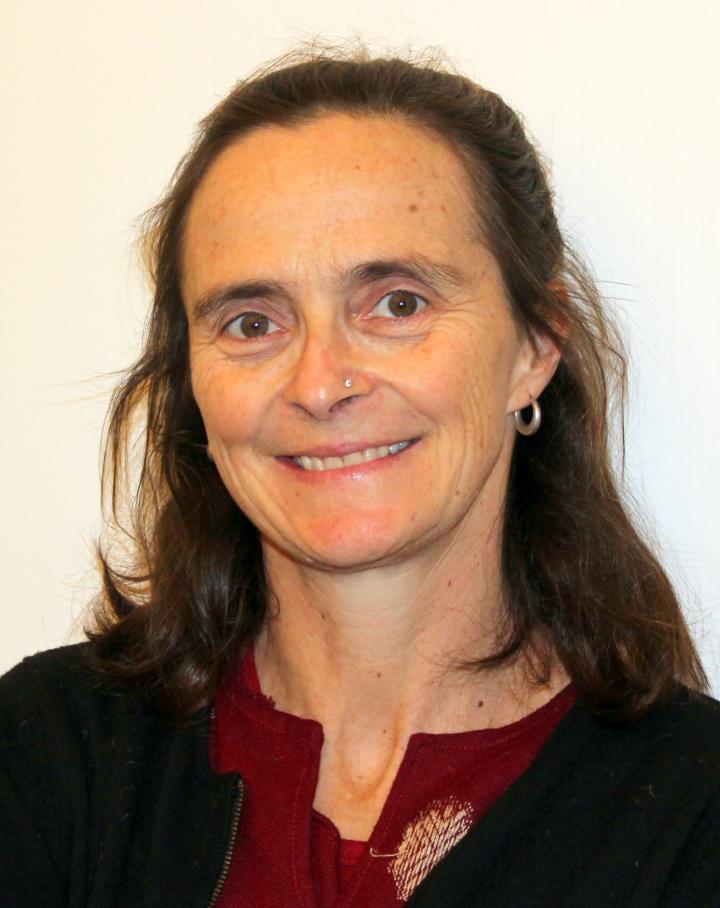
Credit: Lena Mustonen/Umeå University
A survey of nearly 1000 households in the north Indian state of Uttarakhand showed that six percent of adults were identified as depressed. People were two or three times more likely to be depressed if they were from the most socially oppressed castes, had taken a recent loan, lived in poor quality housing or had not completed primary school. This is according to research from Umeå University.
Mental health researcher Kaaren Mathias, at the Department of Public and Clinical Medicine, has focused over the last four years on how communities in the northern Indian states of Uttarakhand and Uttar Pradesh can promote, prevent, treat and advocate for mental health.
"I was surprised to find such a strong relationship between social disadvantage and mental illness," says Kaaren Mathias, who lives in India, where she works as a mental health programme manager with the Emmanuel Hospital Association. "People who had not completed primary school were nearly four times more likely to be depressed than those who had completed high school."
Further qualitative studies, conducted by Kaaren Mathias in 2014, revealed that nearly all people with mental distress had experienced social exclusion and many had experienced economic, verbal and physical violence. However, people also described experiences of belonging, social support, and social participation. People with friends or family members experiencing mental distress as well as those who believed that mentally distressed people can recover were more willing to be socially close to them.
The communities in Kaaren Mathias' research are characterised by complicated relationships between mental health and social inequalities such as gender, poverty, class, caste and education. Gender inequality is one of the most significant social factors impacting mental health competency as it leads to a heavier load in caregiving, impoverishment and experiences of violence for women caregivers.
"Bringing together the findings from this research, I picture community mental health competence using the picture of a tree, where all parts are organically connected. The roots are the many social factors affecting mental health. The trunk connects these with four branches: access to care, knowledge, safe social spaces and partnerships for action. The research shows how people with mental distress, caregivers and community members together find coping strategies despite many obstacles and few resources. Amidst the shadows there are patches of light," says Kaaren Mathias.
###
Kaaren Mathias is a public health physician from New Zealand who has been living and working in India for the last 11 years. She works as mental health programme manager with the Emmanuel Hospital Association, a large faith-based organisation which works for health and community transformation in North India.
For more information, please contact:
Kaaren Mathias, Department of Public Health and Clinical Medicine, Umeå University 91-789-5121-535; [email protected]
Media Contact
Daniel Harju
[email protected]
46-725-522-918
@UmeaUniversity
http://www.umu.se/umu/index_eng.html