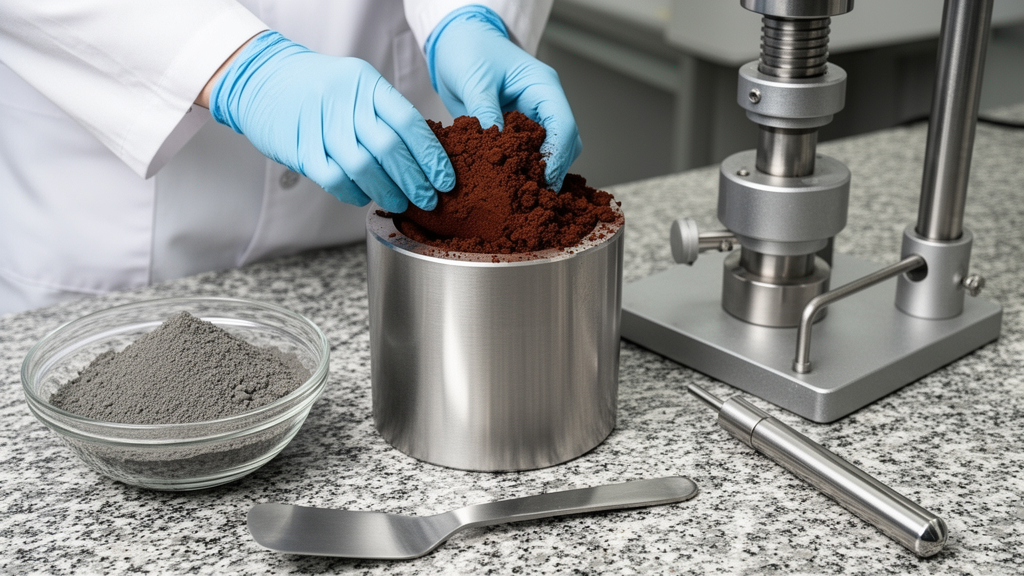
Civil engineering researchers have demonstrated that combining two distinct agro-industrial waste by-products can significantly improve the mechanical stability and moisture resilience of expansive black cotton soil. Utilizing a structured mathematical optimization framework known as Scheffe’s design of experiments, an investigative team evaluated binary additive blends composed of calcium carbide residue and palm oil fuel residue. Laboratory assessments of the treated soil mixtures revealed substantial performance gains over natural clay, achieving peak unconfined compressive strength values of 735 kilonewtons per square meter alongside maximum durability ratings of 58 percent. Expansive soils present persistent structural hazards worldwide because their mineralogical composition causes severe volumetric swelling during wet periods and pronounced shrinkage cracking during dry spells. By replacing standard commercial stabilizers with reclaimed industrial residues, the research demonstrates a rigorous mathematical pathway for transforming problematic expansive subgrades into load-bearing civil engineering materials while diverting hazardous manufacturing and agricultural waste streams from overburdened disposal sites.
Expansive clays such as black cotton soil pose critical design challenges across transportation corridors, building foundations, rail lines, and hydraulic channel systems due to their acute sensitivity to seasonal moisture fluctuations. The underlying soil matrix is typically characterized by an abundance of smectite clay minerals, most notably montmorillonite, which feature expansive interlayers that absorb significant quantities of water during rainy seasons. This hydrous expansion exerts substantial upward swelling pressures on overlying pavements and foundational footings, inducing severe differential heave, pavement distortion, and structural cracking. Conversely, subsequent moisture loss during arid periods triggers rapid volumetric shrinkage, causing deep ground fissures, structural settlement, and localized shear failures within civil infrastructure. Traditional ground-improvement protocols rely heavily on conventional hydraulic binders like ordinary Portland cement and commercial quicklime to suppress this shrink-swell behaviour. However, escalating environmental concerns, substantial carbon dioxide emissions, and high financial costs associated with manufacturing primary binders have motivated geotechnical engineers to seek sustainable secondary pozzolanic materials derived directly from regional industrial outputs.
The baseline geotechnical material evaluated in the laboratory program was natural Deba black cotton soil, extracted from an average subgrade depth of 1.50 meters within Deba, located in Gombe State, Nigeria. Geotechnical index testing of the unprocessed soil confirmed a natural moisture content of 20.20 percent, an elevated liquid limit of 56.30 percent, and a plastic limit of 28.70 percent. This yielded a plasticity index of 28.70 percent, substantially exceeding the 11 percent upper threshold established by the American Association of State Highway and Transportation Officials for subgrade suitability. Grain size distribution analysis classified the material as a highly plastic inorganic clay, designated as CH under the Unified Soil Classification System and A-7-6(14) under AASHTO criteria, comprising 0.475 percent gravel, 27 percent sand, and 72.028 percent fine particles.
To mitigate the unfavorable engineering properties of this regional clay, the experimental investigation incorporated two non-conventional additive residues collected directly from processing facilities. Calcium carbide residue was obtained as a discarded byproduct of acetylene gas manufacturing from a welding workshop located along the Eket-Mkpat Enin Road in Akwa Ibom State, Nigeria. Global industrial production of calcium carbide residue reaches approximately 56 million tons annually, creating severe ecological concerns due to its hyper-alkaline nature, which threatens groundwater reserves and adjacent soil ecosystems when discarded into open environments. The second additive, palm oil fuel residue, was collected from an active palm oil extraction milling press situated at Ukpom Ikot Ekem within Ikono Local Government Area. Burning fibrous agricultural residue during palm oil production generates substantial volumes of ash that consume vast swathes of usable land. Combining calcium carbide residue, which possesses high calcium hydroxide contents akin to commercial slaked lime, with silica-rich and potassium-bearing palm oil fuel residue provided a complementary binder formulation.
To overcome the laborious, costly, and resource-intensive nature of traditional trial-and-error laboratory proportioning, the investigators implemented Scheffe’s simplex lattice design of experiments to model and optimize the soil-stabilizer composite. This mathematical methodology formulated a second-degree polynomial lattice model tailored for a four-component mixture comprising soil, compaction water, calcium carbide residue, and palm oil fuel residue. Under Scheffe’s simplex principles, the relative proportions of the four active components are constrained to sum to unity within a normalized tetrahedral factor space. A total of twenty distinct mixture proportions were systematically developed and evaluated in two sequential phases. The initial ten experimental trials served as formulation points to calculate the regression coefficients of the predictive polynomial response equations for both unconfined compressive strength and durability. An independent set of ten additional mixture proportions was subsequently formulated across the factor space to serve as experimental control points for validating model accuracy.
Mechanical performance evaluations demonstrated that stabilizing the raw black cotton soil with optimum additive dosages yielded substantial improvements in compressive load resistance. All test specimens were blended thoroughly, compacted under Standard Proctor compaction energy, and cured inside moisture-controlled chambers for seven days prior to axial load testing in accordance with standard British testing specifications. While the untreated natural soil registered a baseline unconfined compressive strength of only 101 kilonewtons per square meter, the treated soil composites produced strength values ranging from a minimum of 505 kilonewtons per square meter up to a peak value of 735 kilonewtons per square meter. The maximum compressive strength was recorded at trial point Y3, reflecting a sevenfold increase over the unmodified soil. This strength development is driven by pozzolanic reactions occurring between free calcium from the carbide residue and soluble silica within the palm oil ash, producing interlocking calcium silicate hydrate gel networks that bind adjacent soil particles together.
Durability assessments further established the enhanced environmental resilience of the stabilized matrix when subjected to harsh, moisture-saturated exposure conditions. Durability was quantified as the ratio of compressive strength retained by specimens subjected to a seven-day wax-cured period followed by de-waxing and complete water immersion for seven days against control specimens continuously cured for fourteen days. Across the tested formulation ratios, durability values varied from a minimum of 40 percent to a peak value of 58 percent, with the optimum performance recorded at design mix Y4. This durability enhancement is attributed to two complementary stabilizing mechanisms: the ultra-fine additive particles act as micro-fillers that pack inter-particle pore spaces to create a denser matrix, while potassium oxide present in the palm oil ash initiates cation exchange. Potassium ions displace weaker hydrous cations within the diffuse double layer of adsorbed water, facilitating the mineralogical conversion of swelling montmorillonite into illite, an inherently stable, non-expanding clay mineral with lower water affinity.
To confirm that the mathematical equations accurately represented laboratory observations, the predictive models were subjected to rigorous statistical validation routines including Student’s t-tests, one-way analysis of variance, and multiple goodness-of-fit error metrics. In the paired two-sample t-test for means, the calculated t-statistic remained strictly below the critical t-value, requiring acceptance of the null hypothesis that no statistically significant difference existed between experimental laboratory results and model-predicted outcomes. Analysis of variance reinforced this conclusion, returning calculated F-values of 0.036 for durability and 0.001 for compressive strength, both substantially smaller than the critical F-value threshold of 4.413873. Goodness-of-fit testing yielded low error parameters, recording a mean absolute error of 0.451, mean squared error of 0.313, and root mean square error of 0.559 for durability, while compressive strength registered corresponding values of 1.862, 6.457, and 2.541. High coefficients of determination, measuring approximately 0.80 for durability and 0.98 for seven-day compressive strength, verified exceptional predictive precision.
Microstructural and spectroscopic investigations using scanning electron microscopy, energy-dispersive X-ray spectroscopy, and Fourier transform infrared spectroscopy provided direct physical confirmation of the chemical mechanisms responsible for soil stabilization. Micrographs of the untreated natural soil displayed loosely packed, irregularly shaped clay flakes arranged in an open, porous flocculent architecture characteristic of unreacted montmorillonite under elevated moisture. In contrast, the optimally treated soil composite exhibited a densely agglomerated, tightly bonded matrix where structural voids were visibly bridged by newly precipitated calcium silicate hydrate and calcium aluminate silicate hydrate cementitious gels. Energy-dispersive X-ray spectra documented an increase in the silicon-to-aluminum atomic ratio from 2.1 in the raw soil to 2.44 in the treated composite, accompanied by elevated calcium concentrations and diminished elemental iron and aluminum. Fourier transform infrared spectroscopy detected a clear vibrational shift in the primary silicon-oxygen stretching band from 991 reciprocal centimeters in the raw soil to 995 reciprocal centimeters following treatment, confirming the synthesis of new cementitious compounds.
Despite the high predictive accuracy and mechanical improvements achieved, the study authors outlined specific operational boundaries and identified avenues for ongoing investigation. The valid operational scope of the second-degree polynomial model remains constrained to parameter values situated strictly within the investigated mix ratio domain established by the four-component factor space. Future investigations must evaluate extended curing intervals, including 56-day and 98-day unconfined compressive strength benchmarks, to characterize long-term pozzolanic strength evolution and continuous binder hydration under field conditions. Finally, comparing Scheffe’s optimization model against alternative machine learning and response surface methodologies will offer broader insights into refining multi-additive binder designs for sustainable ground improvement.
Subject of Research: Optimization of industrial waste by-products for expansive soil amelioration using Scheffe's design of experiments
Article Title: Implementation of agro-industrial by-products in expansive soil amelioration: design of experiment approach
Article References: Attah, I. C. (2025). Implementation of agro-industrial by-products in expansive soil amelioration: design of experiment approach. AI in Civil Engineering, 4(1), Article 8. https://doi.org/10.1007/s43503-025-00050-0
Image Credits: AI Generated
DOI: 10.1007/s43503-025-00050-0
Keywords: Expansive Soil, Black Cotton Soil, Calcium Carbide Residue, Palm Oil Fuel Residue, Soil Amelioration, Design of Experiments, Scheffe Simplex Lattice, Unconfined Compressive Strength, Soil Durability, Scanning Electron Microscopy, Energy Dispersive X-Ray, Fourier Transform Infrared Spectroscopy, Montmorillonite, Pozzolanic Reaction, Calcium Silicate Hydrate, Analysis of Variance, Geotechnical Engineering
News Source: Denise Maddox. (November 12, 2026). Industrial Waste Additives Stabilize Expansive Soil in Optimized Laboratory Mixture Trials. Scienmag.