• HOME
  • NEWS
  • EXPLORE
    • CAREER
      • Companies
      • Jobs
    • EVENTS
    • iGEM
      • News
      • Team
    • PHOTOS
    • VIDEO
    • WIKI
  • BLOG
  • COMMUNITY
    • FACEBOOK
    • INSTAGRAM
    • TWITTER
Monday, June 29, 2026
BIOENGINEER.ORG
No Result
View All Result
  • Login
  • HOME
  • NEWS
  • EXPLORE
    • CAREER
      • Companies
      • Jobs
        • Lecturer
        • PhD Studentship
        • Postdoc
        • Research Assistant
    • EVENTS
    • iGEM
      • News
      • Team
    • PHOTOS
    • VIDEO
    • WIKI
  • BLOG
  • COMMUNITY
    • FACEBOOK
    • INSTAGRAM
    • TWITTER
  • HOME
  • NEWS
  • EXPLORE
    • CAREER
      • Companies
      • Jobs
        • Lecturer
        • PhD Studentship
        • Postdoc
        • Research Assistant
    • EVENTS
    • iGEM
      • News
      • Team
    • PHOTOS
    • VIDEO
    • WIKI
  • BLOG
  • COMMUNITY
    • FACEBOOK
    • INSTAGRAM
    • TWITTER
No Result
View All Result
Bioengineer.org
No Result
View All Result
Home NEWS Science News Chemistry

Indirect surpassing CO2 utilization in membrane-free CO2 battery

Bioengineer by Bioengineer
March 17, 2021
in Chemistry
Reading Time: 2 mins read
0
IMAGE
Share on FacebookShare on TwitterShare on LinkedinShare on RedditShare on Telegram

IMAGE

Credit: UNIST

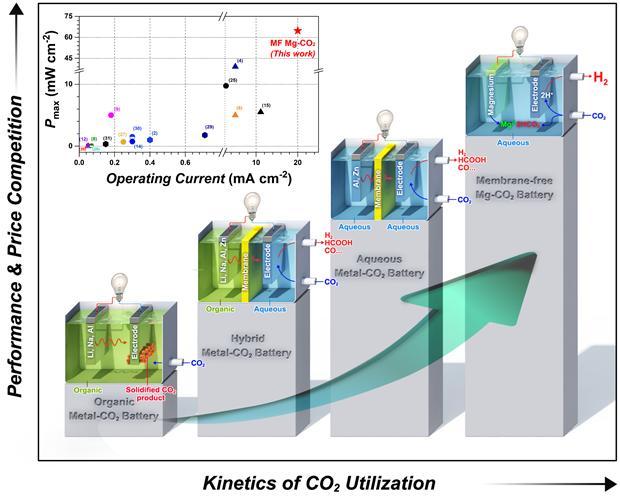
A recent study, affiliated with UNIST has unveiled a novel system, capable of producing hydrogen and electricity quickly and effectively while eliminating carbon dioxide (CO?) emissions significantly.

Published in the January 2021 issue of Nano Energy, this breakthrough has been carried out by Professor GunTae Kim and his research team in the School of Energy and Chemical Engineering at UNIST. In this study, the research team succeeded in developing a membrane-free aqueous metal-CO? battery. Unlike the existing aqueous metal-CO? systems, the new battery is not only easier to manufacture, but also allows continuous operation with one type of electrolyte.

The research team designed a membrane-free (MF) Mg-CO2 battery, as an advanced approach to sequester CO2 emissions by generating electricity and value-added chemicals without any harmful by-products. According to the research team, their MF Mg-CO2 battery operates based on the indirect utilization of CO2 with facile hydrogen generation process. It has been also found that the new battery exhibits high faradaic efficiency of 92.0%.

“In order to translate the newly-developed laboratory-scale MF Mg-CO2 battery technology into a commercial reality, we have envisioned an operational prototype system that produces electricity and value-added chemicals, as a cornerstone to better support sustainable human life from CO2 and earth-abundant renewable power (e.g., wind, solar, seawater),” noted the research team.

The MF Mg-CO2 battery system has a structure similar to that of hydrogen fuel cells for use in cars, since it only requires a Mg-metal negative electrode, an aqueous electrolyte, and a positive-electrode catalyst. However, unlike the existing fuel cells, they are based on aqueous electrolytes. As a result, the newly-developed MF Mg-CO2 battery had successfully sequestered CO2 emissions by generating electricity and value-added chemicals without any harmful by-products.

“Our findings indicate great benefits for the newly-developed MF Mg-CO2 battery technology to produce various value-added chemicals of practical significance and electricity from CO2 without any wasted by-products,” noted the research team. “Through this we have opened the door to electrochemical utilization of CO2 with indirect circulation for future alternative technologies.”

###

Journal Reference

Jeongwon Kim, Arim Seong, Yejin Yang, et al., “Indirect surpassing CO2 utilization in membrane-free CO2 battery,” Nano Energy, (2021).

Media Contact
JooHyeon Heo
[email protected]

Original Source

https://news.unist.ac.kr/indirect-surpassing-co2-utilization-in-membrane-free-co2-battery/

Tags: Chemistry/Physics/Materials SciencesResearch/DevelopmentRobotry/Artificial IntelligenceTechnology Transfer
Share12Tweet8Share2ShareShareShare2

Related Posts

AI and Physics Collaborate to Design Advanced Hydrogen Storage Materials

June 25, 2026

International Team Including Dresden Scientists Develops Novel Designer Proteins for Advanced Study of Living Tissue

June 25, 2026

New Study Uncovers Key Factors Driving Water Chemistry in Nanoscale Environments

June 25, 2026

Plasma Technology Extends Catalyst Lifespan in Hydrogen Production

June 24, 2026
Please login to join discussion

POPULAR NEWS

  • Saying Goodbye to PGY-6: Pediatric Fellowship Realities

    103 shares
    Share 41 Tweet 26
  • Multi-Hospital Study Reveals Long Covid Burden Is Twice as High as Current Estimates

    92 shares
    Share 36 Tweet 23
  • Detection of EDCs in Breast Milk and Infant Urine Up to Six Months Highlights Early Exposure Risks

    77 shares
    Share 31 Tweet 19
  • New Drug Candidate Developed at McMaster Shows Potential for Treating Brain Cancer

    58 shares
    Share 23 Tweet 15

About

We bring you the latest biotechnology news from best research centers and universities around the world. Check our website.

Follow us

Recent News

Tracking Lanthanide-Labeled Microplastics in Plants

POSTECH Researchers Slash Cost of Reconstituted Cell-Free Systems by 95%

AI and Physics Collaborate to Design Advanced Hydrogen Storage Materials

Subscribe to Blog via Email

Success! An email was just sent to confirm your subscription. Please find the email now and click 'Confirm' to start subscribing.

Join 82 other subscribers
  • Contact Us

Bioengineer.org © Copyright 2023 All Rights Reserved.

Welcome Back!

Login to your account below

Forgotten Password?

Retrieve your password

Please enter your username or email address to reset your password.

Log In
No Result
View All Result
  • Homepages
    • Home Page 1
    • Home Page 2
  • News
  • National
  • Business
  • Health
  • Lifestyle
  • Science

Bioengineer.org © Copyright 2023 All Rights Reserved.