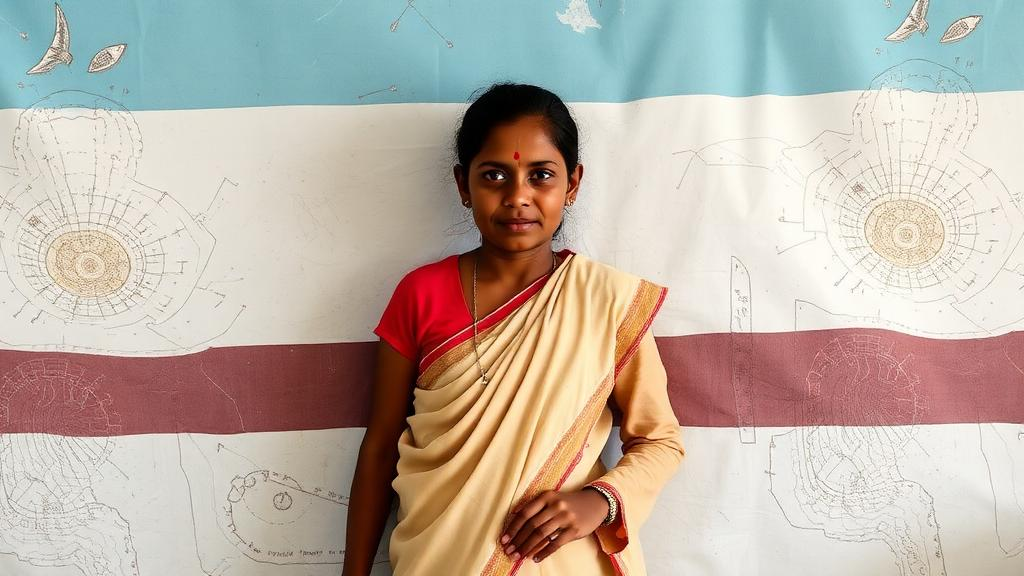
India runs one of the largest publicly funded health insurance experiments in human history. The Pradhan Mantri Jan Arogya Yojana, known as PM-JAY, promises hospital coverage worth 500,000 rupees per family per year to roughly 700 million people, making it the largest entitlement-based health protection program on the planet. Unlike conventional insurance schemes that require households to enroll, PM-JAY flips the model: eligibility is determined automatically through a national socioeconomic census, and beneficiaries need only complete a simplified identity verification to activate their benefits. On paper, this design eliminates the enrollment bottleneck that has historically excluded the poorest from social protection. In practice, according to a new quantitative study published in PLOS Global Public Health, the verification step itself has become a formidable barrier, and the people who fail to clear it are precisely those the scheme was designed to protect.
The research team, led by Swati Srivastava of the University of Heidelberg together with colleagues at the German Development Institute and other institutions, analyzed cross-sectional survey data collected between 2019 and 2020, covering 50,002 individuals across five Indian states. Their central question was deceptively simple: among people automatically entitled to PM-JAY benefits, who actually completes the verification process, and who gets left behind? Because the scheme’s architects deliberately removed enrollment requirements, any gap between eligibility and uptake must arise at the verification stage, making this the critical choke point for the entire program. The answer, the study found, is that only about one in five eligible individuals had verified their status within the first year of the scheme’s launch, a figure that should alarm anyone invested in universal health coverage.
Methodologically, the study employed logistic regression models with district-level random effects, a statistical approach that allows researchers to separate individual and household characteristics from the influence of the localities in which people live. This multistate design matters because India’s states vary enormously in administrative capacity, health infrastructure, and implementation culture. By modeling district as a random effect, the team could quantify how much of the variation in verification uptake was attributable to where people lived rather than who they were. The result was striking: district-level factors explained nearly one-third of the total variability in verification, indicating that the quality of local implementation, not merely household circumstances, shapes who gains access to the scheme.
The individual-level findings reveal a consistent gradient of advantage running through the verification process. Older adults were substantially more likely to verify than children and adolescents, with people aged 60 and above showing roughly 2.3 times higher odds of verification compared with those aged 0 to 15 years. Education emerged as another powerful predictor: individuals with higher education had about 2.3 times the odds of verification relative to those with no formal schooling. People who had previously enrolled in a predecessor publicly funded health insurance scheme were nearly twice as likely to verify, suggesting that prior exposure to insurance bureaucracy confers a durable advantage. Those living with chronic illness also showed modestly higher odds, with an adjusted odds ratio of 1.175, plausibly because illness creates direct contact with the health system and a pressing motivation to activate coverage.
Two demographic patterns stand out as particularly troubling for equity. Women were less likely than men to complete verification, and household members other than the head or the head’s spouse were also disadvantaged. In a scheme that covers entire families, this means that the benefits of verification appear to flow through a narrow gate: the household head, typically male, acts as the point of contact with the verification system, and everyone else’s access depends on his initiative. This household-level bottleneck echoes a well-documented pattern in Indian social policy, where women’s lower mobility, lower documentation ownership, and lower bargaining power within households translate into lower uptake of entitlements nominally extended to them. Any reform that does not address the gendered structure of verification, the authors argue, will reproduce these disparities indefinitely.
Notably, the study also found that historically disadvantaged castes and religious minorities demonstrated relatively higher verification rates once other factors were accounted for. This is an encouraging signal that PM-JAY’s entitlement-based design, which automatically includes marginalized communities without requiring them to navigate application procedures, may be working to counteract some forms of exclusion. However, the authors caution against complacency. Higher verification rates among disadvantaged groups relative to other eligible people does not mean these groups have achieved adequate coverage in absolute terms; with overall uptake at roughly one-fifth of the eligible population, even relatively well-verified communities remain largely unprotected. The equity story is therefore one of relative progress within a system that is failing broadly.
The qualitative texture of the verification experience, gathered from beneficiary reports, exposes the practical frictions that statistics alone cannot convey. Many respondents described long wait times at verification centers, inconsistent and unpredictable documentation demands that varied from one visit or one official to the next, and, most seriously, requests for informal payments to complete a process that is legally free. These findings transform the abstract language of administrative burden into something concrete: a day’s lost wages for a laborer who cannot afford to leave work, a missing document that requires a trip to a distant office, a small bribe that is small only for those who can afford it. For households living at the economic margin, each of these frictions is a rational reason to postpone or abandon verification, especially when no immediate illness makes the benefit feel urgent.
The study’s policy prescriptions follow directly from its evidence base. The authors call for gender-sensitive outreach that brings verification to women rather than waiting for household heads to act on their behalf, and for streamlined household-wide verification so that a single successful encounter activates coverage for every eligible member rather than only the individual who showed up. They also emphasize strengthening local health system capacity, given the finding that district-level factors explain such a large share of the variation in uptake. Where infrastructure is weak and staffing thin, verification stalls regardless of how motivated beneficiaries may be. Simplifying documentation requirements, standardizing procedures across centers, and enforcing the prohibition on informal payments round out the reform agenda, each targeting a specific friction documented in the data.
The broader significance of this research extends well beyond India’s borders. Dozens of low- and middle-income countries are experimenting with publicly funded health insurance as a pathway to universal health coverage, and many have adopted entitlement-based designs in the belief that automatic eligibility removes the equity problems of voluntary enrollment. The PM-JAY evidence demonstrates that this belief is only half right: eliminating enrollment does not eliminate exclusion, it merely relocates the barrier to whatever administrative step comes next. Verification, identity documentation, and the everyday bureaucracy of proving who you are can filter out the elderly, the uneducated, women, and peripheral household members just as effectively as enrollment fees once did. Programs that measure success by the number of people eligible on paper, rather than the number verified and able to use services, will systematically overstate their achievements.
For India, the stakes could hardly be higher. PM-JAY represents a flagship commitment to protecting the country’s most vulnerable populations from catastrophic health expenditures, and its first-year verification rate of roughly one-fifth suggests that the promise remains distant for the majority of those it names as beneficiaries. The study’s multistate, large-sample design gives its findings considerable weight, and its identification of underserved groups, older adults aside, provides a concrete map for outreach. Whether the scheme can close the gap between entitlement and uptake will depend on treating verification not as a technical afterthought but as the central equity challenge it has proven to be. The alternative is a health insurance system that works beautifully for those who need it least and fails, quietly and predictably, for those who need it most.
Subject of Research: Determinants of identity verification uptake among beneficiaries of India's PM-JAY publicly funded health insurance scheme
Article Title: Bridging the gap between health insurance eligibility and uptake: A multistate quantitative analysis of entitlement-based verification patterns under India’s PM-JAY Scheme
Article References: Srivastava, S., Ciecierski-Holmes, T., Strupat, C., Parmar, D., Jain, N., & De Allegri, M. (2026). Bridging the gap between health insurance eligibility and uptake: A multistate quantitative analysis of entitlement-based verification patterns under India’s PM-JAY Scheme. PLOS Global Public Health, 6(10), e0007451. https://doi.org/10.1371/journal.pgph.0007451
Image Credits: AI Generated
DOI: 10.1371/journal.pgph.0007451
Keywords: PM-JAY, universal health coverage, health insurance, India, verification, health equity, public health policy, administrative burden, gender disparities, logistic regression, entitlement-based coverage, health systems
News Source: Phoebe Ingram. (October 13, 2026). India’s Free Health Insurance Reaches Millions on Paper but Verification Gaps Leave the Poorest Behind. Scienmag.