

• HOME
  • NEWS
  • EXPLORE
    • CAREER
      • Companies
      • Jobs
    • EVENTS
    • iGEM
      • News
      • Team
    • PHOTOS
    • VIDEO
    • WIKI
  • BLOG
  • COMMUNITY
    • FACEBOOK
    • INSTAGRAM
    • TWITTER
Friday, August 28, 2026
BIOENGINEER.ORG
No Result
View All Result
  • Login
  • HOME
  • NEWS
  • EXPLORE
    • CAREER
      • Companies
      • Jobs
        • Lecturer
        • PhD Studentship
        • Postdoc
        • Research Assistant
    • EVENTS
    • iGEM
      • News
      • Team
    • PHOTOS
    • VIDEO
    • WIKI
  • BLOG
  • COMMUNITY
    • FACEBOOK
    • INSTAGRAM
    • TWITTER
  • HOME
  • NEWS
  • EXPLORE
    • CAREER
      • Companies
      • Jobs
        • Lecturer
        • PhD Studentship
        • Postdoc
        • Research Assistant
    • EVENTS
    • iGEM
      • News
      • Team
    • PHOTOS
    • VIDEO
    • WIKI
  • BLOG
  • COMMUNITY
    • FACEBOOK
    • INSTAGRAM
    • TWITTER
No Result
View All Result
Bioengineer.org
No Result
View All Result
Home NEWS Science News Biology

Increasing production of seed oils

Bioengineer by Bioengineer
January 25, 2018
in Biology, Science News
Reading Time: 2 mins read
0
Share on FacebookShare on TwitterShare on LinkedinShare on RedditShare on Telegram
IMAGE

Plant-derived oils are widely used all over the world both for food and for industrial purposes. In recent years they have also attracted attention as raw materials for potential bio-fuels and bio-plastics that are friendly to the environment. Because of these, the demand for vegetable oils is expanding year by year. Researchers in Japan have succeeded in inducing the genes involved in oil synthesis in seeds to work for longer periods of time, thereby allowing them to accumulate more seed oil. Their results have been reported online in the Plant Biotechnology Journal on October 26, 2015.

Many plants store oil and protein in their seeds as energy sources needed for germination. The National Institute for Basic Biology's Drs. Masatake Kanai, Shoji Mano and Mikio Nishimura et al., in the process of studying the mechanism that controls the synthesis and degradation of oils in plant seeds, revealed that oils are actively synthesized only during the mid-phase of the seed formation process.

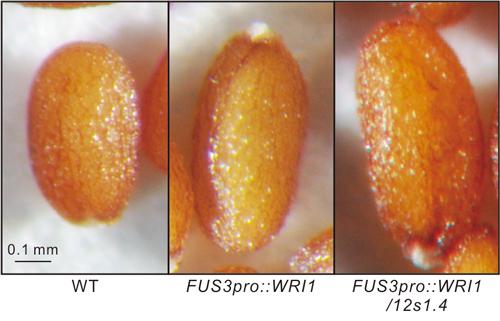
The research group considered that by extending the period seeds synthesize oils, they should be able to increase their oil content in seeds. Therefore, using the model plant Arabidopsis, they extended the expression time of WRI1, a gene that activates oil synthesis. As a result, they were able to increase the oil content of the seeds to 140% as compared to wild-type. Also, while extending the oil synthesis phase, suppressing protein synthesis in the late-phase of seed formation increased the oil content of the seeds as compared to wild-type to 170%.

Because of this study it is now clear that the length of the oil synthesis phase in seed formation is one of the primary factors that determine final oil content. Moreover, by suppressing protein synthesis while extending the oil synthesis period they succeeded in a further large increase in oil production.

Dr. Kanai of the research group, said "By applying the current results to crop breeding, prolonging the period of oil synthesis will generate many new crops with high oil content".

###

Journal Information

Plant Biotechnology Journal
"Extension of oil biosynthesis during the mid-phase of seed development enhances oil content in Arabidopsis seeds"
Masatake Kanai, Shoji Mano, Maki Kondo, Makoto Hayashi and Mikio Nishimura
DOI: 10.1111/pbi.12489


Share12Tweet8Share2ShareShareShare2

Related Posts

How Design, Modeling, and Spatial Analysis Shape Genomic Selection

How Design, Modeling, and Spatial Analysis Shape Genomic Selection

August 28, 2026
Complete Guazuma ulmifolia Genome Reveals Evolution, Drought Adaptation, and Flavonoid Biosynthesis

Complete Guazuma ulmifolia Genome Reveals Evolution, Drought Adaptation, and Flavonoid Biosynthesis

August 28, 2026

Genetic study identifies barley hotspots for inherited cold-stress resilience

August 28, 2026

Nasal CRISPR Lipid Nanoparticles Targeting MAPK9 Reduce Brain Inflammation After Traumatic Injury

August 28, 2026
Please login to join discussion

POPULAR NEWS

  • How Design, Modeling, and Spatial Analysis Shape Genomic Selection

    29 shares
    Share 12 Tweet 7
  • Complete Guazuma ulmifolia Genome Reveals Evolution, Drought Adaptation, and Flavonoid Biosynthesis

    29 shares
    Share 12 Tweet 7
  • Genetic study identifies barley hotspots for inherited cold-stress resilience

    29 shares
    Share 12 Tweet 7
  • Nasal CRISPR Lipid Nanoparticles Targeting MAPK9 Reduce Brain Inflammation After Traumatic Injury

    29 shares
    Share 12 Tweet 7

About

We bring you the latest biotechnology news from best research centers and universities around the world. Check our website.

Follow us

Recent News

How Design, Modeling, and Spatial Analysis Shape Genomic Selection

Complete Guazuma ulmifolia Genome Reveals Evolution, Drought Adaptation, and Flavonoid Biosynthesis

Genetic study identifies barley hotspots for inherited cold-stress resilience

Subscribe to Blog via Email

Enter your email address to subscribe to this blog and receive notifications of new posts by email.

Join 85 other subscribers
  • Contact Us

Bioengineer.org © Copyright 2023 All Rights Reserved.

Welcome Back!

Login to your account below

Forgotten Password?

Retrieve your password

Please enter your username or email address to reset your password.

Log In
No Result
View All Result
  • Homepages
    • Home Page 1
    • Home Page 2
  • News
  • National
  • Business
  • Health
  • Lifestyle
  • Science

Bioengineer.org © Copyright 2023 All Rights Reserved.