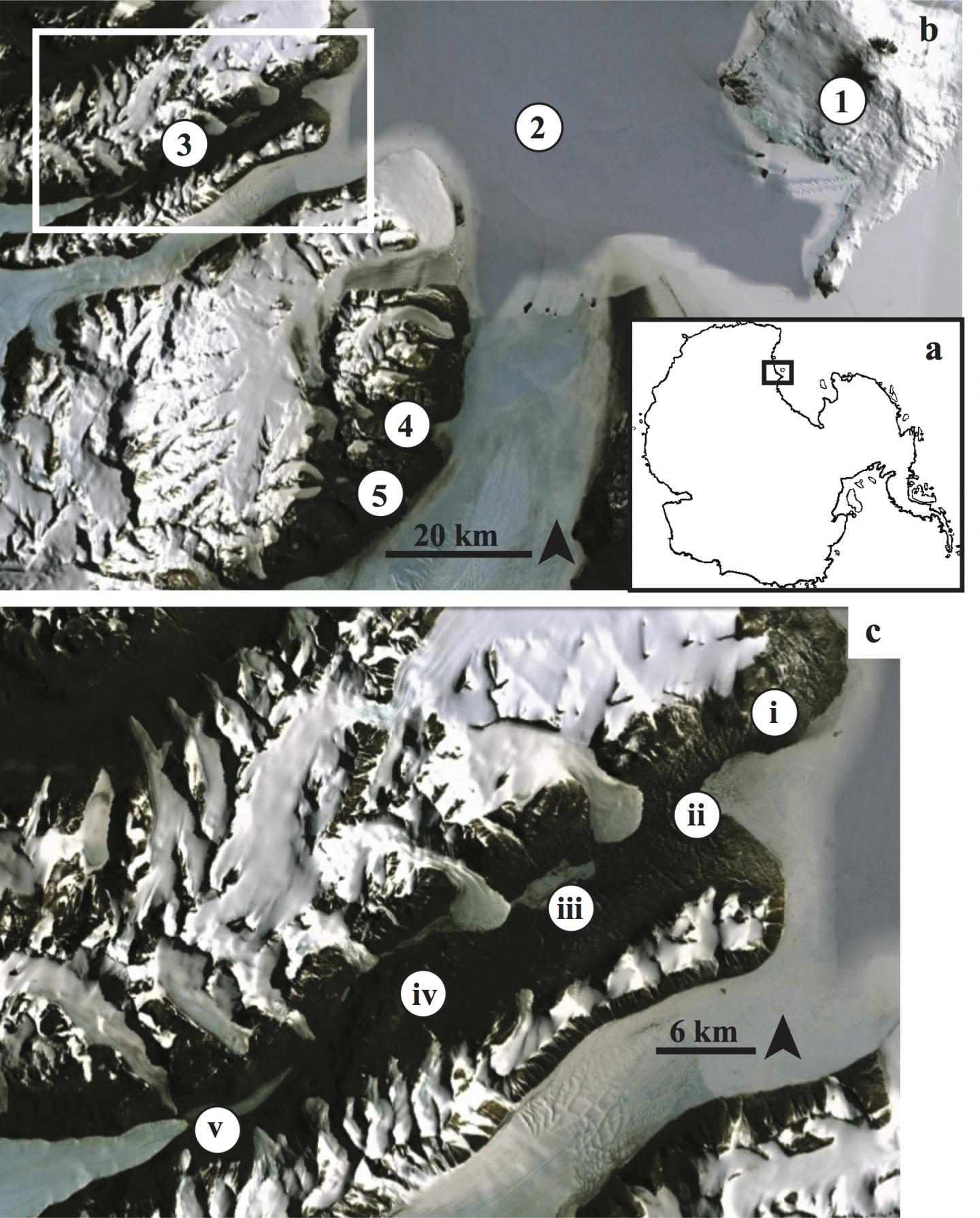
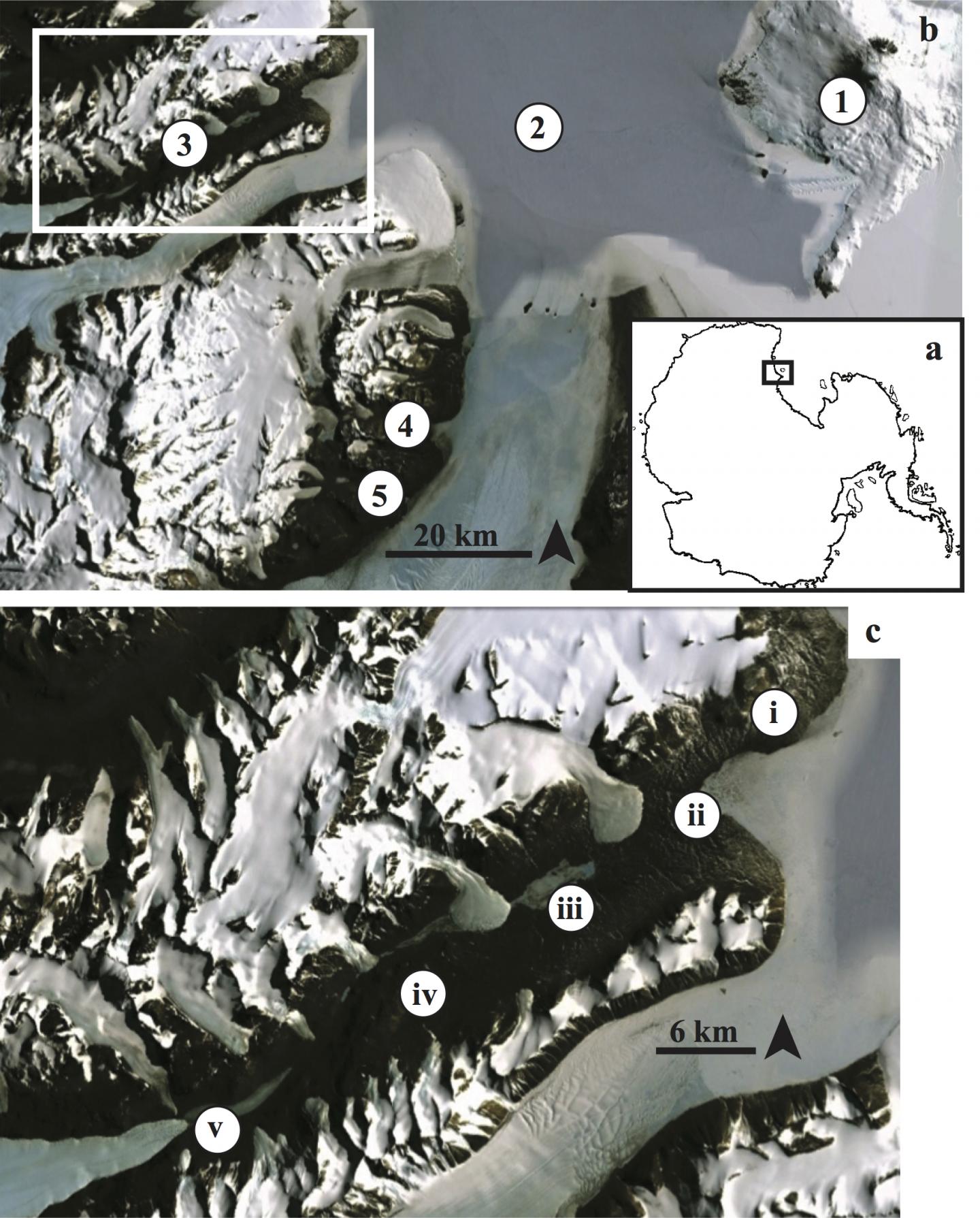
Credit: Satellite images provided by the Polar Geospatial Center. Graphic by Ruth Heindel.
As climate change continues to impact the Antarctic, glacier melt and permafrost thaw are likely to make more liquid water available to soil and aquatic ecosystems in the McMurdo Dry Valleys, potentially providing a more nutrient-rich environment for life, according to a Dartmouth study recently published in Antarctic Science. (A pdf of the study is available upon request).
With an average annual air temperature of -2.2 F and an average precipitation of 3-50 mm per year, the McMurdo Dry Valleys of Antarctica are dominated by dry soils underlain by permafrost. The Dry Valleys ecosystem is severely limited by liquid water and nutrients, resulting in limited organic matter. One such limited nutrient is phosphorus, an element that is essential to all living organisms. Understanding the spatial distribution of phosphorus in the soil is crucial to identifying where life could become more abundant in the future.
Dartmouth scientists examined the variability of soil phosphorus in the McMurdo Dry Valleys by evaluating two forms of phosphorus in surface soil samples: labile phosphorus, which is immediately available to organisms, and mineral phosphorus, which needs to be broken down by weathering before organisms can use it. The researchers analyzed how parent material, landscape age, soil chemistry and texture, and topography affect the two forms of phosphorus.
The findings indicate that in the McMurdo Dry Valleys, as for many other regions, the two forms of phosphorus, labile and mineral phosphorus, are not related. Even though rock type may be used to help predict the amount of mineral phosphorus in soils, it does not predict how much phosphorus is available to organisms. Instead, the available phosphorus was found to be correlated with soil conductivity, soil texture and topography. The findings also revealed that landscape age across a gradient of approximately 20,000 to 1.5 million years was not a strong predictor of either form of phosphorus.
"Mineral phosphorus, while not currently available to organisms, represents a large store of this essential nutrient that could become unlocked in the future," says lead author Ruth C. Heindel, a graduate student in earth sciences at Dartmouth.
As global warming continues to impact the McMurdo Dry Valleys of Antarctica, with more meltwater streams and water tracks travelling across the landscape, more mineral phosphorus is likely to become available through rock weathering over centuries to millennia. Phosphorus loads are also likely to increase to Dry Valleys aquatic ecosystems, which are currently some of the most phosphorus-limited ecosystems on the planet. As more phosphorus becomes available, microscopic organisms, such as nematodes, tardigrades, rotifers, algae and cyanobacteria, may become more abundant in the McMurdo Dry Valleys.
###
Ruth C. Heindel is available for comment at: [email protected]. Angela M. Spickard, research associate at Dartmouth; and Ross A. Virginia , Myers Family Professor of Environmental Science and director of the Institute of Arctic Studies at Dartmouth, also served as co-authors of the study.
Broadcast studios: Dartmouth has TV and radio studios available for interviews. For more information, visit: http://communications.dartmouth.edu/media/broadcast-studios.
Media Contact
Amy D. Olson
[email protected]
603-646-3274
@dartmouth
http://www.dartmouth.edu
############
Story Source: Materials provided by Scienmag