• HOME
  • NEWS
  • EXPLORE
    • CAREER
      • Companies
      • Jobs
    • EVENTS
    • iGEM
      • News
      • Team
    • PHOTOS
    • VIDEO
    • WIKI
  • BLOG
  • COMMUNITY
    • FACEBOOK
    • INSTAGRAM
    • TWITTER
Sunday, August 23, 2026
BIOENGINEER.ORG
No Result
View All Result
  • Login
  • HOME
  • NEWS
  • EXPLORE
    • CAREER
      • Companies
      • Jobs
        • Lecturer
        • PhD Studentship
        • Postdoc
        • Research Assistant
    • EVENTS
    • iGEM
      • News
      • Team
    • PHOTOS
    • VIDEO
    • WIKI
  • BLOG
  • COMMUNITY
    • FACEBOOK
    • INSTAGRAM
    • TWITTER
  • HOME
  • NEWS
  • EXPLORE
    • CAREER
      • Companies
      • Jobs
        • Lecturer
        • PhD Studentship
        • Postdoc
        • Research Assistant
    • EVENTS
    • iGEM
      • News
      • Team
    • PHOTOS
    • VIDEO
    • WIKI
  • BLOG
  • COMMUNITY
    • FACEBOOK
    • INSTAGRAM
    • TWITTER
No Result
View All Result
Bioengineer.org
No Result
View All Result
Home NEWS Science News Biology

Increased sample size in 2015 survey

Bioengineer by Bioengineer
July 14, 2017
in Biology
Reading Time: 2 mins read
0
Share on FacebookShare on TwitterShare on LinkedinShare on RedditShare on Telegram
IMAGE

Credit: Rob Margetta

The National Science Foundation's National Center for Science and Engineering Statistics has more than doubled the sample size of its 2015 Survey of Doctorate Recipients in order to examine employment characteristics for specific fields of degree for the first time.

The 2015 survey reports employment data for eight broad degree fields, as well as more than 200 "fine" fields of degree within those broad categories.

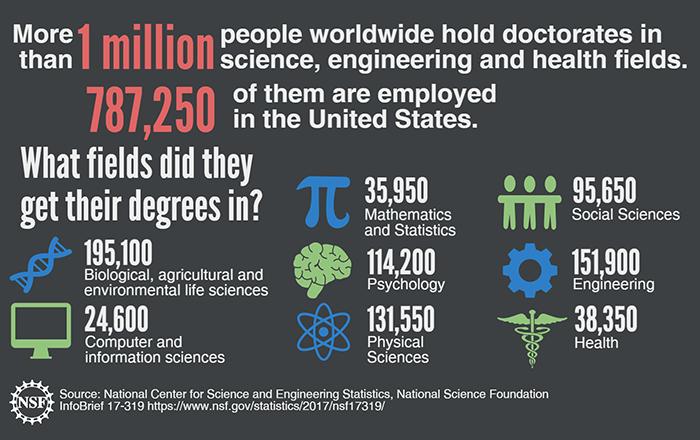
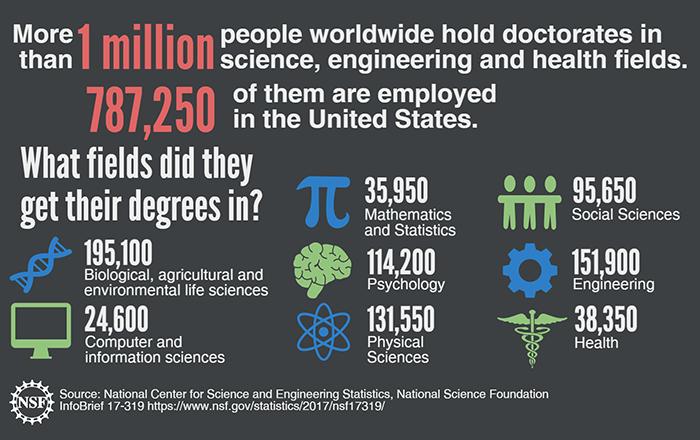
More than 1 million people worldwide held doctorates from U.S. institutions in science, engineering and health (SEH) fields. The 2015 survey sampled data from 120,000 people who had earned doctorates from U.S. institutions in SEH fields.

About 88 percent of SEH doctorate holders resided in the United States and 12 percent abroad. Of doctorate holders residing in the United States, 87 percent were part of the labor force, with 76 percent working full time. Of those not residing in the United States, 94 percent were part of the labor force.

In the United States, 47 percent of working doctorate holders were employed in the business/industry sector and 45 percent at educational institutions. Most of the doctorate holders working abroad (66 percent) were employed in the education sector.

Of doctorate holders residing in the United States, 41 percent were performing research and development (R&D) as their primary work activity. When R&D was reported as either a primary or secondary work activity, the rate increased to 63 percent.

Of the eight broad fields of degree in the survey, the rate of R&D as a primary activity ranged from 18 percent for psychology doctorate holders to 54 percent for engineering doctorate holders.

Nearly 40 percent of the U.S.-trained doctorate holders were born outside the United States, and 73 percent of this group remained in the United States in 2015. At the time of their graduation, doctorate holders born outside the United States included those with temporary visas (72 percent), permanent residents (15 percent), and U.S. citizens (13 percent).

###

For more information and detailed breakdowns of data, read the full report.

Media Contact

Stanley Dambroski
[email protected]
@NSF

http://www.nsf.gov

Share12Tweet8Share2ShareShareShare2

Related Posts

Delayed antiviral response in alveolar type 2 cells heightens influenza susceptibility

Delayed antiviral response in alveolar type 2 cells heightens influenza susceptibility

August 22, 2026
Genetic evidence links sleep disruption to hemorrhoidal disease, revealing a hidden connection

Genetic evidence links sleep disruption to hemorrhoidal disease, revealing a hidden connection

August 22, 2026

LASIK Versus Contact Lenses for Correcting Myopia

August 22, 2026

New Advances in Minimally Invasive Laryngeal Surgery

August 22, 2026
Please login to join discussion

POPULAR NEWS

  • ZCCHC4 boosts replication-dependent histone mRNA translation by interacting with eIF3

    29 shares
    Share 12 Tweet 7
  • KAIST Surface Defects Boost Droplet Formation, Removal, and Heat Transfer by 5.5-Fold

    29 shares
    Share 12 Tweet 7
  • Dual-oxygen pancreatic cancer organoids mirror basal-classical diversity, spatial transcriptomics confirms

    29 shares
    Share 12 Tweet 7
  • Tirzepatide Versus GLP-1 Agonists for Stroke Risk in Atrial Fibrillation and Diabetes

    29 shares
    Share 12 Tweet 7

About

We bring you the latest biotechnology news from best research centers and universities around the world. Check our website.

Follow us

Recent News

ZCCHC4 boosts replication-dependent histone mRNA translation by interacting with eIF3

KAIST Surface Defects Boost Droplet Formation, Removal, and Heat Transfer by 5.5-Fold

Dual-oxygen pancreatic cancer organoids mirror basal-classical diversity, spatial transcriptomics confirms

Subscribe to Blog via Email

Success! An email was just sent to confirm your subscription. Please find the email now and click 'Confirm' to start subscribing.

Join 85 other subscribers
  • Contact Us

Bioengineer.org © Copyright 2023 All Rights Reserved.

Welcome Back!

Login to your account below

Forgotten Password?

Retrieve your password

Please enter your username or email address to reset your password.

Log In
No Result
View All Result
  • Homepages
    • Home Page 1
    • Home Page 2
  • News
  • National
  • Business
  • Health
  • Lifestyle
  • Science

Bioengineer.org © Copyright 2023 All Rights Reserved.