• HOME
  • NEWS
  • EXPLORE
    • CAREER
      • Companies
      • Jobs
    • EVENTS
    • iGEM
      • News
      • Team
    • PHOTOS
    • VIDEO
    • WIKI
  • BLOG
  • COMMUNITY
    • FACEBOOK
    • INSTAGRAM
    • TWITTER
Friday, June 5, 2026
BIOENGINEER.ORG
No Result
View All Result
  • Login
  • HOME
  • NEWS
  • EXPLORE
    • CAREER
      • Companies
      • Jobs
        • Lecturer
        • PhD Studentship
        • Postdoc
        • Research Assistant
    • EVENTS
    • iGEM
      • News
      • Team
    • PHOTOS
    • VIDEO
    • WIKI
  • BLOG
  • COMMUNITY
    • FACEBOOK
    • INSTAGRAM
    • TWITTER
  • HOME
  • NEWS
  • EXPLORE
    • CAREER
      • Companies
      • Jobs
        • Lecturer
        • PhD Studentship
        • Postdoc
        • Research Assistant
    • EVENTS
    • iGEM
      • News
      • Team
    • PHOTOS
    • VIDEO
    • WIKI
  • BLOG
  • COMMUNITY
    • FACEBOOK
    • INSTAGRAM
    • TWITTER
No Result
View All Result
Bioengineer.org
No Result
View All Result
Home NEWS Science News Health

In vivo production of CAR-T cells using virus-mimetic fusogenic nanovesicles

Bioengineer by Bioengineer
March 15, 2024
in Health
Reading Time: 2 mins read
0
CAR transfer, a new method for in vivo CAR-T production.
Share on FacebookShare on TwitterShare on LinkedinShare on RedditShare on Telegram

Chimeric antigen receptors (CARs) are synthesized membrane proteins that enable lymphocytes to recognize and respond to the specific antigens of target cells. Despite the impressive efficacy of CAR-T cell therapy in treating B-cell lymphoma or leukemia, the expensive and complex manufacturing process has hindered its widespread clinical application.
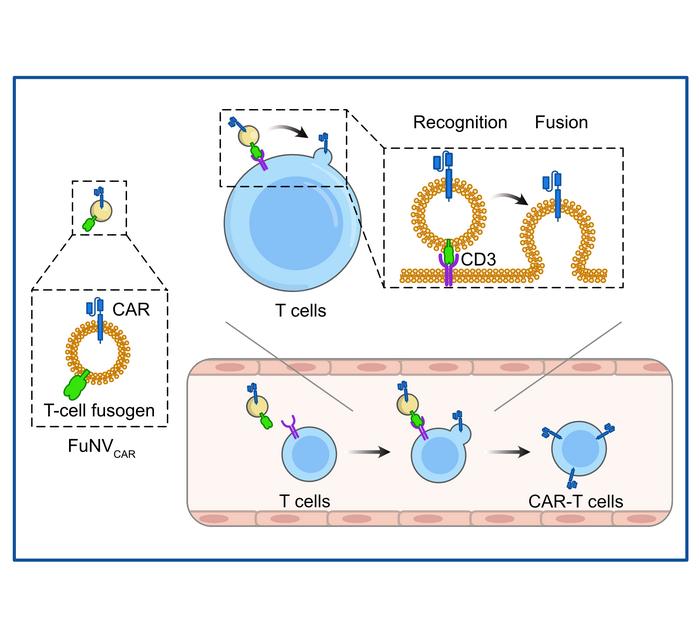
CAR transfer, a new method for in vivo CAR-T production.

Credit: ©Science China Press

Chimeric antigen receptors (CARs) are synthesized membrane proteins that enable lymphocytes to recognize and respond to the specific antigens of target cells. Despite the impressive efficacy of CAR-T cell therapy in treating B-cell lymphoma or leukemia, the expensive and complex manufacturing process has hindered its widespread clinical application.

Previous research has explored the use of nanoparticles for delivering nucleic acids to program circulating T cells in vivo, streamlining CAR-T cell generation and obviating the need for isolating T cells from patients. Meanwhile, inserting the CAR protein directly into the T cell membrane could present a straightforward method, circumventing complications such as cytokine release syndrome (CRS) and the tumorigenic risk associated with random viral gene insertion into the genome.

Led by Prof. Jun Wang and Prof. Cong-Fei Xu from the School of Biomedical Sciences and Engineering at South China University of Technology, researchers have developed a promising strategy that involves the direct fusion of CAR molecules, pre-expressed on fusogenic nanovesicles (FuNVs), to T cells, thereby constructing CAR-T cells in vivo. They engineered the T-cell fusogen by adding an anti-CD3 single-chain variable fragment to the reovirus or the measles virus fusogen. They demonstrated that FuNVs derived from T-cell fusogen-expressing cells carried a substantial quantity of T-cell fusogen, which efficiently induced the fusion between NVs and T cells both in vitro and in vivo. Subsequently, considering the clinical success of anti-CD19 (αCD19) CAR-T cells, the engineered cells expressing T-cell fusogen and αCD19 CAR protein were constructed to produce αCD19 CAR-carrying FuNVs (FuNVCAR). CAR-T cell production was successfully achieved by delivering CAR protein onto T-cells via FuNVCAR in vitro and in vivo. Meanwhile, intravenous injection of FuNVCAR effectively inhibited B-cell lymphoma growth.

To further explore the potential toxicity of FuNVCAR, blood counts and serum biochemical analyses were conducted at 2 days and 14 days, demonstrating comparability to the control group. Throughout the treatment with FuNVCAR, no significant alterations in body weight were observed in mice. Furthermore, in contrast to traditional CAR-T cell treatment, treatment with FuNVCAR did not induce an elevated release of inflammatory cytokines. This observed difference can be attributed to transient CAR-T cells produced by FuNVCAR, which undergoes limited and temporary activation, mitigating the sustained release of inflammatory cytokines.

In summary, this study introduces a novel approach for in vivo CAR-T cell production through FuNV-mediated CAR protein delivery. It is essential to note, however, that this strategy may not be suitable for patients with compromised T cell function.


Journal

Science Bulletin

DOI

10.1016/j.scib.2023.11.055

Share12Tweet8Share2ShareShareShare2

Related Posts

Omicron BA.2.86, JN.1 Broaden Intestinal Cell Tropism

June 5, 2026

Neurofilament Light, GFAP: Biomarkers for Postoperative Delirium

June 5, 2026

Major Trial Finds Finerenone Slows Kidney Decline and Lowers Cardiovascular Risk in Non-Diabetic Chronic Kidney Disease

June 5, 2026

New Study Links Common Blood Pressure Medication to Worsened Kidney Outcomes in Type 2 Diabetes

June 5, 2026

POPULAR NEWS

  • ESMO 2025: mRNA COVID Vaccines Enhance Efficacy of Cancer Immunotherapy

    321 shares
    Share 128 Tweet 80
  • Multi-Hospital Study Reveals Long Covid Burden Is Twice as High as Current Estimates

    88 shares
    Share 35 Tweet 22
  • Saying Goodbye to PGY-6: Pediatric Fellowship Realities

    76 shares
    Share 30 Tweet 19
  • Common Food Preservatives Associated with Elevated Blood Pressure and Increased Heart Disease Risk

    57 shares
    Share 23 Tweet 14

About

We bring you the latest biotechnology news from best research centers and universities around the world. Check our website.

Follow us

Recent News

Here’s a revised version of your headline for a science magazine post: “After Years of Searching, We Discovered ‘The Heaven Sword’ — East Asia’s Tallest Tree”

Evaluating Neuroprotective Drugs in Neonatal Rodent Brain Injury

Omicron BA.2.86, JN.1 Broaden Intestinal Cell Tropism

Subscribe to Blog via Email

Enter your email address to subscribe to this blog and receive notifications of new posts by email.

Join 82 other subscribers
  • Contact Us

Bioengineer.org © Copyright 2023 All Rights Reserved.

Welcome Back!

Login to your account below

Forgotten Password?

Retrieve your password

Please enter your username or email address to reset your password.

Log In
No Result
View All Result
  • Homepages
    • Home Page 1
    • Home Page 2
  • News
  • National
  • Business
  • Health
  • Lifestyle
  • Science

Bioengineer.org © Copyright 2023 All Rights Reserved.