In a groundbreaking advancement that could redefine the future of cancer immunotherapy, researchers have engineered an innovative in vivo “charging station” system designed to supercharge chimeric antigen receptor-invariant natural killer T (CAR-iNKT) cells. Published recently in Nature Biomedical Engineering, this research addresses one of the pivotal challenges limiting the widespread success of CAR-iNKT cell therapies—namely, the insufficient activation and poor persistence of these immune cells within the hostile tumor microenvironment. This next-generation platform cleverly mimics natural immunologic cues, effectively turning the patient’s body into a nurturing arena for potent and sustained anti-tumor immunity.
Invariant natural killer T (iNKT) cells have long captivated immunologists due to their unique properties bridging innate and adaptive immunity. These cells possess the remarkable ability to recognize lipid antigens presented by the non-polymorphic CD1d molecule, distinguishing them sharply from conventional T cells that respond to peptide antigens. Leveraging this specificity, CAR-iNKT cells have emerged as promising candidates in cancer immunotherapy, particularly for solid tumors, where their inherent tumor-homing capabilities provide a crucial therapeutic edge. Yet, despite their potential, clinical outcomes thus far have been hampered by the tumor microenvironment’s ability to curb cell activation and diminish cell survival over time.
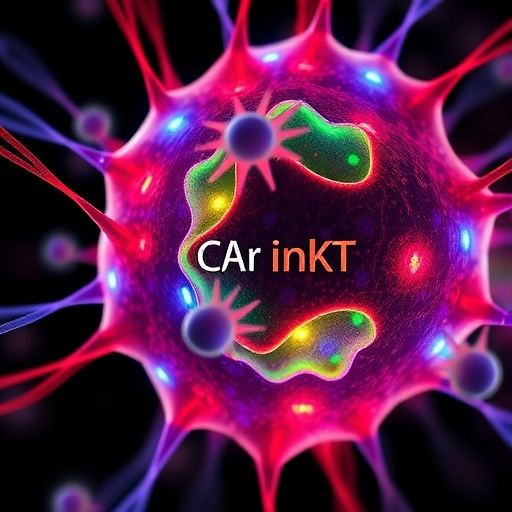
The new study, spearheaded by Li, Nan, Liu, and colleagues, introduces what is termed the iNKT cell-targeted microparticle recruitment and activation system (iMRAS). This biomimetic platform acts as an in vivo “charging station,” strategically implanted or injected in the patient to locally recruit, activate, and expand CAR-iNKT cells precisely where they are needed the most. By providing essential chemotactic signals as well as powerful activating cues, iMRAS essentially recharges exhausted CAR-iNKT cells, fostering a sustained cytotoxic assault on tumor cells that traditional approaches have struggled to maintain.
Unlike systemic administration of stimulatory cytokines or checkpoint inhibitors — approaches which often result in widespread immune-related adverse events — iMRAS focuses on localized modulation within the tumor vicinity. This level of precision activation reduces off-target effects, increasing safety while amplifying therapeutic efficacy. The system’s design incorporates multiple biomolecules that mimic natural signals in the immune system, including chemokines and co-stimulatory ligands, to orchestrate a supportive microenvironment that enhances CAR-iNKT cell recruitment and functional activation.
In preclinical lymphoma and melanoma models, the benefits of iMRAS were striking. The researchers demonstrated that implanted microparticles could recruit a significantly higher number of CAR-iNKT cells compared to controls and sustain their presence over an extended period within the tumor microenvironment. Moreover, these recharged immune cells exhibited enhanced proliferation and cytokine secretion, critical hallmarks of durable antitumor immunity. Tumor growth was notably suppressed, and overall survival in treated animals improved substantially, heralding a promising therapeutic trajectory for future human applications.
This nuanced approach to cell therapy optimization tackles inherent challenges in the tumor microenvironment that often render immunotherapies ineffective. Tumors typically create a suppressive milieu characterized by hypoxia, nutrient competition, and immunosuppressive cytokines, all which collectively impair T cell functionality. By using a localized microparticle system engineered with a biomimetic strategy, iMRAS directly counters these suppressive mechanisms, essentially transforming the tumor site into an immune-stimulatory niche conducive to cell expansion and sustained activity.
The implications of this technology extend beyond immediate tumor control. By enhancing CAR-iNKT cell persistence, iMRAS could reduce the necessity for repeated cell infusions, a significant logistical and financial burden in current CAR-based therapies. This in vivo “charging station” model represents a shift toward more self-sustaining immunotherapies where engineered cells not only perform but renew and amplify their own activity autonomously within the body.
Furthermore, this system’s modular nature suggests it could be adapted for other cellular therapies, potentially including conventional CAR-T cells or other engineered lymphocytes that benefit from localized activation and expansion cues. This versatility could accelerate the broader application of cell-based immunotherapies to a wider variety of solid tumors that have so far proven elusive targets for immune interventions.
The concept of using biomimetic microparticles to modulate immune cell fate in situ forms a compelling narrative in the evolving landscape of cancer immunotherapy, where merging materials science with cellular engineering holds the key to overcoming previous limitations. It is a vivid illustration of how combining deep immunological insight with innovative biomaterial platforms can yield therapies poised to recalibrate immune responses with spatial and temporal precision.
This advancement also reflects an important philosophical shift in immunotherapy design: moving away from systemic immune modulation—often seen as a double-edged sword—to localized, highly targeted strategies that educate and sustain immune effectors exactly where they are needed. By focusing on enhancing natural immune mechanisms rather than indiscriminate activation, such platforms promise safer and more effective cancer treatments.
While further studies are needed to confirm safety, dosage optimization, and efficacy in human trials, the preclinical success of the iMRAS platform shines a hopeful light on the path toward overcoming the long-standing challenges of immune exhaustion and limited cell persistence in cancer therapy. If successfully translated, the technology could significantly extend the lifespan and potency of CAR-iNKT cells, ultimately improving outcomes for patients facing hard-to-treat solid tumors.
In an era where cancer immunotherapy continues to evolve rapidly, this study highlights the power of inventive bioengineering to transform cellular therapies into living drugs empowered by intelligent design. The ability to orchestrate in vivo immune cell recruitment and activation in real-time embodies the next frontier in precision medicine, addressing unmet clinical needs with sophisticated, yet practical, solutions.
The iMRAS platform embodies the convergence of immunology, biomaterials engineering, and cellular therapy innovation—a triad of disciplines converging to push boundaries previously thought insurmountable. This work not only advances the therapeutic potential of CAR-iNKT cells but also underscores the critical importance of the tumor microenvironment in dictating therapy outcomes, offering new avenues for combinatorial or sequential interventions.
As researchers continue to optimize this “charging station” model, they open the door to a new class of hybrid biomaterials that can coexist synergistically with living cells inside the body. This partnership between synthetic platforms and living immune cells illustrates the exciting future of bioinspired therapies capable of adapting dynamically to complex biological landscapes.
Ultimately, what Li, Nan, Liu, and their team have demonstrated is more than a new therapeutic candidate—it is a transformative concept. The in vivo charging station redefines how we think about immune cell therapy by offering a readily deployable, tunable, and robust mechanism to invigorate immune effectors at the battlefront of cancer. For patients and clinicians, this could herald a new generation of powerful, yet safer, immunotherapies that shift the odds decisively in favor of lasting cancer control.
Subject of Research: Engineering a biomimetic platform to recruit, activate, and expand CAR-redirected invariant natural killer T cells for improved cancer immunotherapy outcomes.
Article Title: Engineering an in vivo charging station for CAR-redirected invariant natural killer T cells to enhance cancer therapy.
Article References:
Li, YR., Nan, H., Liu, Z. et al. Engineering an in vivo charging station for CAR-redirected invariant natural killer T cells to enhance cancer therapy. Nat. Biomed. Eng (2026). https://doi.org/10.1038/s41551-026-01629-3
Image Credits: AI Generated
DOI: https://doi.org/10.1038/s41551-026-01629-3
Tags: cancer immunotherapy advancementsCD1d molecule targetingchimeric antigen receptor therapiesimmune cell persistence enhancementin vivo CAR-iNKT cell activationinvariant natural killer T cellslipid antigen recognition by iNKT cellsnext-generation cancer cell therapiesnovel immunologic cue mimickingsolid tumor immunotherapysustained anti-tumor immunitytumor microenvironment challenges