

• HOME
  • NEWS
  • EXPLORE
    • CAREER
      • Companies
      • Jobs
    • EVENTS
    • iGEM
      • News
      • Team
    • PHOTOS
    • VIDEO
    • WIKI
  • BLOG
  • COMMUNITY
    • FACEBOOK
    • INSTAGRAM
    • TWITTER
Wednesday, April 8, 2026
BIOENGINEER.ORG
No Result
View All Result
  • Login
  • HOME
  • NEWS
  • EXPLORE
    • CAREER
      • Companies
      • Jobs
        • Lecturer
        • PhD Studentship
        • Postdoc
        • Research Assistant
    • EVENTS
    • iGEM
      • News
      • Team
    • PHOTOS
    • VIDEO
    • WIKI
  • BLOG
  • COMMUNITY
    • FACEBOOK
    • INSTAGRAM
    • TWITTER
  • HOME
  • NEWS
  • EXPLORE
    • CAREER
      • Companies
      • Jobs
        • Lecturer
        • PhD Studentship
        • Postdoc
        • Research Assistant
    • EVENTS
    • iGEM
      • News
      • Team
    • PHOTOS
    • VIDEO
    • WIKI
  • BLOG
  • COMMUNITY
    • FACEBOOK
    • INSTAGRAM
    • TWITTER
No Result
View All Result
Bioengineer.org
No Result
View All Result
Home NEWS Science News Health

In search of biomarkers to detect patients with latent ‘Plasmodium vivax’ infection

Bioengineer by Bioengineer
June 26, 2018
in Health
Reading Time: 2 mins read
0
Share on FacebookShare on TwitterShare on LinkedinShare on RedditShare on Telegram
IMAGE

Credit: M. Gualdrón-López

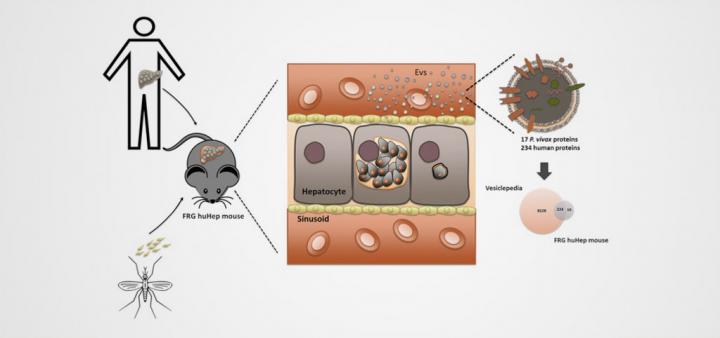
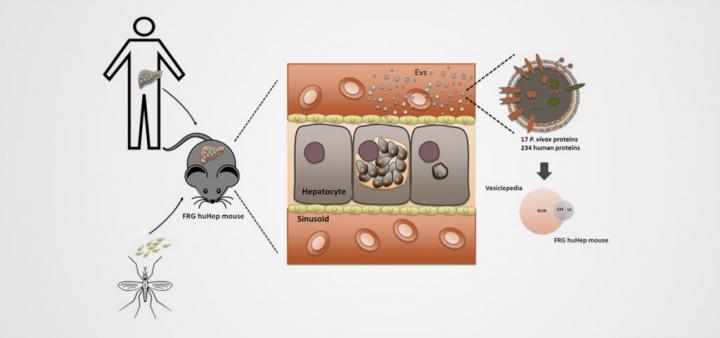
Proteins derived from the latent liver stage of Plasmodium vivax can be detected in small extracellular vesicles that circulate in blood, according to a study led by ISGlobal, an institution supported by "la Caixa" Foundation. The results pave the way for identifying patients with asymptomatic infections, an essential requirement to stop parasite transmission.

P. vivax is the predominant malaria parasite outside Africa and causes around 16 million cases per year. Although considered less lethal than malaria falciparum, malaria vivax can also cause severe disease and is associated with considerable morbidity and mortality in endemic regions. In addition, malaria vivax constitutes one of the greatest obstacles to achieving WHO's target of eliminating malaria from 35 countries by 2030. This is because the parasite can remain latent in the liver during several years after the initial infection, without causing any symptoms. Reactivation of the latent phase (called hypnozoite) causes disease relapse and allows for the possibility of transmitting the parasite to other people. Currently, there are no diagnostic tools capable of detecting asymptomatic hypnozoite carriers.

In this study, the research team led by Hernando A del Portillo (ICREA) and Carmen Fernandez-Becerra, researchers at ISGlobal and the Trias i Pujol Research Institute (IGTP), explored the possibility of using blood circulating exosomes (small vesicles secreted by different cells) to detect the presence of hypnozoites in the liver. For this, they used a new experimental model developed by their collaborators at CIDR in Seattle: 'humanised' mice that contain human liver cells and can therefore be infected by P. vivax. From the blood of these mice, postdoc student Melisa Gualdrón-López managed to isolate human-derived exosomes that contained up to 17 different hypnozoite proteins, including a previously uncharacterized protein.

"These results are a proof-of-concept that liver-derived exosomes can help us identify biomarkers of hypnozoite infection and hopefully develop diagnostic tests for these asymptomatic patients," says del Portillo. Moreover, this experimental model will provide valuable insights into the liver infection phase.

"This work is the result of a SUMA project in collaboration with Juan Ramón González, and set the basis for a NIH-funded project that will further explore this line of research," adds del Portillo.

###

Media Contact

Adelaida Sarukhan
[email protected]
0034-932-271-816

http://www.isglobal.org/en/

Original Source

https://www.isglobal.org/en/new/-/asset_publisher/JZ9fGljXnWpI/content/buscando-biomarcadores-para-detectar-pacientes-con-infeccion-latente-por-plasmodium-vivax- http://dx.doi.org/10.3389/fmicb.2018.01271


Share12Tweet7Share2ShareShareShare1

Related Posts

Active Arcade Gaming Boosts Psychosocial Health in Homebound Seniors

April 8, 2026

How Fungal Ear Infections in Dogs Evade Treatment Reveals New Insights for Veterinary Drug Stewardship

April 8, 2026

Low-Field MRI Revolutionizes Global Dementia Care

April 7, 2026

Nasir Bashir Awarded 2026 IADR John Clarkson Fellowship

April 7, 2026
Please login to join discussion

POPULAR NEWS

  • blank

    Revolutionary AI Model Enhances Precision in Detecting Food Contamination

    98 shares
    Share 39 Tweet 25
  • Imagine a Social Media Feed That Challenges Your Views Instead of Reinforcing Them

    1010 shares
    Share 399 Tweet 250
  • Popular Anti-Aging Compound Linked to Damage in Corpus Callosum, Study Finds

    44 shares
    Share 18 Tweet 11
  • Promising Outcomes from First Clinical Trials of Gene Regulation in Epilepsy

    51 shares
    Share 20 Tweet 13

About

We bring you the latest biotechnology news from best research centers and universities around the world. Check our website.

Follow us

Recent News

Active Arcade Gaming Boosts Psychosocial Health in Homebound Seniors

Retracted Study on AI Transparency in Stroke Prediction

Breakthrough in Precise Synthesis of Chiral Cyclic Imine Esters via Transient Binary Copper Co-Catalysis

Subscribe to Blog via Email

Enter your email address to subscribe to this blog and receive notifications of new posts by email.

Join 78 other subscribers
  • Contact Us

Bioengineer.org © Copyright 2023 All Rights Reserved.

Welcome Back!

Login to your account below

Forgotten Password?

Retrieve your password

Please enter your username or email address to reset your password.

Log In
No Result
View All Result
  • Homepages
    • Home Page 1
    • Home Page 2
  • News
  • National
  • Business
  • Health
  • Lifestyle
  • Science

Bioengineer.org © Copyright 2023 All Rights Reserved.
