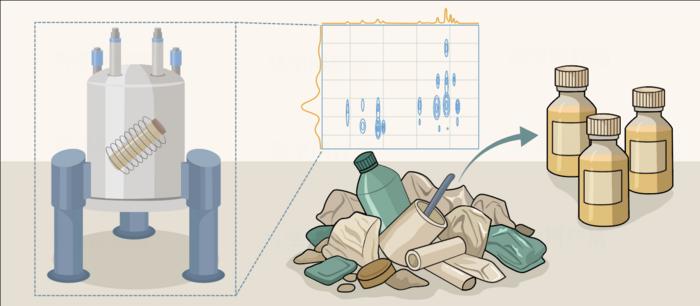
The ever-growing crisis of plastic pollution continues to cast a long shadow over ecosystems and wildlife worldwide. Billions of tons of plastic waste accumulate in oceans, landfills, and natural habitats each year, posing severe environmental hazards. Despite global efforts to recycle and manage these materials, the heterogeneous and complex nature of real-life plastic waste mixtures presents an enormous challenge for current recycling technologies. Addressing these obstacles demands innovative analytical tools to accurately identify and separate the diverse plastic components embedded within these mixtures before effective catalytic recycling can take place.
In a groundbreaking study recently published in Nature, an interdisciplinary research team led by Prof. XU Shutao at the Dalian Institute of Chemical Physics (DICP), in collaboration with Prof. WANG Meng and Prof. MA Ding from Peking University, has deployed an advanced solid-state nuclear magnetic resonance (NMR) technique to revolutionize the analysis of complex plastic waste streams. This state-of-the-art methodology enables precise characterization of the intricate chemical architecture of real-life plastics, thereby guiding highly selective separation and catalytic transformation processes.
Unlike conventional NMR, which predominantly analyzes soluble materials, solid-state NMR spectroscopy is uniquely suited for studying insoluble and heterogeneous substances such as polymers and plastic waste. The researchers harnessed a sophisticated variant known as the 1H-13C Frequency Switched Lee-Goldburg Heteronuclear Correlation (FSLG-HETCOR) NMR. This approach offers enhanced spectral resolution and sensitivity by mitigating homonuclear dipolar couplings, thus revealing distinctly resolved “fingerprints” of different polymeric components within a complex matrix.
.adsslot_1sM0C5BUGk{ width:728px !important; height:90px !important; }
@media (max-width:1199px) { .adsslot_1sM0C5BUGk{ width:468px !important; height:60px !important; } }
@media (max-width:767px) { .adsslot_1sM0C5BUGk{ width:320px !important; height:50px !important; } }
ADVERTISEMENT
Through meticulous optimization of experimental parameters—including spinning rate, contact time, and decoupling field strength—and calibration using 13C-labeled tyrosine hydrochloride as a reference standard, the team deciphered the subtle spectral signatures of an eight-component plastic mixture. This mixture simulated real-world plastic wastes and comprised polystyrene (PS), polylactic acid (PLA), polyurethane (PU), polycarbonate (PC), polyvinyl chloride (PVC), polyethylene terephthalate (PET), polyethylene (PE), and polypropylene (PP).
The resulting spectra exhibited unprecedented clarity, enabling the precise identification of unique functional groups characteristic of each polymer type. This resolution permitted real-time tracking of chemical changes as the plastics underwent catalytic transformations. Such insight is indispensable for optimizing reaction conditions that selectively convert heterogeneous plastic feedstocks into useful monomers or high-value chemical products.
Perhaps most strikingly, the novel NMR technique proved its versatility and robustness by monitoring the entire catalytic process—from the initial complex plastic waste mixture through orthogonal separation stages to the generation of multiple valuable chemicals. This capability establishes solid-state NMR not only as an analytical tool but as a guiding technology directing the engineering of scalable recycling systems that harmonize efficiency with environmental sustainability.
Prof. XU emphasized the transformative potential of this technology, noting that solid-state NMR acts as a “guiding eye” during plastic recycling. By isolating individual components and monitoring their molecular evolution in situ, the technique paves the way for integrated catalytic frameworks that can tackle the plastic pollution crisis on an industrial scale. Such frameworks could consolidate disparate recycling methods, improving overall yield and reducing waste.
The implications of this research extend beyond mere identification. Understanding the molecular-level interactions and transformation pathways of plastics during catalytic processing provides a rational basis for designing targeted catalysts and reaction protocols to maximize recovery of monomers and minimize hazardous byproducts. It bridges a critical knowledge gap that has long hindered efficient plastic upcycling.
Importantly, this study underscores the role of advanced spectroscopic techniques as indispensable tools in environmental chemistry and materials science. Solid-state NMR’s ability to analyze intact, insoluble, and chemically complex samples in their native state represents a paradigm shift in how researchers investigate polymer mixtures. This capability could be extended to a wide range of synthetic and natural polymer systems, broadening its impact.
The team’s achievement also highlights the importance of interdisciplinary collaboration, combining expertise in spectroscopy, polymer chemistry, catalysis, and environmental engineering. Such integrative approaches are essential to tackle multifaceted problems like plastic waste management that demand both fundamental understanding and practical solutions.
Future research inspired by this study may refine NMR techniques further, integrating them with in-line monitoring systems and machine learning-based spectral interpretation. These enhancements could accelerate process optimization and facilitate real-time quality control in industrial recycling facilities. Ultimately, this would contribute to a systemic shift in plastic lifecycle management, reducing reliance on virgin fossil feedstocks.
In sum, this pioneering application of solid-state NMR spectroscopy transcends conventional characterization methods, delivering profound insights into the chemical complexity of plastic waste mixtures. It enables targeted catalytic separation and conversion strategies essential for transforming our approach to plastic pollution. The study is a beacon of scientific innovation with tangible societal and ecological impact, illuminating pathways to a cleaner and more sustainable future.
Subject of Research: Not applicable
Article Title: In-line NMR guided orthogonal transformation of real-life plastics
News Publication Date: 25-Jun-2025
Web References:
https://www.nature.com/articles/s41586-025-09088-7
DOI: 10.1038/s41586-025-09088-7
Image Credits: DICP
Keywords
NMR spectroscopy, Catalysis
Tags: advanced analytical tools for recyclingcatalytic transformation of plasticscharacterization of polymer structuresDalian Institute of Chemical Physics researchenvironmental hazards of plastic accumulationheterogeneous plastic waste analysisinnovative recycling technologiesinterdisciplinary research in environmental scienceplastic pollution crisisreal-life plastic waste managementselective separation methods for plasticssolid-state nuclear magnetic resonance