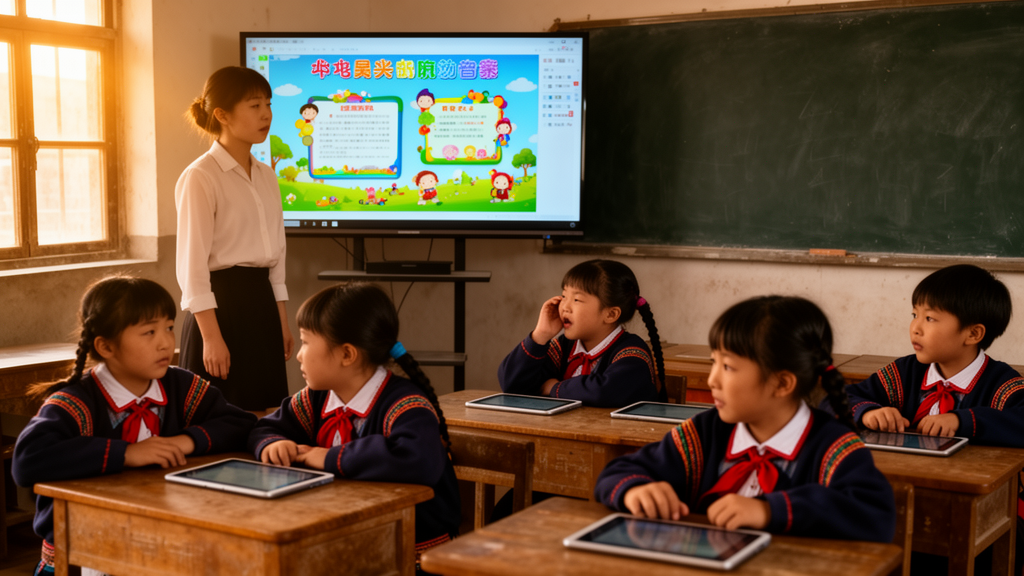
In a region of China where more than half the population speaks a minority language or dialect at home, primary schools are richly equipped with digital tools, yet those tools are rarely used to directly bridge the gap between children’s home languages and Mandarin-medium instruction. That is the central finding of a new interview-based study of two primary schools in the Guangxi Zhuang Autonomous Region, published in June 2026 in the journal AI, Brain and Child.
The research team, led by Yiying Wan of The Education University of Hong Kong with colleagues including Cher Ping Lim, interviewed 91 people across four stakeholder groups: two principals, twenty teachers, nineteen parents, and fifty Grade 4 students. The one-on-one, semi-structured interviews were conducted in June 2024 over a single week, audio-recorded, transcribed, and analyzed using thematic analysis guided by Braun and Clarke’s approach, with coding techniques adapted from grounded theory. The study was framed by Bronfenbrenner’s ecological systems theory, treating the classroom and the home as two microsystems that shape how children encounter technology.
The setting matters. The Chinese Mainland has 56 officially recognized ethnic groups, and Mandarin is the legally designated national language and the standardized medium of instruction. Guangxi, in southern China, is one of the country’s five autonomous regions and home to Zhuang, Yao, Dong, and other ethnic minority groups, with linguistic minority populations constituting over half of the provincial population. Children whose mother tongue is a local dialect or an ethnic minority language must learn content delivered in a language that may be linguistically distant from their own, and research has suggested that reaching age-appropriate academic proficiency in a dominant school language can take four to seven years.
What the researchers found was a school environment where technology integration is physically robust but pedagogically generic. Both principals described dedicated computer rooms, computers for teachers, and widely used multimedia devices such as Seewo screens and the Baguitong platform. All twenty teachers reported using technology in class, incorporating videos to enhance understanding during reading lessons and deploying multimedia devices to implement differentiated instruction within the same lesson. Notably, fifteen of the twenty teachers, or 75 percent, described using technology to support the learning of linguistic minority students, typically through videos, images, and audio materials used to discuss cultural customs. Yet the support these students received was described as comparable to that given to Han Chinese students, and the authors found that this support often prioritized cultural representation over targeted linguistic intervention.
Indeed, the study’s most striking conclusion is what was absent. The forms of scaffolding observed in the data were largely presentation-oriented, involving videos, pictures, audio materials, lesson recordings, and differentiated courseware aimed at general comprehension and classroom participation. Targeted language scaffolds, such as subtitles, bilingual explanations, speech-to-text, text-to-speech, or dialect-aware support, were absent from the accounts. Only one principal highlighted the use of technology specifically to support linguistic minority students, describing teachers who recorded lessons with multimedia devices and shared the recordings with minority students’ parents via mobile phones. The authors conclude that technology serves as a multimodal bridge to aid comprehension, but that its potential to address the medium-of-instruction mismatch remains largely indirect.
Stakeholders also voiced substantial reservations. Principals expressed mixed attitudes about technology’s impact on students, acknowledging benefits such as boosted engagement and broadened vision while worrying about the entertainment aspects of electronic devices, distraction, and harm to eyesight, and noting that schools regulate mobile phone use accordingly. Teachers were generally positive, with twelve of twenty, or 60 percent, holding favorable views of technology for students, but eight of twenty raised concerns about excessive exposure, eyesight, potential addiction, and possible erosion of reading and writing skills. Few teachers expected improvements in technology supporting students’ learning, with only three of twenty, or 15 percent, expressing such hopes, though they wished for better filtering functions, eye protection modes, and more inclusive content about ethnic minorities.
The home microsystem told a different story, one structured by supervision rather than exploration. Among the fifty students, 96 percent reported primarily using technology for studying, with mobile phones the most frequently used devices, followed by computers, tablets, point-reading pens, and projectors. But 92 percent described limits on use duration, such as restrictions to weekends or vacations and time caps of ten to twenty minutes or up to half an hour at a stretch. Parents reported similar patterns, with 84 percent implementing time limits and describing supervision and periodic reminders when children used devices alone. The authors interpret this as home technology use being jointly shaped by children’s learning needs and adults’ risk management.
Perhaps the most consequential finding is a perceptual disconnect between adults and children. When asked how technology could better support learning, students wished for improvements in voice recognition for dictation, eye protection settings, time-limiting functions, more detailed instructional videos with subtitles, and greater language support on devices. One student said, in the researchers’ transcription, “I hope there will be more languages in it. Even if I talk to it in the Yao dialect, it also understands.” Parents, by contrast, emphasized regulation, quality control, and curricular alignment, desiring more targeted learning resources, more free applications, stricter regulation of games and electronic products, and functionalities that support adult supervision. The authors argue that children focused on access to meaning while adults focused on safe governance, and that strict time limits may force students to rush, discouraging the self-paced repetition essential for language development.
Viewed through the ecological lens, the authors contend that technology’s educational effects emerge from the interaction of school, home, and broader systemic contexts. At the macrosystem level, they argue that Mandarin as the institutional medium of instruction continues to frame educational resources as Mandarin-first, making language accommodation less visible as a distinct pedagogical task. They also note that many digital learning products are designed primarily for dominant-language users, leaving features such as dialect recognition, bilingual content, and culturally responsive materials limited. The mesosystem, the connection between school and home, remains inconsistent in their account, leaving a gap between classroom instruction and home practice. Digital equity, they conclude, depends not only on better devices but on better coordination among the principals, teachers, parents, and students who mediate learning.
The study’s implications are design-oriented rather than prescriptive. The authors suggest that developers integrate language-accessibility features such as captions, speech-to-text, and text-to-speech, alongside exploration of dialect-aware functions, and that platforms offer curriculum-aligned, easily editable resources. They recommend that teachers receive professional learning that goes beyond operational skills toward strategies for scaffolding academic language, and that families shift from purely restricting screen time toward facilitating structured learning windows. The authors are careful to note the study’s limits: as a pilot study, its small scale and reliance on interview data from only two schools, one suburban and one rural, in a single medium-sized city in Guangxi limit generalizability and may not capture actual technology practices in classrooms and homes. The study did not directly include macrosystem actors such as government agencies and teacher training providers, and the authors call for future research to triangulate stakeholder perceptions with classroom observations and platform usage data. Within those constraints, the message is clear: in these schools, access to devices exists, but equitable access to meaning in Mandarin-medium classrooms remains an unfinished project.
Subject of Research: Technology integration and digital scaffolding for linguistic minority primary school students in Guangxi, China
Article Title: Digital scaffolding for minority language learners: a multi-stakeholder analysis of technology integration in the Chinese Mainland
Article References: Wan, Y., Li, Y., Zhang, X., Xiong, X., & Lim, C. P. (2026). Digital scaffolding for minority language learners: a multi-stakeholder analysis of technology integration in the Chinese Mainland. AI, Brain and Child, 2(1), Article 12. https://doi.org/10.1007/s44436-026-00034-6
Image Credits: AI Generated
DOI: 10.1007/s44436-026-00034-6
Keywords: educational technology, linguistic minority students, medium of instruction, Mandarin, Guangxi, digital scaffolding, primary education, parental mediation, ecological systems theory, interview study, language accessibility, China
News Source: Courtney Benton. (October 29, 2026). In Chinese minority-language classrooms, technology helps but language scaffolding is missing. Scienmag.