• HOME
  • NEWS
  • EXPLORE
    • CAREER
      • Companies
      • Jobs
    • EVENTS
    • iGEM
      • News
      • Team
    • PHOTOS
    • VIDEO
    • WIKI
  • BLOG
  • COMMUNITY
    • FACEBOOK
    • INSTAGRAM
    • TWITTER
Sunday, October 4, 2026
BIOENGINEER.ORG
No Result
View All Result
  • Login
  • HOME
  • NEWS
  • EXPLORE
    • CAREER
      • Companies
      • Jobs
        • Lecturer
        • PhD Studentship
        • Postdoc
        • Research Assistant
    • EVENTS
    • iGEM
      • News
      • Team
    • PHOTOS
    • VIDEO
    • WIKI
  • BLOG
  • COMMUNITY
    • FACEBOOK
    • INSTAGRAM
    • TWITTER
  • HOME
  • NEWS
  • EXPLORE
    • CAREER
      • Companies
      • Jobs
        • Lecturer
        • PhD Studentship
        • Postdoc
        • Research Assistant
    • EVENTS
    • iGEM
      • News
      • Team
    • PHOTOS
    • VIDEO
    • WIKI
  • BLOG
  • COMMUNITY
    • FACEBOOK
    • INSTAGRAM
    • TWITTER
No Result
View All Result
Bioengineer.org
No Result
View All Result
Home NEWS Science News

In-cell NMR: A new application

Bioengineer by Bioengineer
March 8, 2017
in Science News
Reading Time: 2 mins read
0
Share on FacebookShare on TwitterShare on LinkedinShare on RedditShare on Telegram
IMAGE

Credit: Enrico Luchinat and Lucia Banci

The structure of biological macromolecules is critical to understanding their function, mode of interaction and relationship with their neighbours, and how physiological processes are altered by mutations or changes in the molecular environment.

Ideally, classical structural biology research should interface more with cellular biology, as it is crucial for the structural data obtained in vitro to be validated within the cellular or tissue context. A true cellular structural biology approach should allow macromolecules to be characterised directly in their native environment. Such an approach would guarantee the high significance of data obtained in vivo or in the cell with the high resolution of a structural technique.

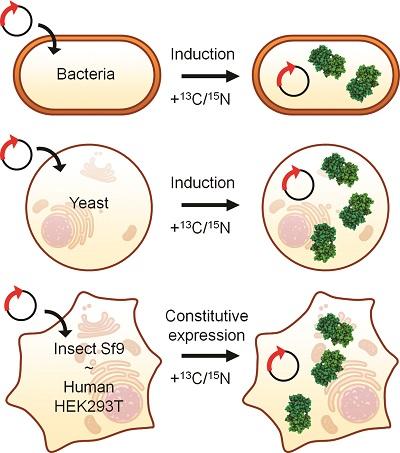
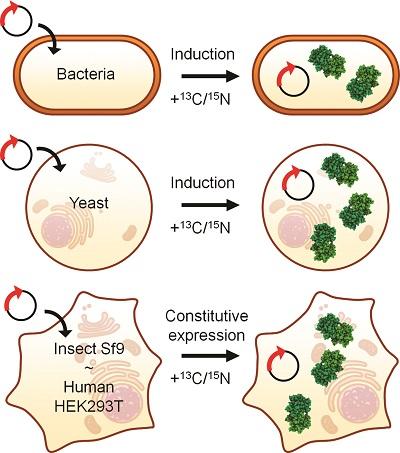
In the Past decade, NMR spectroscopy has been applied to obtain structural and functional information on biological macromolecules inside intact, living cells. The approach, termed "in-cell NMR", utilises the improved resolution and sensitivity of modern high-field NMR spectrometers and exploits selective enrichment of the molecule(s) of interest with NMR-active isotopes.

Since its inception, in-cell NMR has gradually emerged as a possible link between structural and cellular approaches. Being especially suited to investigate the structure and dynamics of macromolecules at atomic resolution, in-cell NMR can fill a critical gap between in vitro-oriented structural techniques such as NMR spectroscopy, X-ray crystallography and single-particle cryo-EM techniques and ultrahigh-resolution cellular imaging techniques, such as cryo-electron tomography.

In a topical review IUCrJ (2017), 4, 108-118 Lucia Banci and her co-worker Enrico Luchinat , both based at the University of Florence, summarise the major advances of in-cell NMR and report the recent developments in the field, with particular focus on its application for studying proteins in eukaryotic and mammalian cells and on the development of cellular solid-state NMR.

###

Media Contact

Jonathan Agbenyega
[email protected]
44-124-434-2878
@iucr

http://www.iucr.org

############

Story Source: Materials provided by Scienmag
Share12Tweet8Share2ShareShareShare2

Related Posts

Ancient Chinese Medicine Compounds Turned Into Next-Generation Antibiotic Candidates by AI

Ancient Chinese Medicine Compounds Turned Into Next-Generation Antibiotic Candidates by AI

October 4, 2026
Hydrogen Sulfide's Hidden Hand: How a Tiny Gas Molecule Rewires Plant Proteins

Hydrogen Sulfide’s Hidden Hand: How a Tiny Gas Molecule Rewires Plant Proteins

October 4, 2026

Junk Food May Age the Ovary Before the Egg Reserve Runs Dry

October 4, 2026

Flickering LEDs Boost Photosynthesis When Pulses Stay Under a Millisecond

October 4, 2026
Please login to join discussion

POPULAR NEWS

  • Alloys That Shrink Their Own Grains: New PIX Mechanism Refines Metals With Heat Alone

    Alloys That Shrink Their Own Grains: New PIX Mechanism Refines Metals With Heat Alone

    29 shares
    Share 12 Tweet 7
  • Endurance Exercise Reshapes the Liver in Males and Females Through Distinct Molecular Routes

    29 shares
    Share 12 Tweet 7
  • Single Transcription Factor PU.1 Rapidly Converts Fibroblasts into Macrophage-Lineage Cells

    29 shares
    Share 12 Tweet 7
  • New Scale Measures How Ready Nurse Educators Really Are for the AI Era

    29 shares
    Share 12 Tweet 7

About

We bring you the latest biotechnology news from best research centers and universities around the world. Check our website.

Follow us

Recent News

Alloys That Shrink Their Own Grains: New PIX Mechanism Refines Metals With Heat Alone

Endurance Exercise Reshapes the Liver in Males and Females Through Distinct Molecular Routes

Single Transcription Factor PU.1 Rapidly Converts Fibroblasts into Macrophage-Lineage Cells

Subscribe to Blog via Email

Success! An email was just sent to confirm your subscription. Please find the email now and click 'Confirm' to start subscribing.

Join 85 other subscribers
  • Contact Us

Bioengineer.org © Copyright 2023 All Rights Reserved.

Welcome Back!

Login to your account below

Forgotten Password?

Retrieve your password

Please enter your username or email address to reset your password.

Log In
No Result
View All Result
  • Homepages
    • Home Page 1
    • Home Page 2
  • News
  • National
  • Business
  • Health
  • Lifestyle
  • Science

Bioengineer.org © Copyright 2023 All Rights Reserved.