• HOME
  • NEWS
  • EXPLORE
    • CAREER
      • Companies
      • Jobs
    • EVENTS
    • iGEM
      • News
      • Team
    • PHOTOS
    • VIDEO
    • WIKI
  • BLOG
  • COMMUNITY
    • FACEBOOK
    • INSTAGRAM
    • TWITTER
Tuesday, September 1, 2026
BIOENGINEER.ORG
No Result
View All Result
  • Login
  • HOME
  • NEWS
  • EXPLORE
    • CAREER
      • Companies
      • Jobs
        • Lecturer
        • PhD Studentship
        • Postdoc
        • Research Assistant
    • EVENTS
    • iGEM
      • News
      • Team
    • PHOTOS
    • VIDEO
    • WIKI
  • BLOG
  • COMMUNITY
    • FACEBOOK
    • INSTAGRAM
    • TWITTER
  • HOME
  • NEWS
  • EXPLORE
    • CAREER
      • Companies
      • Jobs
        • Lecturer
        • PhD Studentship
        • Postdoc
        • Research Assistant
    • EVENTS
    • iGEM
      • News
      • Team
    • PHOTOS
    • VIDEO
    • WIKI
  • BLOG
  • COMMUNITY
    • FACEBOOK
    • INSTAGRAM
    • TWITTER
No Result
View All Result
Bioengineer.org
No Result
View All Result
Home NEWS Science News

In-cell molecular sieve from protein crystal

Bioengineer by Bioengineer
February 9, 2017
in Science News
Reading Time: 2 mins read
0
Share on FacebookShare on TwitterShare on LinkedinShare on RedditShare on Telegram
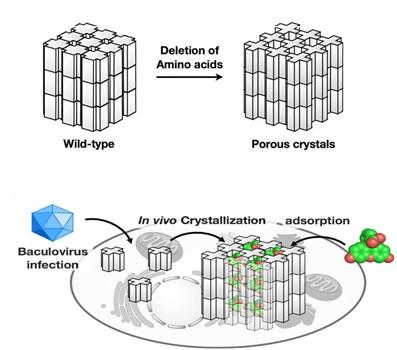
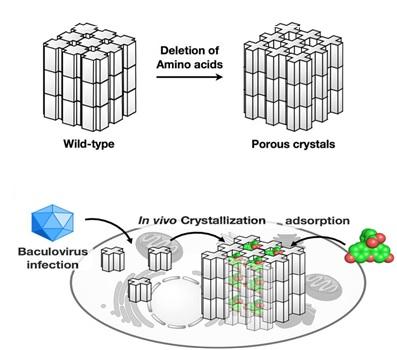
IMAGE

Credit: Tokyo Institute of Technology

In nature, proteins are assembled into sophisticated and highly ordered structures, which enable them to execute numerous functions supporting different forms of life. The exquisite design of natural proteins prompted scientists to exploit it in synthetic biology to engineer molecules that can self-assemble into nanoparticles with desired structure and that may be used for various purposes such as gas storage, enzyme catalysis, intracellular drug delivery, etc.

Cytoplasmic polyhedrosis viruses (cypoviruses) infecting insects are embedded in protein crystals called polyhedra which shield the virus from damage. The structure of polyhedra crystals (PhCs) suggests that they can serve as robust containers which can incorporate and protect foreign molecules from degradation, ensuring their compositional and functional stability.

Overview of Research Achievement

Extreme stability of polyhedra under harsh conditions is provided by dense packing of polyhedrin monomers in crystals with solvent channels of very low porosity, which, however, limits the incorporation of foreign particles. Research group led by Satoshi Abe and Takafumi Ueno at Tokyo Institute of Technology hypothesized that if a porous framework inside PhCs is extended without compromising crystal stability, PhCs can be used for accumulation and storage of exogenous molecules in living cells. As in natural PhCs, polyhedrin monomers form a trimer, the scientists assumed that if amino acid residues at the contact interface of each trimer are deleted, the porosity of the resulting crystals would be increased. To achieve this goal, they genetically engineered polyhedrin monomers, which were then expressed and self-assembled in Spodoptera frugiperda IPLB-Sf21AE, the larva of an armyworm moth, infected with baculovirus. The mutant PhCs maintained crystal lattice of the wild-type PhC but had significantly extended porosity (Figure) due to the deletion of amino acid residues with the rearrangement of intra- and intermolecular hydrogen bonds. As a result, the engineered crystals could adsorb 2-4 times more exogenous molecules (fluorescent dyes) compared to the wild type PhC, with up to 5,000-fold condensation of the dyes from the 10 uM solution.

As a next step, the scientists examined the performance of the mutant crystals in living insect cells. PhCs showed high stability in the intracellular environment. Most importantly, the mutant crystals could accumulate and retain the dyes in live cells, while the natural crystals could not.

Rationale crystal design used by scientists at Tokyo Institute of Technology provides a powerful tool for structural manipulation of self-assembled protein crystals to obtain porous nanomaterials with regulated adsorption properties. The engineered porous PhCs can be used as protein containers for in vivo crystal structure analysis of the cellular molecules and bioorthogonal chemistry in various types of living cells.

Structural analysis of microcrystals

Since tiny crystals with only a few microns size were obtained, the structure analyses were performed at beamlines BL32XU and BL41XU at SPring-8, a large synchrotron radiation facility which delivers the most powerful synchrotron radiation. The high-resolution structures were rapidly analyzed with the help of an automated data collection system developed in RIKEN.

###

Media Contact

Emiko Kawaguchi
[email protected]
81-357-342-975

http://www.titech.ac.jp/english/index.html

############

Story Source: Materials provided by Scienmag

Share12Tweet8Share2ShareShareShare2

Related Posts

β-Sitosterol from Ipomoea carnea Jacq. As a promising anti-inflammatory agent: Evidence from in silico modeling and in vitro validation

β-Sitosterol from Ipomoea carnea Jacq. As a promising anti-inflammatory agent: Evidence from in silico modeling and in vitro validation

August 31, 2026
Design, fabrication and characterization of a wearable Fiber Bragg grating sensor for cardiorespiratory monitoring using finger plethysmography

Design, fabrication and characterization of a wearable Fiber Bragg grating sensor for cardiorespiratory monitoring using finger plethysmography

August 31, 2026

KAIST opens the era of industrial-scale microbial foods, proposing growth strategies for the next-generation protein market

August 31, 2026

Virologist awarded $2 million NIH grant to investigate how virus-infected cells live and die

August 31, 2026
Please login to join discussion

POPULAR NEWS

  • β-Sitosterol from Ipomoea carnea Jacq. As a promising anti-inflammatory agent: Evidence from in silico modeling and in vitro validation

    29 shares
    Share 12 Tweet 7
  • Design, fabrication and characterization of a wearable Fiber Bragg grating sensor for cardiorespiratory monitoring using finger plethysmography

    29 shares
    Share 12 Tweet 7
  • KAIST opens the era of industrial-scale microbial foods, proposing growth strategies for the next-generation protein market

    29 shares
    Share 12 Tweet 7
  • Virologist awarded $2 million NIH grant to investigate how virus-infected cells live and die

    29 shares
    Share 12 Tweet 7

About

We bring you the latest biotechnology news from best research centers and universities around the world. Check our website.

Follow us

Recent News

β-Sitosterol from Ipomoea carnea Jacq. As a promising anti-inflammatory agent: Evidence from in silico modeling and in vitro validation

Design, fabrication and characterization of a wearable Fiber Bragg grating sensor for cardiorespiratory monitoring using finger plethysmography

KAIST opens the era of industrial-scale microbial foods, proposing growth strategies for the next-generation protein market

Subscribe to Blog via Email

Enter your email address to subscribe to this blog and receive notifications of new posts by email.

Join 85 other subscribers
  • Contact Us

Bioengineer.org © Copyright 2023 All Rights Reserved.

Welcome Back!

Login to your account below

Forgotten Password?

Retrieve your password

Please enter your username or email address to reset your password.

Log In
No Result
View All Result
  • Homepages
    • Home Page 1
    • Home Page 2
  • News
  • National
  • Business
  • Health
  • Lifestyle
  • Science

Bioengineer.org © Copyright 2023 All Rights Reserved.